
- Summary
- What Is Clinical Data Review & Analysis?
- Clinical Data Review vs. Analysis vs. Reporting: Understanding Their Unique Roles
- Key Stakeholders in Clinical Data Review & Analysis
- Clinical Data Review & Analysis Workflow in Clinical Trials
- Technology and AI Driving Next-Gen Clinical Data Review & Analysis
- Benefits of AI in Clinical Data Review & Analysis
- Key Challenges in Clinical Data Review & Analysis
- Best Practices for Effective Clinical Data Review
- Regulatory Considerations and Compliance
- The Future of Clinical Data Review and Analysis
- External References
Summary
Clinical data review is the continuous process of evaluating clinical trial data for accuracy, completeness, consistency, and clinical relevance as it is collected, ensuring data quality and early identification of issues. Clinical data analysis builds on this validated data by applying analytical and statistical methods to uncover patterns, trends, and insights that inform clinical development, operational decisions, and regulatory outcomes across the trial lifecycle.
Clinical trials today generate unprecedented volumes of data, far beyond what traditional review and analysis models were designed to handle. This expansion has fundamentally changed how clinical data review and clinical data analysis must be approached.
Several factors have made clinical trial data analysis mission-critical:
- Explosion of data volume and variety across decentralized and hybrid trials
- Heightened regulatory scrutiny around data integrity, traceability, and audit readiness
- Increased operational risk when data quality issues are detected late
- Direct impact on trial timelines, interim decisions, and study outcomes
As a result, data review and analysis are no longer end-stage activities performed just before database lock. They are continuous, intelligence-driven processes that influence decision-making throughout the trial lifecycle.
What Is Clinical Data Review & Analysis?
Clinical data review and clinical data analysis are closely related but distinct activities within data analysis in clinical research.
Clinical Data Review
Clinical data review focuses on ensuring that the collected data is:
- Accurate
- Complete
- Consistent
- Clinically meaningful
This process involves identifying discrepancies, missing values, protocol deviations, and potential safety signals early and continuously.
Clinical Data Analysis
Clinical data analysis goes a step further by:
- Interpreting reviewed and validated data
- Identifying trends, relationships, and patterns
- Generating insights that support clinical, operational, and strategic decisions
Together, these activities support high-quality clinical trial data analysis and ensure that downstream reporting and submissions are reliable.
Clinical Data Review vs. Analysis vs. Reporting: Understanding Their Unique Roles
Clinical data review, clinical data analysis, and clinical data reporting are often treated as interchangeable activities. Each of these functions plays a distinct role in the clinical trial data lifecycle, and conflating them leads to delayed insights and unclear ownership.
Function | Primary Focus | Key Outcome |
Clinical Data Review | Data quality, completeness, consistency | Clean, credible datasets |
Clinical Data Analysis | Interpretation and insight generation | Actionable findings |
Clinical Data Reporting | Summarization and presentation | Regulatory and stakeholder communication |
Clinical data reporting depends entirely on the rigor of review and analysis that precede it. Weak upstream processes result in unreliable outputs, regardless of reporting quality.
Types of Clinical Data Reviewed in Clinical Trials
Clinical data comes from diverse streams, including the key types listed below:
eCRF and Core Clinical Data
Review goes beyond patient demographics and treatment details to ensure longitudinal consistency, confirm protocol compliance, and align with study endpoints, creating a strong foundation for downstream analysis.
Safety and Adverse Event Data
Focuses on detecting trends, assessing causality signals, and identifying discrepancies that may affect patient safety, regulatory reporting, or risk-based monitoring decisions.
Laboratory and Biomarker Data
Involves harmonizing units, verifying reference ranges, and validating repeated measures to maintain analytical rigor and support reliable endpoint interpretation.
Patient-Reported Data (ePRO/eCOA)
Ensures completeness, schedule adherence, and consistency with clinical observations to provide accurate insights into patient experience, treatment tolerability, and quality-of-life outcomes.
External and Vendor-Supplied Data
Requires careful integration of diverse formats, verification of data provenance, and alignment with study timelines to maintain traceability, analytical validity, and cross-source insight.
The primary challenge lies in reconciling these datasets while preserving context, timing, and clinical relevance, especially when data originates from disparate systems.
Types of Clinical Data Analysis in Clinical Trials
Clinical data analysis in clinical trials leverages multiple analytical approaches, each designed to answer specific questions and drive actionable insights:
Descriptive Analysis - What has happened?
Summarizes historical trial data, providing insights into patient populations, outcomes, and operational performance. Establishes a baseline for further investigation.
Diagnostic Analysis - Why did it happen?
Investigates underlying causes of observed trends or deviations, identifying correlations, data patterns, and contributing factors to support root-cause analysis.
Predictive Analysis - What is likely to happen next?
Uses statistical modeling and AI-driven methods to forecast future outcomes, patient responses, or potential operational risks, enabling proactive trial planning.
Prescriptive Analysis - What actions should be taken?
Combines historical and predictive insights to recommend optimal interventions, resource allocation, or protocol adjustments to improve trial performance and outcomes.
Real-Time Analysis - What needs attention now?
Continuously monitors incoming data streams to detect anomalies, safety signals, or workflow deviations, supporting immediate decision-making and risk mitigation.
Together, these analytical approaches form the foundation of advanced clinical development analytics, enabling sponsors and investigators to extract maximum value from complex trial datasets while improving efficiency, compliance, and patient safety.
Key Stakeholders in Clinical Data Review & Analysis
Clinical data review and analysis are inherently cross-functional activities, requiring collaboration across multiple roles to ensure data quality, integrity, and actionable insights. Each stakeholder contributes uniquely to either reviewing, analyzing, or interpreting clinical trial data:
Investigators and Site Staff
Capture accurate, timely, and complete patient data at the source. Their role underpins both reliable data review and subsequent analysis, ensuring clinical observations are correctly documented.
Clinical Operations Teams
Oversee study execution and site performance, monitor data flow, and coordinate corrective actions. Their operational oversight ensures both the review process and analysis readiness are aligned with study timelines.
Data Management Professionals
Validate, reconcile, and structure datasets, manage queries, and maintain clean, analyzable data. They form the backbone of clinical data review while enabling robust data analysis downstream.
Medical Monitors and Safety Teams
Assess clinical relevance, evaluate adverse events, and identify emerging safety signals. Their input is critical for both data review quality and analysis-driven decision-making on patient safety and risk mitigation.
Biostatisticians and Analytics Teams
Apply statistical and analytical methods to extract insights, detect trends, and generate predictive or prescriptive outputs. While their work is analysis-centric, it relies heavily on rigorously reviewed and validated data.
Regulatory and Compliance Professionals
Ensure adherence to GCP, audit-readiness, and traceability of review and analysis processes, bridging operational integrity with regulatory expectations.
Effective clinical data review and analysis are only possible when these stakeholders collaborate seamlessly, supported by shared visibility, standardized workflows, and integrated technology platforms.
Clinical Data Review & Analysis Workflow in Clinical Trials
A modern clinical trial relies on a continuous, structured workflow to ensure data integrity, quality, and actionable insights. Typical steps include:
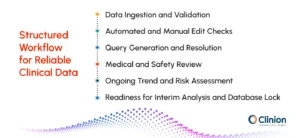
Data Ingestion and Validation
Aggregating data from eCRFs, labs, ePRO/eCOA, and external sources, while verifying completeness, format consistency, and provenance.
Automated and Manual Edit Checks
Applying programmed validations alongside expert review to detect discrepancies, anomalies, and missing values.
Query Generation and Resolution
Promptly identifying data issues and coordinating resolution across sites, data management teams, and clinical operations.
Medical and Safety Review
Evaluating clinical relevance, assessing adverse events, and ensuring patient safety oversight.
Ongoing Trend and Risk Assessment
Continuously monitoring emerging patterns, deviations, and potential risks to support proactive decision-making.
Readiness for Interim Analysis and Database Lock
Maintaining clean, consistent, and validated data to support timely analyses, regulatory submissions, and study milestones.
This integrated and continuous workflow ensures that clinical data review and analysis are proactive rather than reactive, enabling sponsors to detect risks early, maintain high data quality, and accelerate study timelines.
Technology and AI Driving Next-Gen Clinical Data Review & Analysis
Modern clinical trials generate complex, multi-source datasets that demand more than traditional oversight. Advanced technology and AI transform this challenge into an opportunity by:
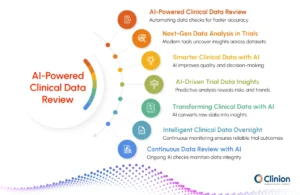
Intelligent Data Capture and Integration
Advanced EDC systems collect structured data across eCRFs, labs, ePRO/eCOA, and vendor sources. AI-assisted harmonization resolves inconsistencies, aligns multi-source data, and ensures traceability and regulatory compliance.
Real-Time Dashboards and Dynamic Oversight
AI-powered dashboards visualize emerging trends, detect anomalies, and flag potential risks immediately, allowing teams to move from reactive corrections to proactive decision-making.
Automated Validation, Reconciliation, and Anomaly Detection
Machine learning algorithms identify discrepancies, missing values, and protocol deviations far earlier than manual review, dramatically reducing query volume and downstream errors.
Predictive and Prescriptive Analytics
AI models forecast operational risks, patient responses, and study outcomes. In contrast, prescriptive analytics suggest optimized interventions, resource allocation, and protocol adjustments to improve efficiency and trial performance.
Automated Medical Coding and Classification
AI streamlines coding of adverse events, lab results, and endpoints, ensuring standardization, reducing human error, and freeing clinical teams to focus on high-value interpretation and decision-making.
Continuous, Intelligence-Driven Review
By integrating automation, AI, and centralized technology platforms, trials shift from periodic, retrospective review to a continuous workflow where data quality, regulatory compliance, and actionable insights are maintained throughout the study lifecycle.
AI is the engine that transforms clinical data review and analysis from labor-intensive, error-prone tasks into predictive, adaptive, and fully integrated trial intelligence.
Benefits of AI in Clinical Data Review & Analysis
AI is transforming how clinical data review and analysis are conducted, bringing tangible improvements to both data quality and trial operations: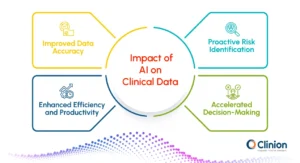
Improved Data Accuracy:
AI-driven algorithms continuously monitor incoming data for discrepancies, outliers, and inconsistencies, reducing manual errors. This ensures that datasets are clean, reliable, and ready for downstream analysis, ultimately supporting more credible study outcomes.
Proactive Risk Identification:
By analyzing data trends in real time, AI identifies potential safety signals, protocol deviations, and operational risks early in the trial lifecycle. Early detection allows clinical teams to intervene promptly, safeguarding patient safety and maintaining regulatory compliance.
Enhanced Efficiency and Productivity:
Automation of repetitive tasks such as query generation, data reconciliation, and trend monitoring reduces the burden on clinical teams. Staff can focus on higher-value activities like strategic decision-making, improving overall trial efficiency, and resource utilization.
Accelerated Decision-Making:
AI synthesizes data from multiple sources, providing actionable insights and predictive trends that enable sponsors and investigators to make faster, evidence-based decisions. This accelerates trial timelines, optimizes resource allocation, and supports adaptive trial designs.
Integrating AI into clinical trial workflows ensures trials are not only faster and more efficient but also more precise, compliant, and strategically guided by real-time, actionable insights.
Key Challenges in Clinical Data Review & Analysis
Even with advanced technology, clinical trials face persistent challenges that can compromise data quality, study timelines, and regulatory compliance:
Challenge | Impact |
Data discrepancies across systems | Leads to inconsistent datasets, increased query resolution time, and potential misinterpretation of results. |
Delayed identification of safety or quality issues | Compromises patient safety oversight and slows regulatory reporting. |
High monitoring burden and staffing constraints | Increases operational costs and limits the scalability of trials. |
Managing protocol amendments and mid-study changes | Creates risk of misalignment between planned and collected data, impacting data integrity. |
Maintaining data integrity across distributed environments | Risks incomplete or inaccurate datasets due to decentralized collection, multiple vendors, or hybrid trial setups. |
These challenges are interconnected and often amplified in complex, multi-site, or decentralized trials. Overcoming them requires not just technology, but robust processes, proactive oversight, and cross-functional collaboration.
Best Practices for Effective Clinical Data Review
To address these challenges, leading organizations adopt a structured, proactive approach to clinical data review:
- Continuous, Not Periodic Review - Review data in real time rather than only at pre-defined intervals, enabling early detection of discrepancies and emerging risks.
- Standardized and Documented Workflows - Clear, consistent procedures for data validation, query resolution, and medical review improve efficiency and accountability.
- Strong Cross-Functional Collaboration - Integrating investigators, clinical operations, data management, medical monitors, and biostatistics ensures shared visibility and faster decision-making.
- Early Risk Identification Strategies - Use risk-based monitoring, automated alerts, and AI-driven anomaly detection to anticipate and mitigate issues before they escalate.
- Strategic Use of Automation with Human Oversight – Automate repetitive tasks such as edit checks, reconciliation, and coding, while retaining human review for clinical judgment, ensuring both efficiency and data quality.
Regulatory Considerations and Compliance
In today’s data-intensive clinical trials, regulatory expectations go beyond final database audits. Effective clinical data review and analysis must ensure:
- Data Integrity and Audit Readiness - Clinical data must be complete, accurate, and verifiable at all stages to withstand inspections.
- Traceability and Version Control - Every modification, query resolution, and workflow step should be fully documented and auditable.
- Alignment with GCP and Global Regulations - Processes must comply with Good Clinical Practice, FDA, EMA, and other regional standards.
- Proactive, Transparent Oversight - Regulators increasingly expect ongoing monitoring, risk-based review, and real-time interventions rather than retrospective fixes.
- Validated Technology and AI Usage - Use of AI-driven review tools must follow validated processes with human oversight to maintain regulatory compliance and defensibility.
By embedding these principles, sponsors can not only satisfy regulatory demands but also enhance the credibility, reliability, and efficiency of their clinical trials.
The Future of Clinical Data Review and Analysis
The future of clinical data review and analysis will evolve from AI-assisted dashboards toward intelligent, agentic ecosystems where trials self-optimize through dynamic adjustments to data collection, site monitoring, and patient engagement based on emerging trends. Advanced cognitive models will reason across studies and historical data to propose novel endpoints and protocol improvements, while patient-level predictive analytics enables hyper-personalized safety monitoring with rapid interventions.
In this vision, clinical data review and analysis will no longer merely support decisions; they will actively shape trial design, strategy, and execution in real time, accelerating research, improving patient outcomes, and fundamentally redefining how clinical evidence is generated.
Clinion’s Multi-Agentic AI: Future of Clinical Data Management
Clinion’s Multi-Agentic AI elevates clinical data management by using intelligent agents that understand your protocol and CRF metadata to propose custom review checks. It flags contextual discrepancies, reducing false positives, and generates smart query drafts ready for review and approval, with all actions fully tracked. This ensures higher data quality, faster issue resolution, and proactive oversight across complex, multi-source datasets. Discover how Clinion can transform your trial data management.
External References