
- Summary
- What is a Clinical Study Report (CSR)?
- Key Sections of a CSR in Clinical Trials
- Types of Clinical Study Reports
- Who Writes and Reviews a CSR?
- How a CSR is Written (Step-by-Step)
- Challenges in Writing a Clinical Study Report (CSR)
- Regulatory Requirements and Updates (2024–2025)
- Clinical Study Report Automation: AI Transforming the Process
- Best Practices for Preparing a CSR in Clinical Trials
- Conclusion: The Future of Clinical Study Reports
Summary
A clinical study report (CSR) is the most critical document produced from a clinical trial, providing regulators and stakeholders with a comprehensive, unbiased account of the study’s design, methodology, results, and conclusions. Unlike journal articles, a CSR follows strict ICH E3 guidelines and serves as the foundation for regulatory submissions and product approvals. This guide explains what a clinical study report is, its structure, types, challenges, regulatory updates, automation, and best practices.
What is a Clinical Study Report (CSR)?
A clinical study report (CSR) is a detailed scientific document that describes the methodology, conduct, and results of a clinical trial. According to the International Council for Harmonisation (ICH) E3 guideline, the CSR offers a transparent and objective account of the trial and serves as the foundation for regulatory submissions to agencies including the U.S. Food and Drug Administration (FDA) and the European Medicines Agency (EMA).
In contrast to journal publications, which typically present findings in a condensed format, a CSR provides comprehensive details. The report includes study design and objectives, efficacy and safety outcomes, statistical analyses, and appendices containing supporting data.
The primary purpose of the CSR is to enable regulators and reviewers to assess whether the investigational product demonstrates sufficient safety and efficacy to warrant approval or continued development.
Fact: A Phase III clinical study report can run to over 1,000 pages, reflecting the complexity of late-stage trials and regulatory scrutiny.
Key Sections of a CSR in Clinical Trials
Every clinical study report (CSR) must adhere to the ICH E3 guideline, which standardizes format and content so that regulatory authorities can evaluate trials consistently. This structure ensures that CSRs provide a clear, complete, transparent, and reproducible account of the study.
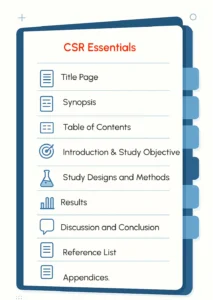
Here are the essential sections of a CSR:
- Title Page - Identifies the trial, sponsor, investigational product (IP), protocol number, and report date.
- Synopsis - A 2–3 page summary of objectives, design, population, endpoints, and main results. This is often the first section regulators review.
- Table of Contents - A detailed map of all report sections, figures, and appendices.
- Introduction & Study Objectives - Explains trial rationale, therapeutic context, and clearly states the primary and secondary objectives.
- Study Design and Methods - Detailed description of trial design, study population, randomization, blinding, dosing, data collection, and statistical methodology.
- Results - Presentation of primary and secondary endpoints, safety data, statistical analysis, pharmacokinetics, and exploratory outcomes.
- Discussion and Conclusions - Interpretation of results in light of study objectives, clinical relevance, and implications for future research or approval.
- Reference List - Key literature, regulatory guidance, and prior studies cited.
- Appendices - Supporting materials such as the study protocol, investigator details, case report forms (CRFs), patient data listings, ethics committee approvals, and audit certificates.
Why this matters: A standardized structure makes CSRs regulatory-ready worldwide. Whether submitted to the FDA, EMA, or other health authorities, the ICH E3 format helps ensure that critical safety and efficacy data are presented clearly, reducing the risk of review delays.
While all CSRs follow the ICH E3 framework, the level of detail can vary depending on the type of report being prepared.
Types of Clinical Study Reports
Each CSR is tailored to its role in the clinical development process, with some designed for full regulatory submissions and others serving more limited objectives.
Type of CSR | When It’s Used | Content Depth |
Full CSR | Pivotal Phase II & III studies supporting regulatory approval (FDA, EMA, etc.). | Comprehensive: full methodology, efficacy, safety, statistical analysis, and appendices. |
Abbreviated CSR | Supportive studies that do not evaluate efficacy or pharmacology. | Condensed: shortened methods/results; must include full safety section. |
Synoptic CSR | Early-phase studies (e.g., Phase I safety/tolerance trials). | Limited: safety data emphasized; minimal or no efficacy data. |
CSR Amendments | When updating a previously submitted CSR with new details or corrections. | Partial: only sections relevant to the amendment; references back to the original CSR. |
Who Writes and Reviews a CSR?
The preparation of a clinical study report (CSR) is a highly collaborative process that brings together experts from multiple disciplines, each contributing specialized knowledge.
Medical Writers:
Draft the majority of the report, including synopsis, methods, safety, and conclusions.
Statisticians:
Contribute to the efficacy and statistical analysis.
Clinicians:
Provide clinical interpretation and context for safety/efficacy findings.
Regulatory Affairs Specialists:
Ensure compliance with ICH E3, FDA, and EMA standards.
Quality Assurance (QA) Teams:
Perform reviews and consistency checks.
In many cases, Contract Research Organizations (CROs) provide medical writing and review services to sponsors, particularly when large volumes of CSRs are needed.
How a CSR is Written (Step-by-Step)
Writing a clinical study report (CSR) is a structured process that transforms raw trial data into a regulatory-ready document. Each stage builds on the previous one, ensuring the report is accurate and aligned with international guidelines.
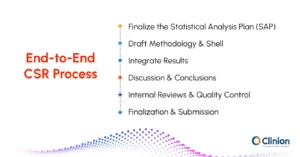
Finalize the Statistical Analysis Plan (SAP):
Defines endpoints and how data will be analyzed. This ensures consistency when the results are later interpreted.
Draft Methodology & Shell:
The medical writer uses the protocol and SAP to create an initial structure.
Integrate Results:
Safety, efficacy, pharmacokinetics, and exploratory outcomes are incorporated once the database is locked.
Discussion & Conclusions:
Trial findings are interpreted in the context of the therapeutic area and existing research, highlighting implications for future development.
Internal Reviews & Quality Control:
Teams review drafts for consistency, accuracy, clarity, and regulatory compliance.
Finalization & Submission:
CSR is submitted to regulators as part of a broader clinical trial dossier.
Challenges in Writing a Clinical Study Report (CSR)
Even with well-defined guidelines, preparing a clinical study report (CSR) is a demanding process. Several factors contribute to the difficulty:
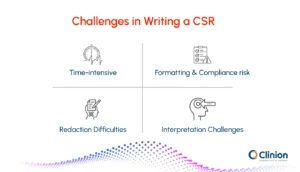
Time-Intensive:
CSRs often go through multiple drafts, extensive team reviews, and quality control cycles, all of which extend timelines.
Formatting and Compliance Risks:
Tables, figures, and appendices must be precise and aligned with regulatory standards; even small inconsistencies can cause setbacks.
Redaction Difficulties
Sensitive information must be carefully removed before disclosure. Over-redaction can reduce transparency, while under-redaction may compromise confidentiality.
Interpretation Challenges:
The discussion and conclusion sections require expert analysis to place trial results in the right clinical and scientific context.
Fact: Regulatory submissions can be delayed by three to six months, not because of trial outcomes, but due to incomplete, inconsistent, or non-compliant reporting.
Regulatory Requirements and Updates (2024–2025)
Recent regulatory changes are reshaping expectations and practices for CSRs, emphasizing transparency, electronic submissions, patient-centricity, data integrity, and stricter compliance.
EU Clinical Trials Regulation (EU-CTR 536/2014)
- Requires mandatory publication of CSRs via the Clinical Trials Information System (CTIS), with strict timelines for submission.
- Redactions must be fully justified to protect confidential information while ensuring transparency.
- This regulation significantly increases public access to trial data, fostering transparency and accountability.
FDA eCTD v4.0 (Effective September 2024)
- Mandates all new regulatory submissions, including CSRs, to use the electronic Common Technical Document (eCTD) version 4.0 standard.
- This requires enhanced structured metadata, machine-readable formatting, and impacts CSR organization and submission workflows.
Plain Language Summaries (PLS)
- EMA and other regulators increasingly expect or require Plain Language Summaries alongside technical CSRs.
- These summaries enhance patient and public understanding of complex trial results, supporting ethical transparency.
ICH E6(R3) Good Clinical Practice Guidance (2024–2025)
- Updates emphasize:
- Data integrity and traceability throughout the clinical trial lifecycle.
- Increased patient-centricity in trial design and documentation.
- Adoption of risk-based approaches to improve study quality and reporting.
- These changes influence CSR writing to better reflect modern quality and compliance practices.
Clinical Study Report Automation: AI Transforming the Process
Preparing a CSR has traditionally been a time-intensive effort, often stretching over several months. Advances in artificial intelligence (AI), machine learning (ML), and natural language processing (NLP) are now transforming this process, making it faster, more accurate, and easier to manage.
How Automation Supports CSR Development
Automation begins at the drafting stage, where AI tools extract structured data directly from protocols, statistical analysis plans (SAPs), and trial databases. Instead of starting from scratch, medical writers receive a first draft that already includes auto-generated narratives, tables, and listings. What once required three to six months of manual work can now be condensed into two to three days, giving teams more time to focus on interpretation and compliance. At the same time, automated checks improve quality by identifying gaps or inconsistencies as the draft takes shape.
Automation in Quality Control (QC)
The value of automation extends beyond drafting. AI systems cross-check values between the narrative text and statistical tables, ensuring that figures are consistent throughout the document. Discrepancies, outliers, and missing data points are flagged automatically, and structured QC reports are generated to guide reviewers. This reduces the risk of human oversight errors and helps ensure the final CSR is both reliable and regulatory-ready.
Challenges in CSR Automation
Despite these advances, automation is not a replacement for expert judgment. The accuracy of AI outputs depends heavily on the quality of the input data - poorly structured datasets can produce flawed results. Similarly, unstructured or complex trial documents may be misinterpreted by algorithms, requiring correction. Above all, human oversight remains essential: medical writers and reviewers provide the interpretation, context, and scientific rigor that automation cannot replace.
Best Practices for Preparing a CSR in Clinical Trials
Producing a high-quality CSR requires more than simply following regulatory templates. These best practices help ensure CSRs are both regulatory-ready and easy to interpret:
Start Early:
Anticipate CSR requirements during trial design to avoid last-minute delays.
Engage Medical Writers Early:
Involve writers from the outset so the CSR format aligns with both regulatory submission and public disclosure needs.
Use Lean Writing:
Avoid duplication, highlight the most important results, and structure information so reviewers can quickly find what they need.
Incorporate Automation Wisely:
AI and QC tools can accelerate drafting and review, but outputs must be validated by experts.
Apply Layered Quality Control:
Multiple review cycles across different teams reduce errors and ensure consistency before submission.
Together, these practices reduce risk, save time, and improve the likelihood of a smooth regulatory review.
Conclusion: The Future of Clinical Study Reports
Clinical study reports are evolving from static regulatory documents into dynamic tools for transparency and scientific progress. As automation and global disclosure requirements advance, CSRs will not only support approvals but also shape how clinical research is shared with the world. The next generation of CSRs will need to balance compliance, clarity, and accessibility, ensuring that trial results benefit regulators, patients, clinicians, and the wider community.
Clinion’s CSR Automation
Clinion’s CSR Automation streamlines report preparation by using AI to extract information directly from the protocol, SAP, and TLFs. This process can automatically generate up to 70% of the content in a format aligned with ICH E3 guidelines. Medical writers then review and refine the draft, ensuring accuracy, context, and compliance before finalization.