
- Summary
- What is ePRO in Clinical Trials?
- Why Traditional Paper Diaries Fail in Clinical Trials
- How ePRO in Clinical Trials Goes Beyond a Digital Questionnaire
- Benefits of ePRO in Clinical Trials
- AI for Smarter Patient-Reported Outcomes in Clinical Trials
- Limitations & Key Considerations for ePRO in Clinical Trials
- What to Consider When Choosing an ePRO Platform
- Conclusion: Why ePRO Is Now Essential, Not Optional
- External References
Summary
ePRO (Electronic Patient-Reported Outcomes) transforms clinical trials by capturing patient health and experiences directly via digital devices, delivering real-time insights, better engagement, and accurate data beyond site visits.
Patient-reported experiences are central to clinical trials, yet they have not kept pace with how modern studies operate. Research shows that while paper diaries appear compliant, only about 11% of entries are recorded at the correct time, compared to real-time compliance rates of up to 94% with electronic diaries used in ePRO for clinical trials. This reliability gap explains the rapid shift toward ePRO, and AI is now taking it even further.
Here's what that means for modern clinical trials, why paper methods are failing, and how AI is strengthening the foundation of patient-reported data.
What is ePRO in Clinical Trials?
ePRO (electronic patient-reported outcomes) refers to the electronic collection of health data directly from patients, without interpretation by clinicians or site staff.
What is reported:
In ePRO, patients report information that only they can reliably provide, including symptoms, treatment side effects, quality of life, daily functioning, and other indicators of disease progression.
How it is captured:
Data is collected using digital tools such as mobile apps, web portals, tablets, smartphones, and eDiary systems used in clinical trials. Patients can complete assessments from home or on the go, making reporting easier and more consistent across study visits and decentralized settings.
This isn’t just digital convenience. It’s a fundamental shift in how trials capture, monitor, and act on patient feedback, generating reliable real-world data while bringing speed, structure, and intelligence to a process long overdue for transformation.
Why Traditional Paper Diaries Fail in Clinical Trials
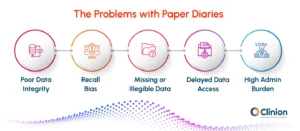
Paper diaries may appear simple, but this simplicity comes at a high cost, particularly in regulated research settings.
Poor Data Integrity:
Paper diaries often lead to missed or delayed entries, retrospective “back-filling,” or fabricated compliance just before site visits, also called “parking lot compliance.” These practices create false adherence signals and can seriously undermine the validity of trial endpoints.
Recall Bias:
When patients rely on memory rather than real-time reporting, symptom timing can become inaccurate, severity may be under- or over-reported, and treatment effects can be distorted. For endpoints that depend on patient perception, this recall bias can materially impact study outcomes.
Missing and Illegible Data:
Paper forms frequently contain skipped questions, ambiguous responses, or illegible handwriting. Each of these issues triggers additional data queries, prolongs cleaning cycles, and increases the workload for site staff.
Delayed Visibility:
With paper diaries, data is only reviewed during site visits. This delay means adverse events may go unnoticed for weeks, and sponsors lack real-time insight into patient experiences. In fast-moving trials, delayed visibility translates directly to delayed action.
High Administrative Burden:
Paper diaries require manual tracking and transcription, which increases errors and rework. This administrative load also reduces the time site staff can dedicate to interacting with patients.
These challenges make paper diaries unreliable and slow, putting the integrity of patient-reported data at risk.
How ePRO in Clinical Trials Goes Beyond a Digital Questionnaire
A common misconception is that ePRO simply mirrors a paper diary on a screen. In reality, ePRO for clinical trials introduces intelligence, structure, and real-time insights that paper could never deliver.
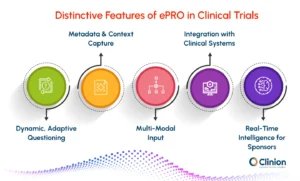
Dynamic, Adaptive Questioning
Modern ePRO systems use logic-driven flows, skip patterns, and response-dependent workflows so patients only see relevant questions. This reduces fatigue, avoids contradictory inputs, and ensures higher-quality responses.
Richer Data Capture
ePRO collects more than answers. It captures metadata like timestamps, device information, location (where permitted), and interaction patterns. Some platforms also allow images, videos, or other patient-generated content, enabling real-world evidence capture and deeper analysis.
Seamless Integration and BYOD Support
ePRO platforms integrate with EDC, CTMS, wearables, and safety systems, creating a unified view of patient data rather than isolated silos. BYOD (Bring Your Own Device) support allows patients to complete assessments on their own devices with personalized accessibility.
Real-Time Intelligence for Sponsors
Immediate access to adherence, symptom, and safety data allows study teams to monitor trends and take adaptive action mid-study, rather than waiting for the next site visit to understand patient experiences.
Benefits of ePRO in Clinical Trials
Unlike paper, ePRO data is time-stamped, user-attributed, validated at entry, and immediately available for review. These features address every major limitation of paper-based PROs while introducing capabilities that paper could never support.
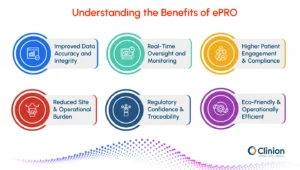
Improved Data Accuracy and Integrity
ePRO captures entries in real time, prevents back-dating with time stamps, enforces mandatory fields, and flags implausible responses instantly. This means data is accurate from the moment it is entered, eliminating weeks of cleaning and correction.
Real-Time Oversight and Monitoring
Sites and sponsors can view patient data immediately. Automated alerts highlight missed entries or safety concerns, and compliance trends are visible across all sites, enabling timely interventions instead of waiting for issues to accumulate.
Higher Patient Engagement and Compliance
Modern eDiary platforms are mobile-friendly, intuitive, and designed for daily use. Features like reminders, notifications, and BYOD access make participation easier, and studies consistently show patients prefer electronic reporting over paper.
Reduced Site and Operational Burden
ePRO removes the need for manual transcription, paper storage, duplicate data entry, and excessive SDV. This lets site teams spend less time managing paperwork and more time supporting patients.
Regulatory Confidence and Traceability
Platforms are 21 CFR Part 11 compliant, with every data point time-stamped and linked to the user. Data is audit-ready by default and endorsed by regulatory authorities like the FDA and EMA for use in primary endpoints.
Eco-Friendly and Operationally Efficient
ePRO eliminates printing, shipping, and storage, reduces manual handling and transcription, and supports more sustainable and modern trial operations.
AI for Smarter Patient-Reported Outcomes in Clinical Trials
While ePRO improves structure and timeliness, it still relies on patients and reviewers to capture and assess data correctly. This can introduce variability, especially when studies collect unstructured inputs such as images, videos, or audio. AI-enhanced ePRO helps reduce this variability by supporting both participants and clinical teams throughout the data collection and review process.
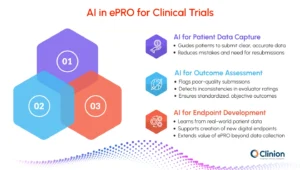
AI for Patient Data Capture:
Even with ePRO, data quality depends on accurate patient submissions, especially for images, video, or audio. AI reduces this reliance on perfect human input. AI-enabled prompts guide patients to frame images correctly, reduce blur, and adjust lighting. Real-time checks flag unusable submissions before upload. AI can also detect and mask sensitive personal information. This ensures patients submit high-quality data the first time, reducing frustration and protocol deviations.
AI for Outcome Assessment:
When clinical trial data, such as images, videos, or audio, is reviewed, human evaluators can interpret the same submission differently, creating variability in results.
AI helps by automatically checking the quality of each submission, flagging unclear or inconsistent data before it reaches reviewers. It also highlights differences between evaluators' scores, providing an objective benchmark.
This ensures consistency across sites and raters, reduces errors, and strengthens the reliability of patient-reported outcomes. By supporting rather than replacing human judgment, AI makes outcome assessment faster, more standardized, and more defensible.
AI for Endpoint Development:
AI leverages real-world patient data captured through ePRO to identify clinically meaningful patterns at scale. Expert annotations train algorithms to recognize these signals, enabling consistent, objective assessment. This approach allows study teams to develop new digital endpoints that reflect actual patient experiences, extending the value of ePRO beyond data collection into innovative outcome creation.
Limitations & Key Considerations for ePRO in Clinical Trials
While ePRO and AI bring significant advantages, it’s important to recognize potential challenges that can affect data quality and study execution.
- Device & Connectivity Dependence: Reliable access is required for consistent reporting.
- Digital Literacy: Patients need guidance to use ePRO tools correctly.
- AI Validation & Oversight: Algorithms must be regularly monitored to ensure accuracy.
- Data Privacy & Security: Protecting sensitive patient information is essential.
With proper planning, training, and oversight, these limitations can be managed, ensuring ePRO and AI deliver reliable, high-quality patient data.
What to Consider When Choosing an ePRO Platform
Selecting the right ePRO for clinical trials involves more than comparing features. Key questions to ask include:
- Does it support BYOD as well as provisioned devices?
- Can it integrate seamlessly with EDC and other clinical systems?
- How are reminders, alerts, and compliance monitored?
- Is the audit trail fully 21 CFR Part 11 compliant?
- Can it scale across geographies, languages, and trial phases?
- Does it support AI-driven quality checks and oversight capabilities?
Today, these capabilities are no longer differentiators. They are baseline expectations for any modern ePRO platform.
Conclusion: Why ePRO Is Now Essential, Not Optional
Patient-reported data is no longer a passive record of symptoms. It is becoming an active driver of trial decisions, safety oversight, and endpoint development. As studies grow more complex and more dependent on continuous patient input, the quality, timing, and usability of that data matter as much as the data itself.
ePRO in clinical trials is not simply a shift from paper to screens. It is a shift toward real-time insight, richer patient signals, and data that can support both today’s endpoints and tomorrow’s digital measures. With AI beginning to enhance how patient inputs are captured and interpreted, ePRO is evolving into a foundation for more adaptive, evidence-driven study designs.
The next generation of clinical trials will be shaped by how effectively they listen to patients and how intelligently they use that information.
Clinion ePRO:
Clinion ePRO is built to remove friction from patient reporting while strengthening the scientific value of every data point. By combining an intuitive patient experience with real-time validation, AI-driven quality checks, and seamless EDC integration, it ensures that patient-reported outcomes are not only easy to capture but ready for confident analysis. The result is faster insight, fewer queries, and data that stands up to regulatory and clinical scrutiny across global trials.
External References