
- Summary
- What is an electronic Trial Master File (eTMF)?
- How the TMF Fits Within the Clinical Trial Process
- Key Document Categories in an eTMF
- Components of an eTMF in Clinical Trials
- Managing Access and Security for Your Electronic Trial Master File (eTMF)
- Compliance Considerations for the eTMF
- Archiving and Retention in eTMF Systems
- Key Benefits of an Electronic Trial Master File
- How to Choose the Right eTMF
- The Future of the Electronic Trial Master File
- Clinion eTMF: Where Compliance Meets Clarity
- External Resources
Summary
The electronic Trial Master File, or eTMF, is now a standard part of clinical operations. As clinical trials grow in scale and regulatory standards become more demanding, the eTMF system gives study teams a centralized digital system to manage trial documentation in a structured and compliant way.
What is an electronic Trial Master File (eTMF)?
An eTMF is the digital equivalent of the traditional Trial Master File. It collects, organises, and maintains all essential documents needed to demonstrate how a clinical trial is planned, conducted, and managed. These records provide evidence of regulatory compliance, adherence to protocol, and the integrity of collected data.
Why eTMF Matters
Regulators expect every clinical trial to maintain a set of essential records that do the following:
- Show how the trial was managed
- Confirm that Good Clinical Practice (GCP) requirements were followed
- Provide evidence of protocol adherence
Demonstrate how data accuracy and participant safety were protected
From Paper TMF to Electronic TMF
Aspect | Paper TMF | Electronic TMF |
Storage | Physical space | Secure digital repository |
Access | Limited to the site | Role-based, global accessibility |
Tracking | Manual | Automated audit trails |
Organisation | Prone to misfiling | Configurable folder structures |
Inspections | Time consuming | Prepared at all times |
The shift from paper to electronic Trial Master File (eTMF) systems allows Sponsors, CROs, and sites to keep documents accurate, consistent, and inspection-ready from start to finish.
How the TMF Fits Within the Clinical Trial Process
The Trial Master File (TMF) serves as the central repository for all essential trial documents, helping sponsors, investigators, and sites maintain compliance, ensure data integrity, and keep records accessible throughout the clinical trial.
Sponsor and Investigator TMF Responsibilities
A complete TMF consists of two components:
- Sponsor TMF, which includes sponsor responsibilities, regulatory submissions, monitoring documentation, and trial-level records.
- Investigator Site File, which contains consent forms, source documents, subject-level data, delegation logs, and site-specific information.
When a Sponsor also acts as the Institution of the Investigator, both TMFs may be combined to avoid duplication.
CRO Participation
When a Contract Research Organisation (CRO) supports a trial, certain responsibilities shift.
The Sponsor must:
- Define which TMF documents each CRO manages
- Ensure CRO quality systems are verified before trial initiation
- Establish expectations around exchange, creation, retention, and remote access
- Monitor documentation consistency across all vendors
Key Document Categories in an eTMF
A complete electronic Trial Master File (eTMF) contains several types of documentation. Some are prepared before the first participant is enrolled, while others are created as the trial progresses.
Essential Documents
These records show how critical trial activities are conducted. They include completed forms and checklists, investigational product (IP) documentation, system validation records, statistical analysis documents, and GMP packaging or blinding documentation.
Superseded Documents
Older versions of documents are kept in the eTMF to maintain a complete history and help reconstruct any changes over time.
Correspondence
Communication records provide context for decisions, escalations, and approvals. This includes emails between Sponsors, CROs, and sites, letters from regulatory authorities, and correspondence with ethics committees.
Components of an eTMF in Clinical Trials
The content of an electronic TMF follows the structure defined in regulatory guidance, especially ICH GCP Section 8. These components document trial preparation, conduct, and closeout.
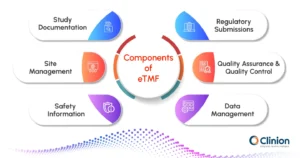
Study Documentation
- Protocol and protocol amendments - Outline the study plan and any modifications during the trial.
- Investigator’s Brochure - Provides detailed information about the investigational product for investigators.
- Delegation of authority logs - Tracks which study team members are responsible for specific tasks.
- Study team training documents - Demonstrate that all staff have completed the required training for the trial.
Regulatory Submissions
- Ethics committee approvals - Confirm that the trial meets ethical standards.
- Regulatory authority submissions and responses - Record communication with regulatory bodies regarding trial approval.
- Compliance-related documents - Ensure adherence to local and international regulations.
Site Management
- Initiation, monitoring, and closeout visit reports - Document key activities at each trial site.
- Site contracts and financial agreements - Capture formal agreements with participating sites.
- Communication with sites - Maintain correspondence regarding trial procedures and updates.
Quality Assurance and Quality Control
- Monitoring checklists - Track site visits and compliance activities.
- Audit reports - Record findings from internal or external audits.
- Issue logs and resolutions - Document problems identified during the trial and how they were resolved.
Safety Information
- Safety reports - Record any adverse events and follow-up actions.
- SUSAR notifications - Track suspected unexpected serious adverse reactions.
- DSMB correspondence - Document communications with the Data Safety Monitoring Board.
Data Management
- eCRF specifications - Outline electronic case report form setup and requirements.
- Validation plans - Ensure data collection systems are properly validated.
- Data review meeting minutes - Record discussions and decisions from data review meetings.
Managing Access and Security for Your Electronic Trial Master File (eTMF)
An eTMF works well only when access is clearly defined, and documents are handled carefully throughout the trial, helping teams stay aligned and audit-ready.
Access to the eTMF
Access to the eTMF is assigned based on specific roles, ensuring that only authorized users can view or edit relevant documents. This protects sensitive trial information, prevents accidental unblinding, and keeps participant data secure. Regular reviews of permissions help maintain compliance throughout the study.
Storage Requirements
An eTMF must be stored in a secure digital environment with system backups and environmental protections. Proper storage safeguards documents against data loss or corruption and ensures records remain available for audits or inspections.
Investigator Site eTMF
Investigators manage site-specific records such as source documents, signed consent forms, code lists, Investigator brochures, and procedural manuals from the Sponsor. Organizing these documents within the eTMF ensures data integrity, simplifies monitoring, and supports regulatory review.
Compliance Considerations for the eTMF
Regulatory authorities require eTMF systems to maintain accurate, complete, and timely documentation across all stages of a clinical trial. Ensuring compliance involves multiple layers of oversight and control.
Quality Management
Periodic quality reviews verify that documents are correctly indexed, accurately filed, and uploaded promptly, preserving the integrity and reliability of the eTMF.
Digital Document Controls
Before documents are converted or transferred, systems must confirm data accuracy, maintain readability, enforce standardized naming conventions, and support a robust audit trail for traceability.
Validation of Digitisation
Scanning or converting paper records into an eTMF requires validation to ensure the digital version fully replicates the original, capturing all content without errors or omissions.
Destruction of Originals
Original paper documents can only be disposed of once their certified digital counterparts have been validated and approved, guaranteeing regulatory retention requirements are fully met.
Certification & Security Expectations
Choosing an eTMF also means ensuring the platform meets the required regulatory and quality standards.

Key certifications include:
- ISO 27001 - Information security management
- ISO 14155 - Clinical investigations for medical devices
- GCP Compliance - Ethical and scientific quality standards
- 21 CFR Part 11 - FDA requirements for electronic records and signatures
- GDPR/AVG - Data privacy regulations in Europe
- HIPAA - Protection of personal health information in the U.S.
- ISO 9001 (preferred) - Quality management system standard
Archiving and Retention in eTMF Systems
Proper archiving and retention are critical to ensure that documents in an electronic Trial Master File remain accessible long after a clinical trial concludes.
Archiving Expectations
The complete eTMF, including audit trails, must remain available for review. Data should be preserved in its original form, and any migration to new storage media must be validated to confirm that information integrity is maintained.
External Archiving
When using an external archive, Sponsors must verify that the facility meets regulatory standards, clearly define responsibilities through formal agreements, and maintain precise knowledge of TMF locations at all times.
Retention Time Factors
The duration for retaining documents depends on participant follow-up periods, the nature of the investigational product, applicable local regulations, and agreements among Sponsors, CROs, and site investigators.
Key Benefits of an Electronic Trial Master File
Adopting an eTMF transforms the management of clinical trial documentation, offering more than just digital convenience.
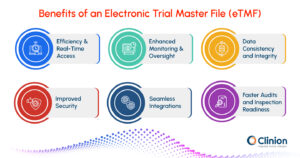
Efficiency and Real-Time Access
With a centralized eTMF, documents are available instantly to authorized users, eliminating delays caused by physical file transfers or misfiled records. Teams can review and approve documents simultaneously across multiple sites, speeding up trial operations and decision-making.
Enhanced Monitoring and Oversight
eTMF systems provide a clear view of document completion, submission timelines, and site activities. Sponsors and monitors can identify gaps or delays in real time, ensuring that corrective actions are taken promptly and trial compliance is maintained.
Data Consistency and Integrity
Structured digital filing ensures that all documents follow standardized formats and are stored in the correct sequence. Version control and audit trails prevent data discrepancies, reduce the risk of errors, and make it easier to reconstruct trial activities when needed.
Improved Security
Electronic TMFs safeguard sensitive information through role-based access, encryption, and secure audit trails. This protects participant data, prevents accidental unblinding, and ensures that critical documents are tamper-proof throughout the trial lifecycle.
Seamless Integrations
Modern eTMF systems can integrate with other eClinical platforms, such as eCRFs, RTSM, and safety reporting tools. This reduces manual data entry, minimizes duplication, and ensures that information flows smoothly across systems, maintaining a single source of truth.
Faster Audits and Inspection Readiness
An organized eTMF enables regulators or auditors to retrieve documents quickly, ensuring trials are inspection-ready at any time. Automated indexing and reporting reduce administrative burden while supporting compliance with Good Clinical Practice (GCP) guidelines.
How to Choose the Right eTMF
Selecting the right electronic Trial Master File (eTMF) is critical for ensuring smooth trial operations and regulatory compliance. While requirements vary depending on study size and complexity, decision makers should consider several key factors:
Evaluation Criteria
- Alignment with TMF reference models: Ensures the eTMF structure meets industry standards and supports consistent filing across studies.
- Role-based access and permission controls: Protect sensitive data while enabling appropriate visibility for team members.
- Quality management capabilities: Supports document review, version control, and audit readiness.
- Integration readiness: Seamlessly connects with eClinical systems such as EDC, ePRO, CTMS, eCRFs, and safety platforms.
- Data protection and validation support: Maintains data integrity and regulatory compliance.
- Scalability: Adapts to both small-scale trials and large, multi-site global studies.
Creating a simple table can help evaluate vendors objectively:
Criteria | Why It Matters |
Usability | Simplifies daily document handling |
Compliance Tools | Ensures audit readiness and regulatory adherence |
Integration | Reduces duplicate work and supports connected systems |
Scalability | Supports trials of varying sizes and complexity |
Support Model | Ensures operational continuity and timely issue resolution |
The Future of the Electronic Trial Master File
The evolution of the eTMF is driven by technology, regulatory expectations, and the push toward fully connected digital ecosystems.
Moving to Structured Content
Traditional document-based filing is gradually being replaced with structured content models that enable:
- Metadata-driven organization for easier search and retrieval
- Reusable components across studies
- Better standardization and consistency in trial documentation
Automation and Intelligent Document Management
Emerging AI-powered capabilities help streamline eTMF management by supporting:
- Automated classification of documents
- Risk-based review and quality alerts
- Predictive completeness checks to ensure the TMF remains inspection-ready
Integrated Clinical Operations
Modern eTMF systems are increasingly connected with CTMS, eISF, safety systems, and other data platforms, providing a unified operational view and simplifying oversight across the trial lifecycle.
Expanded Global Adoption
As regulatory bodies worldwide encourage digital transformation, more emerging markets are adopting eTMF systems. This shift supports remote inspections, reduces paper dependency, and enhances operational efficiency.
The electronic Trial Master File is more than a digital filing system. By centralizing trial documentation, eTMF systems provide teams with real-time visibility across every phase of a study, supporting regulatory compliance and safeguarding the integrity of critical data. It becomes a dynamic hub where teams can spot trends, anticipate bottlenecks, and ensure critical milestones are never missed.
Clinion eTMF: Where Compliance Meets Clarity
Clinion eTMF is a secure, scalable, and fully compliant system that streamlines trial documentation with real-time tracking and automated oversight, reducing reconciliation efforts from day one. Its analytics dashboards provide clear visibility into document completeness, quality, and timeliness. Whether you use the built-in DIA reference model or a sponsor-specific setup, Clinion eTMF ensures structured, compliant, and inspection-ready documentation throughout the study.
External Resources
Electronic trial master file - Wikipedia
Clinical trial master file migration: A preordained step for a centralized electronic trial master file - PMC
Trial Master File Reference Model | CDISC
Guideline on the content, management and archiving of the clinical trial master file (paper and/or electronic)