
- Summary
- Agentic AI: Advancing Beyond Automation
- RPA vs GenAI vs Agentic AI: What Sets Them Apart
- Clinion’s Multi-Agentic AI in Data Review
- The Challenges Clinion’s Agentic AI Solves
- Scaling Beyond Data Review: The Future of Clinion’s Agentic AI
Summary
Clinion’s Multi-Agentic AI can reduce a Data Manager's workload by 90%, accelerate review cycles, and set a new benchmark for clinical data management efficiency.
Despite advances in automation, the daily workload of Data Managers has barely changed. Trials still produce massive volumes of data, and teams spend days waiting for datasets, combing through listings, and raising queries one by one. Yet, even after these efforts, rising data volumes continue to heighten the risk of missed discrepancies.
Rule-based automation has reduced some effort, but fails when trial logic evolves. Gen AI has introduced faster insights and natural language interaction, yet it still relies on Data Managers to prepare datasets, define prompts, and validate outputs. The result is that much of the operational burden remains unchanged.
Agentic AI: Advancing Beyond Automation
What sets Agentic AI apart is not speed or scale, but its defining properties: autonomy, adaptability, and contextual decision-making. These capabilities are realized through a multi-agentic approach that transforms how work is executed.
Instead of executing a linear sequence of rules or waiting for prompts, multiple specialized agents operate in coordination, each with a defined function. Their strength lies in how they apply contextual reasoning and adjust in real time:
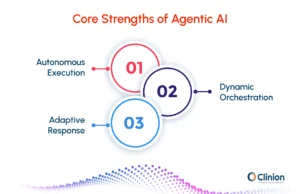
Autonomous Execution:
Agents determine next steps within their scope and act without constant human intervention.
Adaptive Response:
When trial conditions, logic, or data streams evolve, agents recalibrate automatically, ensuring continuity without manual reprogramming.
Dynamic Orchestration:
Outputs are synchronized across agents, with decisions routed and refined in real time to maintain accuracy and efficiency across the workflow.
This structure moves beyond rule-based automation and prompt-driven GenAI. By combining independent action with system-wide coordination, multi-agent AI enables the sustenance of complex clinical workflows with greater scalability and significantly reduced operational burden.
RPA vs GenAI vs Agentic AI: What Sets Them Apart
Approach | How It Works | Limitations | Why Agentic AI Wins |
RPA | Follows pre-set rules | Breaks when trial logic changes; can’t adapt | Dynamically adapts |
GenAI | Generates insights from prompts | Needs human guidance; limited scalability | Runs at scale, without prompts |
Agentic AI | Acts autonomously, understands context, adapts dynamically | Regulatory requirements limit full autonomy, requiring oversight; yet, more advanced than both RPA and GenAI | Scalable, accurate, context-aware, automates end-to-end review |
Clinion’s Multi-Agentic AI in Data Review
Clinion applies the principle of multi-agentic AI to one of the most demanding stages of clinical data management: data review. Its platform brings together specialized agents that work in coordination, exchanging context and adjusting dynamically so that reviews progress efficiently with minimal human oversight.
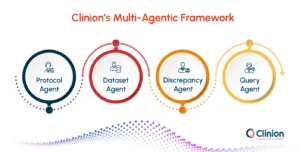
Specialized agents include:
- Protocol Agent – interprets trial protocols and CRF metadata without manual mapping.
- Dataset Agent – generates live, ready-to-use datasets in real time, removing delays from biostatistics.
- Discrepancy Agent – reviews datasets for mismatches and protocol deviations, flagging them instantly.
- Query Agent – auto-creates queries, leaving only review and approval as the final step.
Measurable Impact of Clinion’s Multi-Agentic AI
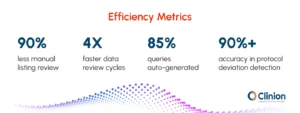
This coordinated approach has shown clear results in live clinical studies, delivering quantifiable improvements in both speed and accuracy.
- Reduces manual listing review workload by 90%, freeing teams to focus on higher-value oversight.
- Accelerates data review cycles by 4× through automated dataset generation and continuous discrepancy checks.
- Auto-generates 85% of queries, leaving Data Managers responsible only for final validation.
- Achieves 90%+ accuracy in identifying protocol deviations, ensuring cleaner datasets and more reliable downstream analysis.
For CROs and sponsors, the impact is decisive: faster trial timelines, stronger confidence in data integrity, and lower operational risk. Data Managers are able to step away from routine validation and focus on higher-value oversight and decision-making.
The Challenges Clinion’s Agentic AI Solves
Clinion’s Multi-Agentic AI delivers impact by cutting through the recurring challenges that slow reviews and overburden Data Managers. These include:
- Time drain → Review cycles cut from days to hours.
- Human blind spots → Discrepancies that are often missed in manual checks are flagged automatically.
- Prompt reliance → Eliminates the need for Data Managers to constantly guide the system.
- Cross-team bottlenecks → Removes dependency on biostatistics teams for dataset preparation.
Fragmented data sources → Possible to harmonize inputs from labs, ePRO, wearables, and more.
Scaling Beyond Data Review: The Future of Clinion’s Agentic AI
Clinion’s Multi-Agentic AI is not just a tool for data review; it is a foundational capability designed to extend across the entire clinical data management lifecycle.
The same architecture is now being extended to automate protocol-to-eCRF mapping, manage data reconciliation across diverse sources, support automated CSR generation, and build domain-specific knowledge libraries that continuously improve accuracy and efficiency.
Today, Clinion’s Agentic AI has already demonstrated transformative reductions in manual workload. This proven impact demonstrates its ability to address today’s challenges while providing a scalable, adaptive model of clinical data management; one that is both more reliable today and prepared for the complexity of tomorrow’s trials.