
- Summary
- What Is Database Lock in Clinical Trials?
- How to Define Database Lock Criteria in Clinical Trials
- How to Prepare Clinical Trial Data for Faster Database Lock
- Common Database Lock Delays and How to Identify Them Early
- Managing Late Data Changes Before Database Lock
- Final Database Lock Process: Review, Sign-Off, and Execution
- Accelerating Database Lock Without Compromising Data Integrity
- External References
Summary
Accelerating database lock in clinical trials involves continuous data cleaning, timely query resolution, and early reconciliation. Clear completion criteria, controlled late changes, coordinated reviews, and documented approvals help teams reduce delays while preserving data integrity through final sign-off and lock.
By the time a study reaches its final lock review, the team should already know what remains open, who owns it, and what must happen before the database can be finalized. The challenge is not simply completing individual activities, but making sure those activities come together at the right time.
What Is Database Lock in Clinical Trials?
Database lock is the controlled restriction of further changes to a defined clinical trial database after the required preparation and authorization. It establishes a defined data state for the intended analysis. Locking does not necessarily remove access: authorized users may still be able to view or export data while editing is disabled.
Some studies use a data freeze or soft lock to restrict editing before final lock. These controls may apply to individual forms, visits, or larger portions of the database. Their precise meaning, permissions, and place in the workflow should follow the system configuration and sponsor-approved procedures.
Before deciding when to apply those controls, the team needs to establish exactly what is being finalized.
How to Define Database Lock Criteria in Clinical Trials
The Data Management Plan (DMP), together with referenced procedures, should describe the study-specific criteria for locking and unlocking the database. This gives teams a common basis for planning and assessing completion.
The plan needs to answer three practical questions:
- Which data are included? Define the relevant cut-off, participants, visits, forms, and external datasets.
- What must be complete? Define the reviews, reconciliations, coding activities, signatures, and other study-specific requirements that must be finished before lock.
- Who makes the decision? Assign responsibility for confirming readiness, authorizing lock, and performing the system action.
The lock criteria should also explain how to handle data that are still missing at the end of the study. Not all missing data can be recovered. For example, if a required assessment was never performed, the value cannot be created later simply by raising more queries. In such cases, the missing data should be reviewed, its impact assessed, and the outcome documented according to the study’s predefined procedures.
This is different from data that have been collected but not yet entered. A missing eCRF entry may still be completed by the site, whereas an assessment that was never performed has to be documented as missing and handled appropriately during finalization.
Once these expectations are clear, teams can organize the work needed to meet them.
How to Prepare Clinical Trial Data for Faster Database Lock
Data cleaning, reconciliation, coding, and study-required reviews should progress alongside study conduct wherever their inputs are available. The aim is to avoid carrying preventable work into the period after Last Patient Last Visit (LPLV), while allowing independent activities to move forward in parallel.
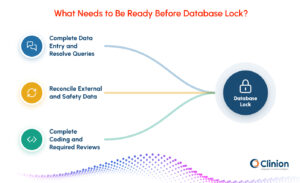
Complete Data Entry and Resolve Queries Continuously
Assess completeness against the forms and visits expected for each participant. Looking only at records already entered can overlook an entirely missing form.
For query follow-up, distinguish items awaiting a site response from responses awaiting reviewer assessment. These need different actions. A reminder to the site will not resolve an item that is already waiting for an internal decision.
Give each outstanding query a clear next step. The reviewer may need to assess a correction, accept a supported explanation, or request specific additional information. Where clarification is necessary, explain the discrepancy precisely rather than sending a broad request to “check the data.”
Prioritize according to the importance of the information and the unresolved question, not simply the easiest items to close. Research published by SCDM supports targeted attention to critical data and clearer query wording rather than indiscriminate query generation.
The goal is an adequately addressed discrepancy. A query can be appropriately resolved when the original value is confirmed as accurate; it does not always need to produce a data change.
Reconcile External and Safety Data Throughout the Study
Give external-data deliveries separate milestones for receipt and acceptance. A file arriving on time does not establish that it is ready for use.
A practical acceptance process should check the agreed file structure and identifiers, reconcile relevant records, and confirm which version supports the intended analysis. These checks should operate within the study’s validated transfer process and documented data flow. EMA guidance emphasizes pre-specified transfers and protection of data and file integrity.
For a laboratory delivery, check whether expected samples are represented, whether participant and visit identifiers can be matched, and whether replacement records supersede the correct earlier versions. Resolve discrepancies with the responsible party before treating the delivery as accepted.
Where clinical and safety databases contain overlapping serious adverse event information, complete the agreed SAE reconciliation as part of closeout preparation.
Schedule the final vendor delivery with time for corrections and the reviews that follow. A receipt date immediately before lock leaves little room to address a rejected file or an unexpected inconsistency.
Complete Medical Coding and Required Reviews Progressively
Clarify ambiguous reported terms while the relevant site personnel remain available, and review coding results as they accumulate. MedDRA guidance calls for qualified review and human oversight of automated term selection to ensure that coding reflects the reported information.
Complete the monitoring and data reviews required by the study alongside this work. Depending on the study, this may include planned SDV or SDR, medical review, investigator review, and assessment of protocol deviations. The objective is not to apply the same level of review everywhere, but to complete the activities defined by the study’s risk-based approach.
Protocol deviations should be assessed for their effect on the data and planned analysis, rather than simply marked as reviewed or closed.
Involve biostatistics before the final handover so that agreed listings or review outputs can help surface inconsistencies that may affect the planned analysis, while maintaining the study’s blinding requirements.
With these activities underway, the next question is which remaining item could still determine the lock date.
Common Database Lock Delays and How to Identify Them Early
A database lock readiness tracker should show the small number of outstanding issues that can still affect the planned lock date. Its purpose is not to create another completion percentage, but to make the remaining dependency, responsible action, and expected outcome visible.
The following hypothetical entries illustrate a practical format:
Outstanding issue | What it prevents | Responsible next action | Evidence of completion |
A record in the final laboratory delivery cannot be matched to a visit | Acceptance of the relevant laboratory dataset | Site confirms the identifier; vendor supplies any required correction | Corrected delivery accepted and reconciliation documented |
An endpoint adjudication required by the study remains pending | Finalization of the affected endpoint record | Authorized adjudicator completes the assessment | Final adjudication output received and checked by the responsible team |
For each live issue, also record the accountable owner, agreed due date, current status, and when that status was last verified.
In the first example, reviewing unrelated EDC records will not resolve the immediate dependency. The priority is obtaining the site confirmation, followed by the vendor’s action and acceptance of the result.
Prioritize issues according to what they prevent next, not simply how long they have been open. An item due tomorrow may already threaten the lock date if its completion triggers several more days of review. Similarly, a high overall completion percentage should not outweigh one unresolved issue affecting an important endpoint or required dataset.
The last verification date matters because later corrections can affect an earlier readiness assessment.
Managing Late Data Changes Before Database Lock
A readiness assessment describes the data at a particular point in time. When data change afterward, the team needs to determine which earlier checks or decisions are affected.
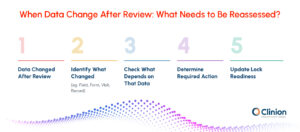
Consider a hypothetical visit-date correction after source data verification and investigator signature. It may change the visit-window assessment or affect related records. Changing signed content also has implications for the validity of the existing signature and any required re-signing.
Trace the effect of the correction rather than automatically repeating every review for the participant. Check the revised visit-window result, relevant dependent records, and the review or endorsement requirements affected by that change.
Use the audit trail alongside the applicable review records to establish what happened and which actions remain necessary. A targeted reassessment should neither overlook consequences nor restart unrelated work.
Where freeze controls are used, retain a defined route for necessary corrections. The purpose is to control changes and their impact, not to prevent legitimate data correction simply because the lock date is approaching.
Once the required reassessments are complete, the team can move from managing outstanding work to authorizing finalization.
Final Database Lock Process: Review, Sign-Off, and Execution
Final sign-off brings together three distinct responsibilities: confirming the reported data, approving the lock decision, and performing the controlled system action.
Confirm Investigator Review and Current Signatures
Investigator review should occur at appropriate points throughout the trial. EMA states that a single signature immediately before database lock will rarely be sufficient, emphasizing timely review of important data and ongoing investigator oversight.
At finalization, confirm that the required endorsements are complete and current. Coordinate availability, appropriate authorization, and system access with sites before the deadline.
Give investigators a clear view of the records requiring their attention and allow time for questions arising from that review. Treating signature collection as a last-minute administrative task leaves no room to investigate a substantive concern.
Obtain Study-Level Authorization
Investigator endorsement of reported data and authorization to lock the study database serve different purposes. The lock approval should follow the responsibilities established in the study’s procedures, rather than assuming that one signature substitutes for another.
Before approving lock, the designated reviewers should be able to trace each required activity to its final status: accepted external data, completed study-specific reviews, current signatures, and documented decisions for any outstanding exceptions.
The approval record should identify the scope being locked and reference these final records. For example, “review complete” should lead to the corresponding accepted review output, while an exception should lead to its documented assessment and authorized disposition.
Build these references as activities are completed rather than reconstructing decisions from emails and meeting notes at the final lock review.
Execute the Lock and Record the Handover
After authorization, the designated user performs the lock and confirms that the intended restrictions are in place. Retain a record of the action, responsible person, date, time, and relevant reason. EDC systems can provide an auditable history of lock and unlock actions.
Identify the corresponding data extract and supporting information supplied onward. Maintain traceability between the approved database state and the delivered files, with appropriate retention of relevant metadata and audit records.
Database lock does not itself complete every analysis dataset or statistical output. Extraction and determination of analysis sets should follow the planned statistical analysis and be documented accordingly.
Accelerating Database Lock Without Compromising Data Integrity
Database lock brings the study’s data preparation to a defined, documented endpoint. Reaching it sooner depends on completing the work throughout the trial and ensuring that nothing is left waiting between data cleaning, review, and final approval.
With that preparation in place, sign-off confirms readiness rather than becoming the point at which unfinished work is discovered. The outcome is more than an earlier lock date: it is a reliable handover to the statistical team, supported by completed reviews, documented decisions, and traceable data. That is the purpose of accelerating database lock: timely progress to analysis without compromising the integrity of the data.
How Clinion EDC Supports Database Lock Readiness
Clinion EDC’s AI-assisted data review enables data managers to create custom datasets using natural-language prompts, examine relevant records, and raise queries within the EDC, including bulk issuance where appropriate.
During lock preparation, data managers can use these datasets to focus review on specific records, check existing issues, and raise queries against data that require clarification. This keeps data review and query management connected to the EDC instead of treating custom reporting as a separate end-stage activity.
The study team remains responsible for evaluating responses, completing the required reviews, and making the final lock decision.
External References