
- Summary
- What Are SDTM and ADaM, and Where Do They Fit?
- What Makes SDTM and ADaM Data Submission-Ready?
- Where AI Actually Adds Value in CDISC Standardization
- Why Metadata Is the Foundation of AI-Assisted CDISC Standardization
- AI-Assisted Raw-to-SDTM Mapping
- AI-Assisted SDTM-to-ADaM Development
- Maintaining Traceability from SDTM to Analysis
- Validation, Review and Remediation
- Governance and Human Oversight for AI-Assisted CDISC Workflows
- Conclusion: Making CDISC Standardization More Efficient with AI
- External References
Summary
AI can assist CDISC standardization by helping teams interpret source data, suggest SDTM mappings, implement approved ADaM derivations, generate specifications and code, review metadata, and investigate validation findings.
Introduction
Preparing clinical trial data for regulatory submission involves more than converting raw data into a standard format. Study-specific data must be mapped to SDTM, transformed into analysis-ready ADaM datasets, supported with metadata and documentation, validated, and kept traceable from collection through analysis.
Much of this work still requires manual interpretation, especially when source structures vary, mappings are ambiguous, or analysis derivations are study-specific.
AI can help reduce that effort by adding contextual intelligence to parts of the workflow that traditionally rely heavily on manual review. The opportunity is not to automate CDISC decision-making entirely, but to combine AI assistance, deterministic standards checks, and expert oversight to move clinical data more efficiently toward submission readiness.
What Are SDTM and ADaM, and Where Do They Fit?
SDTM and ADaM solve different problems within the clinical data lifecycle. Understanding that distinction is important before looking at where AI can assist.
At a high level, the data journey looks like this:
Clinical Data
SDTM
ADaM
Statistical Analysis
Regulatory Submission
Each step transforms the data for a different purpose while maintaining the context needed to understand where the information came from and how it was used.
SDTM: Standardizing Clinical Data for Regulatory Review
The Study Data Tabulation Model (SDTM) provides a standardized way to organize clinical study data into domains and variables. CDISC describes SDTM as a conceptual model for representing clinical study data that can be used for purposes including regulatory submission.
Instead of every study representing similar clinical concepts differently, SDTM establishes consistent structures for commonly collected information.
For example:
| Clinical information | Typical SDTM domain |
| Demographics | DM |
| Adverse Events | AE |
| Laboratory Tests | LB |
| Concomitant Medications | CM |
| Exposure | EX |
In practice, study-specific source data must be mapped into these standard domains and variables. That mapping can require interpretation when the structure or terminology used in the source does not directly correspond to SDTM.
ADaM: Preparing Standardized Data for Analysis
The Analysis Data Model (ADaM) provides standardized structures for analysis-ready datasets and is designed around principles such as usability, clarity, reproducibility, and traceability back to SDTM.
Common ADaM datasets include:
- ADSL for subject-level analysis data
- ADAE for adverse-event analysis
- ADLB for laboratory analysis
- ADTTE for time-to-event analyses
Unlike SDTM, ADaM frequently contains derived variables created specifically for analysis.
A clinical analysis may, for example, require:
- baseline values and baseline flags
- change from baseline
- treatment-emergent flags
- analysis populations
- analysis visit assignments
- relative study days
- time-to-event parameters
These values may depend on study-specific statistical rules defined in the protocol, Statistical Analysis Plan (SAP), dataset specifications, and other approved documentation.
FDA's current Study Data Technical Conformance Guide states that ADaM datasets should be derived from SDTM data and highlights traceability from analysis results to ADaM and from ADaM back to SDTM.
This creates an important distinction for AI-assisted workflows: AI may help implement an approved analysis rule, but it should not independently determine the statistical intent of the study.
Statistical programmers and statisticians still need to define, review, and approve study-specific analysis logic.
SDTM vs ADaM at a Glance
| SDTM | ADaM | |
| Primary purpose | Standardize study data for tabulation and regulatory review | Prepare data for statistical analysis |
| Typical input | Clinical source/study data | Primarily SDTM plus approved analysis requirements |
| Typical output | Standard domains such as DM, AE, LB, CM | Analysis datasets such as ADSL, ADAE, ADLB |
| Key focus | Consistent representation | Analysis usability and derivation |
| Traceability | Back to collected/source data | Back to SDTM and forward to analysis results |
| AI opportunity | Mapping, terminology, transformation and metadata assistance | Specification, derivation, programming and traceability assistance |
AI CDASH Mapping: What It Means for Your Next Trial
Learn how AI-assisted CDASH mapping can help clinical teams standardize CRF data, improve mapping consistency, support review workflows, and prepare cleaner downstream data.
What Makes SDTM and ADaM Data Submission-Ready?
Creating structurally valid SDTM and ADaM datasets is an important part of regulatory submission preparation, but submission readiness involves more than producing the datasets themselves.
Regulators also need enough metadata, documentation and traceability to understand what the submitted variables mean, where they originated, how derived values were calculated, and how the datasets relate to the study and its analyses.
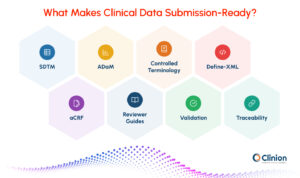
FDA's June 2026 Study Data Technical Conformance Guide, for example, describes supporting components including Define-XML, the annotated Case Report Form, the Clinical Study Data Reviewer's Guide, and the Analysis Data Reviewer's Guide alongside standardized datasets. A submission-ready clinical data package therefore needs to bring several elements together:
Standardized SDTM Datasets
Submitted tabulation data must follow the applicable SDTM and SDTMIG conventions, including expected structures, variable definitions, terminology, formats, and study-specific implementation decisions.
Analysis-Ready ADaM Datasets
ADaM datasets should support the analyses being performed while maintaining traceability to the underlying SDTM data. FDA specifically notes that submitted ADaM datasets should include complete metadata in the corresponding Define-XML.
Define-XML Metadata
Define-XML describes the datasets, variables, controlled terminology, origins, and derivations required to interpret the submitted data. FDA describes the data definition file as a particularly important part of an electronic dataset submission and calls for complete information, especially for derived variables.
Annotated CRF
The annotated Case Report Form provides traceability between fields used to collect subject data and the corresponding variables represented in SDTM. FDA describes the aCRF as a document that maps clinical data collection fields to the related variables or values contained within SDTM datasets.
Reviewer Guides
The cSDRG helps explain clinical study data, implementation decisions, conformance issues, and other information that may help reviewers understand the submitted data.
The ADRG provides similar context for analysis datasets, including terminology and information needed to interpret the analysis data. FDA recommends these reviewer guides as part of standards-compliant study data submissions.
Validation and Traceability
SDTM and ADaM datasets also need to be checked against applicable standards and submission requirements, with traceability maintained across source data, standardized datasets, derivations, and analysis results.
Validation findings, implementation decisions, and any study-specific exceptions should be addressed or documented as part of submission preparation.
Where AI Actually Adds Value in CDISC Standardization
The difficult part of CDISC standardization is not always checking whether a dataset follows a known rule. It is often deciding how study-specific data should be represented within the standard in the first place.
Consider a laboratory result. Recognizing that a source field contains a lab value is only the beginning. The team may still need to determine the appropriate LB test code, result variable, units, reference-range representation, timing information, and any transformation required. Those decisions depend on the meaning and context of the source data, not simply the field name.
Once those decisions have been made, many subsequent checks become more deterministic. A conformance engine can test whether required variables are present, variable attributes are valid, terminology is permitted, and defined relationships are satisfied.
This is where the roles of AI and rules-based automation begin to separate.
| Task | Appropriate approach |
| Is a required SDTM variable missing? | Deterministic conformance rule |
| Does a value conform to the applicable controlled terminology? | Deterministic terminology check |
| Does the dataset violate a defined structural relationship? | Deterministic validation |
| What clinical concept does this unfamiliar source field represent? | AI-assisted interpretation + expert review |
| Which SDTM domain and variable best represent that concept? | AI-assisted recommendation + standards expert review |
| What transformation is needed between source and target? | AI-assisted specification/programming based on approved mapping |
| Is the proposed mapping appropriate for this study and submission context? | Human standards expertise |
This also explains why AI should not be positioned as a replacement for CDISC validation tools. Conformance rules answer whether data violates a defined requirement. AI is more useful when the workflow first has to interpret the source, evaluate possible mappings, or investigate why a finding occurred.
A practical AI-assisted workflow therefore looks less like:
Source Data → AI → CDISC-Compliant Dataset
and more like:
Source Data + Metadata + Standards Context → AI Recommendation → Expert Approval → Dataset Generation → Deterministic Validation → Review and Remediation
For those recommendations to be useful, AI needs enough information to understand both the source data and the standard it is being mapped to. That context comes from metadata.
Why Metadata Is the Foundation of AI-Assisted CDISC Standardization
An AI system cannot reliably map clinical data simply by looking at column names. The quality of an AI-assisted mapping depends heavily on the metadata surrounding the data.
A source variable such as RESULT means very little on its own. But if the system knows that it comes from a Hematology form, represents Hemoglobin, uses g/dL, and has been handled consistently in previous approved studies, the possible SDTM mappings become much narrower. That supporting information comes from several layers of metadata.
The same principle applies across SDTM and ADaM: the more reliable contextual metadata available to the system, the less it has to infer from incomplete information.
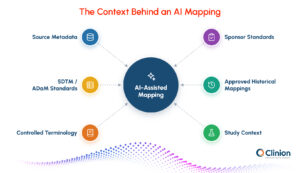
Metadata layer | What it provides |
Source metadata | What was collected, where, in what format, and under what conditions |
CDISC metadata | Applicable domains, variables, terminology and implementation rules |
Sponsor/study metadata | Approved mappings, conventions, transformations and study-specific decisions |
Metadata Must Also Be Version-Controlled
CDISC standards and Controlled Terminology are updated over time. An AI-assisted workflow therefore needs to use the versions applicable to the study and submission rather than simply relying on a general knowledge of CDISC standards.
That means the system needs to know the applicable standard, implementation guide, terminology release, sponsor conventions, and study-specific requirements. Without that version context, a mapping can appear reasonable but still be inappropriate for the study being prepared.
AI-Assisted Raw-to-SDTM Mapping
With the source metadata and applicable CDISC standards in place, AI can assist with the actual work of converting study-specific data into SDTM.
Its role can be grouped into three areas: proposing mappings, helping define transformations, and identifying mappings that need expert attention.
Propose Source-to-SDTM Mappings
AI can compare a source field and its metadata against the applicable SDTM structure and suggest a target domain and variable.
For example:
Source | AI-assisted recommendation |
Adverse event end date | AE.AEENDTC |
Hemoglobin result | Appropriate LB result variables |
Treatment start date | Appropriate EX timing variable |
The recommendation can also include the reasoning behind the proposed mapping, making it easier for a standards expert to review.
The value is greatest when mappings are not already predefined or when source structures vary between studies.
Help Define the Required Transformation
Some source data can be mapped directly, while other data needs to be transformed before it fits the SDTM structure.
AI can assist in drafting transformation logic for tasks such as:
- standardizing dates and times
- aligning source values with controlled terminology
- converting units
- combining multiple source fields
- assigning standard test codes
- applying conditional mapping rules
Where the mapping has already been approved, AI can also help translate that decision into mapping specifications or programming logic.
Flag Mappings That Need Expert Review
AI should not force a mapping when the available information is unclear.
If a source field could reasonably map to more than one SDTM concept, conflicts with existing metadata, or lacks enough information to determine the correct representation, it can flag the case for review.
This allows standards experts to focus their attention on the mappings that genuinely require interpretation rather than reviewing every source field with the same level of effort.
Once the source data has been standardized into SDTM, the nature of the problem changes. ADaM development is less about determining how collected data should be represented and more about applying approved analysis requirements while preserving traceability back to SDTM.
AI-Assisted SDTM-to-ADaM Development
Once data has been standardized into SDTM, the focus shifts from representing collected data consistently to preparing it for statistical analysis.
ADaM datasets are built around the analyses defined for the study. They may include derived values such as baseline, change from baseline, treatment-emergent flags, analysis populations, or time-to-event variables.
AI can assist by helping translate approved analysis requirements into ADaM specifications and programming logic.
Support ADaM Specifications and Derivations
Analysis requirements may be defined across the Statistical Analysis Plan (SAP), dataset specifications, SDTM data, and study metadata.
AI can help bring these inputs together to draft elements such as:
- source and target variables
- derivation rules
- analysis flags
- treatment variables
- baseline and change variables
For example, if an approved specification defines change from baseline, AI can help translate that rule into the corresponding ADaM derivation and programming logic.
The important point is that AI is implementing an approved analysis requirement, not deciding what the analysis should be.
Assist with Programming and Consistency Checks
Once derivations have been defined, AI can help generate or review code used to create the ADaM datasets. It can also compare the specification, source SDTM data, and programmed output to identify issues such as:
- a required source variable being unavailable
- a derivation differing from the approved specification
- an expected analysis variable being missing
- documentation and implemented logic not matching
This can help teams identify inconsistencies earlier in the development process.
Maintaining Traceability from SDTM to Analysis
ADaM is not only about creating analysis-ready variables. Teams must also be able to show where those variables came from and how they were derived.
A simplified traceability path looks like:
SDTM Data → ADaM Variable → Derived Analysis Variable → Analysis Result
For example:
Laboratory result in SDTM
Analysis value in ADaM
Baseline and change-from-baseline values
Statistical analysis
This allows programmers, statisticians, and reviewers to understand how an analysis result connects back to the standardized study data.
AI can assist by checking whether those links remain consistent across specifications, metadata, programming, and datasets.
It may help identify situations where:
- an ADaM variable has no clearly documented SDTM source
- a derivation does not match the specification
- variable origin information is incomplete
- metadata and the actual dataset do not agree
The value of AI here is not to create traceability after the fact, but to help teams identify gaps in the traceability chain before submission.
Validation, Review and Remediation
After SDTM and ADaM datasets have been generated, they still need to be checked against the applicable standards and submission requirements.
Deterministic validation tools are designed to identify defined issues such as missing variables, terminology problems, invalid attributes, or structural inconsistencies.
AI can add value after those findings have been produced. Instead of treating every validation message separately, AI can help:
- group related findings
- identify recurring patterns
- connect a finding to the relevant mapping or derivation
- suggest where the underlying problem may originate
- summarize findings that need expert review
For example, several validation messages may trace back to a single mapping or transformation issue. Identifying that relationship can help teams investigate the underlying cause rather than addressing each message independently.
This keeps the responsibilities clear: validation tools check defined rules, while AI can help teams understand and investigate the findings those checks produce.
Governance and Human Oversight for AI-Assisted CDISC Workflows
Using AI within SDTM and ADaM workflows introduces a new requirement: teams need to know what the AI used, what it recommended, what was changed, and who approved the final decision.
A practical governance framework should cover four areas.
Use Approved Standards and Study Context
AI recommendations should be grounded in the standards and metadata applicable to the study, including the relevant SDTM or ADaM version, implementation guide, controlled terminology, sponsor conventions, and approved study specifications.
This reduces the risk of producing a technically plausible recommendation that does not match the standards or conventions being used for the submission.
Keep AI Recommendations Traceable
Teams should be able to review how an AI-generated mapping, derivation, or code suggestion was produced.
For important decisions, the workflow should retain information such as: the source information used, the proposed output, the rationale for the recommendation, any changes made during review and the final approved decision. This makes AI-assisted decisions easier to review and reproduce later.
Control Changes to Approved Logic
Mappings and derivations may change during study development. If an approved rule is modified, teams need to understand what changed and whether the change affects downstream datasets, metadata, programming, or analyses. AI can help identify these dependencies, but changes should still move through the same controlled review process as other standards or programming updates.
Validate the Final Output
AI-generated mappings, specifications, and code should ultimately be assessed against the applicable standards, approved study requirements, metadata, and traceability expectations. Final outputs should also address any relevant validation findings before they are used for submission.
Conclusion: Making CDISC Standardization More Efficient with AI
AI has the potential to make CDISC standardization more efficient by reducing the manual effort involved in interpreting source data, preparing mappings, implementing approved derivations, reviewing metadata, and investigating validation findings.
Its value is strongest where teams need to work through large volumes of study-specific information while still applying consistent standards and documented rules. In these areas, AI can help surface relevant context, suggest likely actions, and make review more focused.
At the same time, SDTM and ADaM remain standards-driven processes. The meaning of the data, the statistical intent of the study, and the final decisions about mappings, derivations, and submission outputs still require qualified human judgment.
As AI becomes more integrated with CDISC standards, controlled terminology, study metadata, and organizational knowledge, the opportunity is not simply faster dataset generation. It is a more consistent and informed standardization process, with experts able to spend less time on repetitive interpretation and more time on the decisions that require clinical, statistical, and standards expertise.
External References