

- Summary
- What Is an EDC System in Clinical Trials?
- What Is an eCRF in Clinical Trials?
- EDC vs eCRF: What Is the Difference?
- How Do eCRFs Work Within an EDC System?
- What Makes an Effective eCRF?
- How to Design an Effective eCRF: 10 Best Practices
- Common eCRF Design Mistakes and How to Avoid Them
- How AI Is Changing eCRF Design and Study Build
- Designing eCRFs for Better Clinical Trial Data
- How Clinion Supports AI-Assisted eCRF Design
- External References
Summary
EDC (Electronic Data Capture) is the software system used to collect, manage, validate, and review clinical trial data, while an eCRF (electronic Case Report Form) is the digital form used to capture protocol-required participant data within that system. EDC manages the broader clinical data workflow; eCRFs define what information is collected and how it is structured.
Effective eCRF design goes beyond converting a paper form into a digital format. It requires translating the study protocol into standardized data fields, logical forms, validation rules, and workflows that support accurate data collection, efficient site operations, and reliable downstream analysis.
What Is an EDC System in Clinical Trials?
An Electronic Data Capture (EDC) system is a software platform used to collect and manage clinical trial data electronically. It provides a centralized environment where authorized users can enter, review, validate, correct, and monitor study data throughout the trial.
Modern EDC systems support more than data entry. Depending on their capabilities, they can also manage study configuration, automated edit checks, data queries, audit trails, role-based access, data review, reporting, and database lock activities.
For sponsors and CROs, the EDC system provides the operational and technical framework for managing clinical data. The eCRFs configured within it determine which data points are collected from study participants and how that information is presented to site personnel.
What Is an eCRF in Clinical Trials?
An electronic Case Report Form (eCRF) is a digital data collection form used to record protocol-required information for an individual clinical trial participant.
According to ICH E6(R3), a Case Report Form is a data acquisition tool designed to record protocol-required information reported by the investigator to the sponsor. An eCRF is its electronic implementation.
An eCRF may capture information such as:
- Demographics and medical history
- Inclusion and exclusion criteria
- Vital signs and clinical assessments
- Laboratory results
- Concomitant medications
- Adverse events
- Treatment administration and study outcomes
Each eCRF contains predefined questions, fields, response options, and associated metadata. Depending on the study design and EDC configuration, it may also use conditional logic, calculations, and automated validation checks.
The purpose is to capture the information needed for the study in a consistent, structured, and reviewable format.
EDC vs eCRF: What Is the Difference?
The main difference between EDC and eCRF is their scope. EDC is the system that manages clinical trial data, while eCRF is the data collection form used within that system. They serve complementary functions rather than competing purposes.
Aspect | EDC | eCRF |
Full form | Electronic Data Capture | Electronic Case Report Form |
Primary purpose | Collect and manage clinical trial data | Record protocol-required participant data |
Scope | Study-wide data management environment | Individual forms and data fields |
Main functions | Study setup, validation, queries, review, reporting, audit trails | Structured data collection and field-level controls |
Users | Investigators, site staff, data managers, monitors, sponsors and CRO teams | Primarily authorized site personnel and other designated data originators |
Example | An EDC platform supporting a Phase III study | A Vital Signs or Adverse Events form |
Relationship | Hosts and manages the eCRF workflow | Operates within the EDC environment |
An EDC system can contain many eCRFs organized by study visit, assessment type, or clinical domain. For example, a single participant may have separate eCRFs for demographics, medical history, vital signs, laboratory assessments, and adverse events.
Each form captures a defined set of data, while the EDC system supports the broader processes needed to manage that data throughout the study.
How Do eCRFs Work Within an EDC System?
An eCRF is created during study setup by translating protocol requirements into structured data collection forms. Once configured and tested, authorized users can access these forms according to the study's visit schedule and workflow.
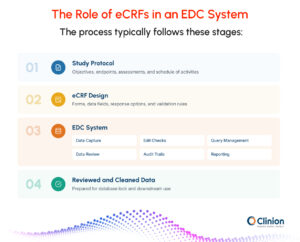
During study conduct, site personnel enter data into eCRFs, or data may transfer from authorized external sources, depending on the study design. The EDC system then applies configured checks, supports review of potential discrepancies, and maintains relevant records of data changes.
This relationship makes eCRF design an important part of the overall clinical data management process. Poorly structured forms can create difficulties during data entry, validation, query resolution, and downstream analysis.
What Makes an Effective eCRF?
An effective eCRF captures the information required by the protocol in a way that is clear, consistent, and practical for site personnel to complete.
The goal is not to collect as much information as possible, but to collect the right information with appropriate structure and controls.
Design principle | Why it matters |
Protocol alignment | Ensures the required study data is captured |
Clear field definitions | Reduces ambiguous or inconsistent responses |
Logical form structure | Supports efficient site data entry |
Standardized terminology | Improves consistency and downstream data mapping |
Appropriate edit checks | Helps identify meaningful discrepancies |
Minimal duplication | Reduces unnecessary data entry and reconciliation |
Data traceability | Supports review, auditability, and data integrity |
Site usability | Makes forms easier to complete accurately |
These principles align with CDISC's CRF design recommendations, which emphasize consistent field organization, logical clinical flow, and forms that are practical for site personnel.
How to Design an Effective eCRF: 10 Best Practices
eCRF design begins with understanding what the protocol requires and ends with confirming that the configured forms work correctly for the intended study. The following steps address the main decisions involved in building usable, accurate, and analysis-ready eCRFs.
1. Start With the Study Protocol
The clinical trial protocol should be the primary reference for determining what information the eCRF needs to collect.
Before designing forms, study teams should identify the trial's objectives, endpoints, eligibility criteria, assessments, safety requirements, and schedule of activities.
Each proposed data field should have a clear purpose. For example, if blood pressure is required for a safety assessment, the eCRF must capture the relevant measurements, units, and contextual information specified by the protocol.
Collecting additional information without a defined purpose can increase site burden, create unnecessary review work, and introduce more opportunities for inconsistent data.
2. Map Study Visits and Assessments to eCRFs
Once the required data is identified, it needs to be organized into a structure that reflects the study's visit schedule.
This includes determining which forms are required at screening, baseline, scheduled treatment visits, follow-up, and other protocol-defined time points.
A visit-to-form matrix helps study teams understand where each assessment belongs.
Study visit | Example eCRFs |
Screening | Demographics, Medical History, Eligibility |
Baseline | Vital Signs, Laboratory Assessments, Concomitant Medications |
Treatment Visit | Vital Signs, Treatment Administration, Adverse Events |
Follow-up | Safety Assessments, Adverse Events |
Early Termination | Disposition and applicable safety assessments |
Illustrative structure only. Actual forms and collection schedules depend on the protocol.
Unscheduled visits, repeat assessments, and conditional procedures should also be accounted for. The design must accommodate protocol-permitted events without forcing site users to enter information into an inappropriate visit or form.
3. Define Data Fields and Response Options Clearly
Every eCRF field should have a clearly defined question, expected response, data type, and any relevant instructions.
For example, a field labeled simply "Weight" may leave important questions unanswered. A more complete design identifies whether the value is numeric, which unit is expected, and whether alternative units are permitted.
Choose field types according to the information being collected:
- Numeric fields: Measurements, laboratory values, and other quantitative data.
- Date and time fields: Assessments, procedures, and clinical event dates.
- Dropdowns or radio buttons: Responses from predefined categories.
- Checkboxes: Multiple selections, where clinically appropriate.
- Free-text fields: Explanations or descriptions that cannot be adequately represented by predefined choices.
Response options should also distinguish between situations such as "No," "Unknown," "Not Done," and "Not Applicable" when those distinctions are relevant.
A missing response should not automatically be interpreted as a negative finding.
4. Use CDASH and Standardized Terminology
Standardization helps ensure that similar clinical concepts are collected consistently across forms, visits, and studies.
The Clinical Data Acquisition Standards Harmonization (CDASH) standard, developed by CDISC, provides recommendations for collecting clinical trial data in a structured format and supports traceability to downstream Study Data Tabulation Model (SDTM) datasets.
When applicable, eCRF designers should consider:
- CDASH-aligned variable concepts and collection instructions.
- Standardized response terminology and clinical definitions.
- Consistent measurement units and date conventions.
- Reusable form designs for common assessments.
- Alignment with downstream data mapping requirements.
Not every study-specific field will have a direct CDASH equivalent, and using CDASH does not automatically create an SDTM-compliant dataset. Study teams still need to define and validate the appropriate transformations and mappings.
5. Organize Forms Around Clinical Workflow
An eCRF should reflect the order in which information is reasonably available during the clinical assessment, rather than simply following a database-centric structure.
For example, a Vital Signs form may begin with the assessment date and time, followed by measurements such as blood pressure, pulse, temperature, and body weight, as applicable.
Related fields should appear together, instructions should be clear, and repeated information should be minimized.
Clinical operations and site representatives should review the form layout to identify potential usability problems before the study goes live.
6. Apply Conditional Logic Where Appropriate
Conditional logic allows fields or forms to appear, become required, or be skipped based on predefined responses.
For example, an adverse event-related question may determine whether additional information is needed:

This prevents users from completing irrelevant fields while ensuring that required follow-up information becomes available.
However, branching logic must be carefully tested. If conditions are too restrictive or incorrectly configured, required information may become inaccessible, especially after earlier responses are corrected.
7. Configure Meaningful Edit Checks and Validation Rules
Edit checks help detect missing, inconsistent, or potentially incorrect data during clinical data collection.
Common validation checks include:
Edit check type | Example |
Required-field check | A mandatory assessment result is missing |
Range check | A measurement falls outside a configured range |
Date check | An assessment date is inconsistent with a related date |
Cross-field check | Two related responses contradict each other |
Cross-form check | Information differs between related forms |
Visit-window check | An assessment falls outside the protocol-defined window |
The aim is to identify discrepancies that may affect data reliability, participant safety, or study requirements.
Not every unusual value should automatically trigger a query. A clinically valid observation can fall outside an expected range.
Edit checks should therefore be risk-based, clinically appropriate, and designed to avoid excessive or low-value queries.
8. Account for Data Sources and Traceability
Not all eCRF data originates from manual entry by site personnel. Depending on the study, relevant data may come from electronic health records, laboratory systems, ePRO applications, medical devices, or other authorized systems.
During eCRF design, teams should understand where each data element originates and how it enters the study database.
Key considerations include the source of the information, authorized data originator, transfer method, relevant metadata, and how subsequent corrections are recorded.
The distinction between source data and the eCRF is important. An eCRF entry is not automatically the source record. Its status depends on where and how the data was originally captured.
Traceability should allow authorized reviewers to understand who recorded or changed data, when the action occurred, and the reason for changes where applicable.
9. Design for Downstream Review and Analysis
The usefulness of an eCRF extends beyond the moment of data entry. Its structure also affects how easily clinical data can be reviewed, reconciled, transformed, and analyzed.
For example, inconsistent terminology or poorly defined response categories can complicate the creation of standardized analysis datasets.
Study teams should consider downstream requirements while defining data fields, including:
- How data will be mapped to relevant standards.
- Whether repeat assessments require multiple records.
- How missing and partially known information will be represented.
- Which data elements may need reconciliation with external systems.
- How protocol amendments may affect existing data and form versions.
These decisions are easier to address during initial design than after significant study data has been collected.
10. Review, Test, and Validate eCRFs Before Go-Live
Before an eCRF is released for production use, its configuration should be tested against approved study requirements.
Testing should go beyond confirming that fields are displayed correctly.
It should establish that the forms support realistic clinical workflows, capture the required data, apply the intended validation checks, and handle corrections appropriately.
A practical review should include:
- Form layout and field-level instructions
- Required fields and response options
- Visit and assessment availability
- Conditional logic and calculations
- Edit checks and query generation
- Data corrections and audit trails
- User permissions and access controls
- Expected data exports and mappings
Clinical data management, clinical operations, and other relevant subject-matter experts should participate according to their responsibilities.
Testing should also consider what happens when users enter unexpected but permissible values, change earlier responses, or complete an unscheduled visit.
The objective is to identify problems before they affect live study data.
Common eCRF Design Mistakes and How to Avoid Them
Even when an eCRF captures all required protocol information, design decisions can introduce unnecessary complexity into the data collection process.
The following mistakes can affect site usability, data consistency, and the amount of cleaning required during the study.
Common mistake | Potential impact | Better approach |
Collecting unnecessary data | Increased site burden and review effort | Include fields with a defined study purpose |
Using ambiguous field labels | Inconsistent interpretation | Define questions, units, and response options clearly |
Overusing free-text fields | Difficult standardization and analysis | Use structured responses when appropriate |
Poor form organization | Longer data-entry time | Align forms with the clinical workflow |
Excessive edit checks | More low-value queries | Prioritize clinically meaningful checks |
Duplicating information | Conflicting entries and reconciliation work | Identify the intended source for each data element |
Ignoring site feedback | Forms that are difficult to complete | Include site-facing review during design and testing |
Overlooking protocol amendments | Inconsistent form versions and data structures | Plan controlled changes and assess their impact |
Many of these problems cannot be solved simply by adding more validation rules. A well-designed eCRF should reduce ambiguity and unnecessary work at the point of collection rather than relying entirely on downstream data cleaning.
How AI Is Changing eCRF Design and Study Build
Traditional eCRF development involves reviewing the clinical trial protocol, identifying required assessments, defining visits and forms, configuring data fields, and creating validation rules. Much of this work requires manually translating protocol information into structured study-build specifications.
AI-assisted study-building tools can support this process by extracting and organizing relevant protocol information into proposed study-design components.
Depending on the system, AI may assist with:
- Protocol interpretation: Identifying visits, assessments, procedures, and data collection requirements.
- eCRF generation: Suggesting forms and fields based on protocol content.
- Edit-check development: Proposing validation logic for relevant data relationships.
- Standards mapping: Suggesting CDASH- and SDTM-related metadata mappings.
- Consistency review: Highlighting potential gaps or inconsistencies between protocol requirements and the proposed study structure.
For example, rather than manually identifying every assessment and assigning it to a visit, study teams can review an AI-generated visit-to-form matrix and refine it against the protocol.
However, AI-generated specifications are not automatically correct, complete, or ready for production. Protocol interpretation can involve clinical judgment, study-specific exceptions, and requirements that automated extraction may not fully capture.
Qualified study teams remain responsible for reviewing and approving the proposed design and validating the resulting configuration before use.
Designing eCRFs for Better Clinical Trial Data
The difference between EDC and eCRF is straightforward: the EDC system provides the environment for managing clinical trial data, while eCRFs define how protocol-required information is captured.
What matters most is how effectively the two work together. Well-designed eCRFs can reduce avoidable data-entry errors, support consistent collection across sites, and make downstream review and analysis more manageable.
As study designs become more complex, combining clear protocol requirements, standardized data structures, practical site workflows, and appropriate validation remains essential. AI-assisted study-building tools can help streamline the process, but the quality of the final eCRF still depends on sound design decisions and qualified human oversight.
How Clinion Supports AI-Assisted eCRF Design
Clinion AI supports the protocol-to-EDC study-build process by helping teams convert clinical trial protocols into structured study-design components. The tool can generate proposed visits, eCRF pages, data items, edit checks, and CDASH/SDTM mappings from protocol content. Study teams can then review and approve the generated specifications before exporting the relevant study-build metadata.
By reducing manual specification work while retaining human review, AI-assisted study building can help teams prepare EDC configurations more efficiently and maintain closer alignment between the protocol and the proposed data collection structure.
External References