- Summary
- RBQM vs. RBM in Clinical Trials: What Is the Difference?
- Why RBQM Needs a Connected Platform
- Critical-to-Quality Factors and Risk Assessment in RBQM
- KRIs and QTLs in RBQM: Turning Risk Into Measurable Oversight
- Centralized Monitoring in RBQM: Detecting Known and Unexpected Risk Signals
- How RBM Uses Risk Signals to Prioritize Monitoring
- Risk and Issue Management in RBQM: From Signal to Resolution
- Traceability in RBQM: Connecting Risk, Decisions, and Actions
- How AI Is Supporting RBQM in Clinical Trials
- What AI Should Not Replace in RBQM
- What Sponsors and CROs Should Look for in an RBQM Platform
- How an RBQM Platform Works in Practice: A Clinical Trial Example
- From Risk-Based Monitoring to Continuous Quality Oversight
- External References
Summary
Risk-Based Quality Management (RBQM) helps clinical trial teams identify, assess, monitor, and control risks that could affect participant safety or trial reliability. Risk-Based Monitoring (RBM) is one part of RBQM, using risk signals and centralized oversight to focus monitoring where attention is most needed.
RBQM vs. RBM in Clinical Trials: What Is the Difference?
Risk-Based Quality Management and Risk-Based Monitoring are closely related, but they are not interchangeable.
RBQM is the broader quality management framework. It begins with identifying the aspects of a clinical trial that are critical to participant safety and the reliability of trial results. Study teams then identify potential risks to those areas, evaluate their significance, establish appropriate controls, and continue reviewing those risks as the study progresses.
RBM is the monitoring component within that broader framework. It uses risk information to determine where monitoring attention should be focused and how monitoring activities should be performed. Instead of applying the same level of review to every site, subject, or data point, RBM helps teams direct resources toward areas where emerging risk signals require closer attention.
Area | RBQM | RBM |
Scope | Overall clinical trial quality management | Monitoring strategy within RBQM |
Primary focus | Identifying and controlling risks to critical aspects of the trial | Directing monitoring effort according to risk |
Typical activities | Identification of Critical-to-Quality factors, risk assessment, risk controls, QTLs, and ongoing risk review | KRIs, centralized monitoring, site prioritization, targeted SDR/SDV, remote or on-site monitoring |
When it applies | From study planning through trial conduct and closeout | From monitoring strategy development through trial conduct and closeout |
The relationship is therefore straightforward: RBQM determines what risks matter and how they should be managed, while RBM uses that risk information to guide monitoring activities.
However, implementing this approach becomes more difficult when risk assessments, clinical data, operational metrics, monitoring findings, and follow-up actions are managed across separate tools. This is why modern RBQM increasingly depends on platforms that can connect these activities into one continuous risk-management process.
Why RBQM Needs a Connected Platform
The principles of Risk-Based Quality Management are straightforward: identify what matters, understand what could go wrong, monitor for meaningful change, and act when risk increases. In practice, however, those activities are often spread across different systems, teams, and documents.
A study may assess risks in a spreadsheet, collect clinical data in the EDC, track operational metrics in the CTMS, review safety information in a separate system, and document monitoring findings elsewhere. When these activities are disconnected, teams may still be performing RBQM tasks, but the overall quality process becomes harder to manage consistently.
The challenge is not simply a lack of dashboards. It is the lack of a continuous connection between:
Risk
Data
Signal
Decision
Action
A connected RBQM platform helps bring these elements together so that identified risks can be linked to the data and indicators used to monitor them, emerging signals can be investigated in context, and resulting actions can be tracked through to resolution.
This becomes especially important as trials generate information from multiple clinical and operational sources. Risk oversight needs to extend beyond individual data points and give study teams enough context to understand whether a signal is isolated, persistent, or part of a broader pattern.
A modern RBQM platform therefore should not begin with alerts. It should begin much earlier, with a clear understanding of the factors that are critical to trial quality and the risks that could affect them.
Critical-to-Quality Factors and Risk Assessment in RBQM
Risk-based quality management starts by defining what is most important to protect in the study. These are often described as Critical-to-Quality (CtQ) factors: aspects of trial design, conduct, and data that can meaningfully affect participant safety or the reliability of trial results.
Depending on the study, CtQ factors may relate to areas such as:
- participant eligibility and informed consent;
- safety reporting;
- randomization and blinding;
- investigational product handling;
- endpoint collection;
- protocol-critical procedures;
- data needed for primary or key secondary analyses.
Once these critical areas are understood, the study team can identify what could threaten them.
For example, if timely safety reporting is critical, delayed adverse event reporting may be identified as a risk. If treatment allocation must remain blinded, inappropriate access to treatment information may represent another risk. The point is to connect each risk to something that genuinely matters to the study, rather than creating a generic list of possible issues.
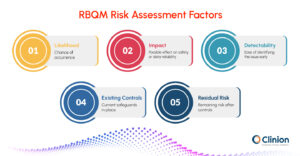
How Risk Assessment Works in RBQM
After risks are identified, they need to be evaluated so that the study team can determine which ones require the greatest attention.
This assessment helps teams prioritize their quality activities and decide where additional controls, monitoring, or mitigation may be needed.
Tools such as a Risk Assessment and Categorization Tool (RACT) can help structure this process by recording risks, categories, scores, controls, mitigation plans, owners, and reassessment history.
Within an RBQM platform, the value is not simply storing the risk assessment digitally. The more important capability is maintaining the relationship between the identified risk and the rest of the quality process.
A platform may therefore allow teams to:
- link risks to CtQ factors;
- assign risk owners;
- document controls and mitigation plans;
- update risk scores as the study evolves;
- retain version history and rationale;
- connect individual risks to the indicators used to monitor them.
Once a risk has been identified and assessed, the next question is practical: how will the study team know if that risk is beginning to increase during trial conduct? That is where Key Risk Indicators and Quality Tolerance Limits come into the RBQM process.
KRIs and QTLs in RBQM: Turning Risk Into Measurable Oversight
Key Risk Indicators (KRIs) and Quality Tolerance Limits (QTLs) provide measurable ways to track whether important quality risks are changing during trial conduct. Although both support risk oversight, they operate at different levels and should not be treated as interchangeable.
What Are Key Risk Indicators in Clinical Trials?
A Key Risk Indicator (KRI) is a measurable signal used to monitor whether an identified risk may be increasing. KRIs are commonly used at the site, country, or process level and help study teams identify areas that may require closer review.
Examples may include:
- protocol deviation rates;
- delayed data entry;
- query aging;
- missing data;
- adverse event reporting timelines;
- unusual enrollment patterns;
- high rates of screen failure or withdrawal.
A KRI does not automatically mean that a quality problem exists. Instead, it acts as an early signal that the underlying data or process should be reviewed in context.
For example, if one site has a higher protocol deviation rate than comparable sites, the issue may reflect training gaps, protocol complexity, site workload, or another operational factor. The KRI helps draw attention to the pattern, but the study team still needs to determine its significance.
What Are Quality Tolerance Limits?
A Quality Tolerance Limit (QTL) is generally applied at the study level and is linked to risks that could materially affect participant safety or the reliability of trial results.
QTLs define an acceptable range for an important quality parameter. If that range is exceeded, the study team evaluates whether the deviation points to a broader or systemic issue and whether corrective action is needed.
Examples could include trial-level measures related to:
- important protocol deviations;
- missing critical endpoint data;
- treatment discontinuation;
- safety reporting;
- other parameters tied directly to critical-to-quality factors.
The difference is important because a site-level variation may require targeted investigation, while a study-level QTL deviation may indicate that the issue extends beyond an individual site.
Area | KRI | QTL |
Primary level | Site, country, or process | Overall study |
Purpose | Detect emerging or localized risk | Detect potential systemic quality risk |
Typical use | Ongoing monitoring and site prioritization | Oversight of critical trial-level parameters |
Example | One site's query-aging rate exceeds threshold | Trial-wide missing critical endpoint data exceeds predefined tolerance |
What happens next | Review the signal and determine whether intervention is needed | Evaluate the deviation, its impact, and whether broader action is required |
How an RBQM Platform Supports KRIs and QTLs
A platform should do more than display indicator values. It should help teams manage how those indicators are defined, monitored, interpreted, and followed through.
Relevant capabilities may include:
- configurable KRI and QTL definitions;
- study-specific thresholds and tolerance ranges;
- trend views over time;
- drill-down from study to country, site, or underlying data where appropriate;
- alerts when predefined conditions are met;
- documentation of review and investigation;
- version-controlled management of thresholds and any justified changes;
The important point is that a threshold breach is the beginning of an evaluation, not the end of one.
KRIs and QTLs are particularly useful for monitoring risks that have already been anticipated. But not every quality problem can be predicted during study planning. Trial data may also contain unusual patterns that were never defined as a KRI or QTL.
This is where centralized monitoring extends the RBQM approach from tracking known risks to identifying both expected and unexpected signals across the study.
Centralized Monitoring in RBQM: Detecting Known and Unexpected Risk Signals
Centralized monitoring evaluates clinical and operational data across the study so that emerging risk patterns can be identified and reviewed in context. Rather than examining every site or data source independently, teams can look across multiple sources to understand where closer attention may be needed. Depending on the trial, this may include data from:
- EDC;
- CTMS;
- laboratory systems;
- ePRO or eCOA;
- safety systems;
- RTSM;
- other operational or study-specific data sources.
The objective is not simply to collect more data in one place. It is to help study teams recognize when a pattern, trend, or combination of signals may indicate an emerging quality issue.
Threshold-Based Monitoring for Known Risks
Threshold-based monitoring evaluates predefined indicators against agreed limits or conditions. For example, an RBQM platform may flag a site when a configured KRI moves beyond its defined threshold or shows a sustained unfavorable trend.
Because these conditions are defined in advance, threshold-based monitoring is particularly useful for risks the study team already knows it needs to watch.
Statistical Monitoring for Unexpected Patterns
Centralized statistical monitoring goes a step further by comparing patterns across sites, participants, or data domains to identify behavior that appears unusual relative to the rest of the study.
This may help surface patterns such as:
- unusually consistent or inconsistent data;
- atypical distributions across sites;
- unexpected participant-level patterns;
- unusual visit or reporting behavior;
- differences in adverse event reporting;
- patterns that are difficult to detect through individual listings or predefined thresholds alone.
The key difference is that statistical monitoring does not always begin with a known problem. It asks whether the data itself is showing something sufficiently unusual to deserve investigation.
Viewing Risk in Cross-Domain Context
A single signal rarely tells the whole story.
For example, a high protocol deviation rate at one site may be more meaningful if it occurs alongside delayed data entry, repeated query issues, unusual enrollment patterns, or previous monitoring findings.
A connected RBQM platform can help reviewers move from a high-level signal into the supporting context and understand whether several indicators are pointing toward the same underlying concern.
Risk can therefore be reviewed at different levels, from the overall study and country down to the site, participant, and underlying data.
The purpose is not to generate as many alerts as possible. Too many disconnected alerts can create another review burden. The value comes from helping teams separate routine variation from signals that may require closer attention.
Once those signals have been identified and reviewed in context, the next question becomes operational: which sites, subjects, or processes require more monitoring attention, and what type of monitoring response is proportionate to the level of risk?
That is where centralized risk detection begins to translate into Risk-Based Monitoring.
How RBM Uses Risk Signals to Prioritize Monitoring
Once risk signals have been identified and reviewed in context, Risk-Based Monitoring (RBM) helps translate those signals into monitoring priorities.
The purpose is not to reduce monitoring for the sake of efficiency. It is to apply monitoring effort in proportion to the level and type of risk observed across the study.
A site showing stable performance may continue under the planned monitoring approach, while a site with persistent or multiple risk signals may require closer review. The response can vary depending on the nature, severity, and persistence of the issue.
Potential monitoring responses may include:
- targeted remote review;
- focused review of specific data or processes;
- increased monitoring frequency;
- targeted Source Data Review (SDR) or Source Data Verification (SDV);
- direct site follow-up;
- focused on-site monitoring where warranted.
The important point is that risk signals inform monitoring decisions; they do not automatically determine them. A threshold breach or high-risk score still requires review within the wider study context.
Site Prioritization in Risk-Based Monitoring
One of the most practical uses of RBM is deciding which sites need attention first.
Rather than relying on one indicator, site prioritization can consider multiple sources of information, such as KRI status, protocol deviations, data completeness, query patterns, safety reporting, enrollment activity, previous monitoring findings, and unresolved quality issues.
Taken together, these signals can help monitoring teams identify where additional oversight may have the greatest value.
Risk picture | Potential monitoring response |
Stable performance with no significant signals | Continue planned oversight |
Emerging isolated signal | Targeted review or remote follow-up |
Multiple or persistent risk signals | Expanded review and closer site engagement |
Significant or escalating quality concern | Focused intervention and possible on-site review |
This does not mean every site should be reduced to a single risk score. A score can help prioritize review, but reviewers still need to understand which signals contributed to it and whether they represent a meaningful quality concern.
Monitoring Should Adapt as Risk Changes
Risk is not static throughout a clinical trial. A site performing well during early enrollment may later develop data-entry delays, protocol deviations, or safety-reporting issues, while a site that initially required closer oversight may stabilize after intervention.
RBM should therefore allow monitoring intensity to change as new evidence emerges. Monitoring findings can then feed back into the broader risk assessment to determine whether the existing level of oversight remains appropriate.
But monitoring is only one part of the response. When a signal is confirmed as a meaningful quality issue, the study team also needs to investigate the underlying cause, assign appropriate actions, and follow the issue through to resolution.
That is where RBQM moves from monitoring risk to managing it.
Risk and Issue Management in RBQM: From Signal to Resolution
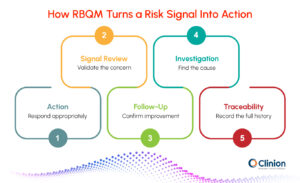
A risk signal only becomes useful when the study team can evaluate it, determine whether it represents a meaningful issue, and take appropriate action.
This is where RBQM moves beyond detection. The focus shifts from identifying that something may be wrong to understanding what the issue is, why it occurred, what needs to change, and whether the response was effective.
Investigating the Signal
Not every alert, KRI breach, or statistical anomaly represents a confirmed quality issue. The first step is to review the signal in context and determine whether it reflects normal variation, a temporary operational issue, a site-specific problem, a broader process weakness, or a potentially systemic quality concern.
For example, an increase in protocol deviations may result from inconsistent site execution, unclear protocol instructions, training gaps, or a study process that is difficult to follow. The signal identifies where to look; the investigation determines what is actually happening.
Assigning and Managing Corrective Actions
Once an issue is confirmed, the response should be proportionate to its significance.
Actions may include:
- additional site training;
- clarification of study procedures;
- targeted monitoring;
- process changes;
- increased oversight;
- escalation to the appropriate functional owner;
- Corrective and Preventive Action (CAPA), where warranted.
Not every issue should automatically result in a CAPA. The response should reflect the severity, recurrence, and potential impact of the problem.
An RBQM platform can support this process by helping teams document:
- the issue and supporting evidence;
- severity or priority;
- assigned owner;
- root-cause assessment;
- agreed action;
- target date;
- escalation status;
- follow-up findings;
- closure rationale.
Confirming Whether the Action Worked
Closing an issue should not simply mean marking a task as complete.
The study team may need to review subsequent data or monitoring results to determine whether the action actually reduced the risk.
For example, if repeated late data entry leads to site retraining, the team can continue monitoring data-entry timeliness to see whether performance improves. If the same signal persists, further investigation or a different intervention may be required.
The outcome of that follow-up should feed back into the ongoing risk assessment so that the study team can determine whether the concern has reduced, remained unchanged, or requires further action. .
Once an issue has been evaluated and addressed, the next requirement is equally important: the organization must be able to reconstruct what was identified, why a decision was made, what action followed, and what happened afterward.
That is where traceability becomes a core RBQM platform capability.
Traceability in RBQM: Connecting Risk, Decisions, and Actions
RBQM depends not only on identifying and addressing risk, but also on maintaining a clear record of how those decisions were made.
As risks evolve during a study, teams need to be able to trace the path from the original concern to the evidence reviewed, the decision taken, and the outcome that followed. Without that connection, important context can be lost across spreadsheets, monitoring reports, emails, and separate systems.
A connected RBQM platform should therefore preserve the relationship between the original risk, the indicators used to monitor it, the signals generated, the review performed, the resulting decision, and any subsequent action or outcome.
What Should Be Traceable in an RBQM Platform?
For each significant risk or issue, teams should be able to understand:
- what risk was identified;
- which Critical-to-Quality factor or study objective it was linked to;
- what indicator, threshold, or data pattern triggered review;
- what supporting data was examined;
- who reviewed the signal;
- what decision was made;
- why that decision was made;
- what action was assigned;
- whether the action was completed;
- whether the risk changed after the intervention.
This creates a complete history of how quality oversight was performed rather than a collection of disconnected records.
Why Traceability Matters
Traceability supports several practical needs.
It helps study teams maintain continuity when responsibilities change, allows quality and monitoring functions to understand how an issue developed over time, and provides evidence that risk-based decisions were made using a defined process.
It also helps teams distinguish between:
- a signal that was reviewed and dismissed as non-significant;
- an issue that required targeted monitoring;
- a recurring problem that led to escalation;
- a broader risk that required process-level action.
The value is not simply maintaining an audit trail. It is maintaining the reasoning and context behind each quality decision.
From Historical Record to Ongoing Oversight
Traceability also makes RBQM more useful over time.
When previous signals, investigations, and outcomes remain connected, teams can compare current behavior with historical patterns and assess whether a risk is recurring, stabilizing, or worsening.
This creates a stronger basis for ongoing risk review because the study team is not evaluating each new signal in isolation.
At this point, the full RBQM workflow is in place: risks are identified, measured, monitored, prioritized, acted on, and documented. The next question is how advanced analytics and AI can strengthen these steps without replacing the underlying quality framework or human oversight.
How AI Is Supporting RBQM in Clinical Trials
Once the RBQM workflow is connected, advanced analytics and AI can help study teams identify patterns earlier, prioritize what requires attention, and interpret increasingly complex risk information. But these capabilities are not interchangeable, and not every automated function in an RBQM platform should be described as AI.
A useful distinction is between rules-based monitoring, statistical analytics, machine learning, and newer generative or agentic AI capabilities.
Approach | Role in RBQM | Example |
Rules-based monitoring | Detects predefined conditions or threshold breaches | Flagging a KRI that exceeds its configured limit |
Statistical analytics | Identifies unusual patterns or outliers across study data | Detecting a site whose data distribution differs significantly from peer sites |
Machine learning | Evaluates multiple variables to identify complex patterns or estimate emerging risk | Prioritizing sites based on combinations of operational and data-quality signals |
Generative AI / NLP | Interprets, retrieves, summarizes, or explains structured and unstructured information | Summarizing related risk signals or extracting potential risks from protocol text |
Agentic AI | Supports multi-step activities by coordinating information and actions within defined controls | Gathering signal context, preparing an investigation summary, and suggesting the next review step |
The distinction matters because each technology supports a different part of the RBQM process and requires different levels of validation, explainability, and human oversight.
AI-Assisted Risk Identification and Assessment
Risk identification traditionally depends on protocol review, therapeutic-area experience, historical knowledge, and structured risk-assessment workshops.
AI can support this process by helping teams analyze larger volumes of information and surface potential areas for consideration. For example, AI-assisted tools may help:
- extract relevant study processes or endpoints from a protocol;
- identify sections that may introduce operational complexity;
- retrieve similar risks from historical studies;
- suggest potential risk categories or controls;
- connect protocol information with an existing risk library.
The output should be treated as decision support rather than a finalized risk assessment. Study teams still need to determine whether a suggested risk is relevant, how significant it is, and what controls are appropriate for the specific trial.
AI and Advanced Analytics for Risk Signal Detection
As studies generate data across multiple systems, reviewing every signal manually becomes increasingly difficult. Statistical methods and machine learning can help identify combinations of patterns that may be less visible through individual thresholds alone.
Potential applications include detecting:
- unusual site-level behavior;
- atypical participant data patterns;
- unexpected changes in data quality;
- combinations of KRIs that may indicate increasing site risk;
- unusual enrollment or reporting behavior;
- recurring patterns across related data domains.
Machine learning may also support predictive risk assessment, where the objective moves from identifying a problem that has already crossed a threshold toward recognizing a developing pattern that may warrant earlier review.
This does not mean that a predicted high-risk site is automatically problematic. The model can help prioritize attention, but the signal still needs to be understood within the context of the study.
Generative AI for Risk Review and Investigation
Generative AI can play a different role by helping reviewers work with the information surrounding a risk signal.
Instead of identifying only whether a threshold has been crossed, it may help bring together and summarize relevant context such as:
- recent KRI changes;
- previous monitoring findings;
- unresolved issues;
- protocol deviations;
- related site-performance trends;
- historical actions and outcomes.
A reviewer could potentially ask a natural-language question such as:
“Why has this site been prioritized for review?”
The system could summarize the contributing signals and provide links back to the underlying evidence for verification.
Generative AI may also assist with drafting investigation summaries, organizing findings, or retrieving relevant historical context. However, these outputs should remain reviewable and traceable to the source information used to generate them.
Agentic AI and the Next Step in RBQM Automation
Agentic AI extends beyond answering a question or generating a summary. Within appropriately controlled environments, it may help coordinate information across several parts of the risk-review process.
For example, an agent could gather relevant site information, retrieve recent risk signals and historical trends, organize the findings, and prepare contextual information for a reviewer. The benefit is not autonomous quality decision-making, but reducing the manual effort involved in assembling information before review.
However, greater autonomy also creates greater governance requirements. The more an AI system influences prioritization, investigation, or recommended actions, the more important it becomes to understand what data it used, how its output was generated, and where human approval is required.
AI can therefore strengthen RBQM by helping teams detect, prioritize, interpret, and investigate risk, but it should operate within the quality-management framework rather than replace it. This makes the boundary between AI assistance and accountable human decision-making especially important.
What AI Should Not Replace in RBQM
AI can help study teams work faster across large volumes of risk information, but it should not become the final authority for decisions that require clinical, operational, or quality judgment.
Within RBQM, qualified human oversight remains important for decisions involving:
- the clinical significance of a risk signal;
- participant-safety implications;
- confirmation of root cause;
- approval of major corrective or preventive actions;
- acceptance of residual risk;
- interpretation of significant QTL deviations;
- changes to monitoring strategy;
- escalation of important quality concerns.
The reason is simple: an AI system may identify an association, pattern, or likely explanation, but that does not mean it fully understands the trial context or the consequences of acting on that information.
For example, a model may identify a site as higher risk because several indicators are trending unfavorably. That signal may be useful for prioritization, but the study team still needs to determine whether the pattern reflects a genuine quality issue, a temporary operational condition, or an explainable feature of the study population or site workflow.
Explainability and Traceability Are Essential
The more AI influences risk prioritization or investigation, the more important it becomes to understand:
- what data contributed to the output;
- which factors influenced the result;
- whether the source information is current and complete;
- how the recommendation can be verified;
- who reviewed and approved the resulting decision.
For generative AI in particular, reviewers should be able to move from a summary or recommendation back to the underlying evidence rather than treating generated text as the source of truth.
Human Oversight in AI-Enabled RBQM
A practical AI-enabled RBQM model keeps qualified study teams accountable for interpretation and final decisions.
AI can assist by surfacing relevant information, highlighting patterns, organizing context, and suggesting areas that may deserve attention. The reviewer then evaluates that information against the protocol, study circumstances, clinical relevance, and established quality processes before deciding what action, if any, is appropriate.
This balance allows organizations to benefit from faster analysis and better prioritization without weakening accountability.
The broader implication is that the value of an RBQM platform should not be judged by how much it automates. It should be judged by whether it helps teams make better, more proportionate, and more traceable quality decisions.
What Sponsors and CROs Should Look for in an RBQM Platform
An RBQM platform should do more than display dashboards or risk scores. Its value lies in how well it connects risk identification, monitoring, investigation, and follow-up.
Key capabilities to look for include:
- integration with relevant clinical and operational data sources;
- configurable risks, KRIs, QTLs, and thresholds;
- detection of both predefined and emerging risk signals;
- drill-down from high-level signals to supporting data;
- issue, action, and follow-up management;
- clear traceability of decisions and outcomes;
- explainable and reviewable AI or predictive outputs;
- support for ongoing risk reassessment as the study evolves.
The strongest platforms are those that help teams move from identifying risk to understanding and acting on it without losing context between systems or functions.
How an RBQM Platform Works in Practice: A Clinical Trial Example
Consider a study where completeness of primary endpoint data is identified as a Critical-to-Quality factor. Missing or delayed endpoint assessments are therefore recognized as a study risk, and an appropriate indicator is configured to monitor completion rates across sites.
During trial conduct, centralized monitoring identifies that one site has a sustained increase in missing or delayed endpoint assessments compared with other sites. The pattern is reviewed in context and the site is prioritized for targeted monitoring.
RBQM activity | Example |
Critical-to-Quality factor | Completeness of primary endpoint data |
Identified risk | Missing or delayed endpoint assessments |
Risk indicator | Endpoint completion rate by site |
Signal detected | One site shows a persistent increase in missing or delayed assessments |
Monitoring response | Targeted review of the site |
Investigation | Site workflow or training issue identified |
Action | Focused training or process correction |
Follow-up | Subsequent endpoint completion is reviewed for improvement |
The important point is that the platform does not simply generate an alert. It helps maintain the connection between the original risk, the signal that emerged, the monitoring response, the action taken, and the resulting outcome.
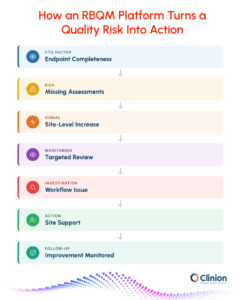
This is what turns RBQM from a collection of individual monitoring activities into a continuous quality-management process.
From Risk-Based Monitoring to Continuous Quality Oversight
RBQM is most effective when risk management, monitoring, investigation, and follow-up operate as one connected process rather than as separate activities.
RBM helps study teams focus monitoring effort where it is most needed, while the broader RBQM framework ensures that those monitoring decisions remain tied to Critical-to-Quality factors, study risks, and documented actions.
Modern RBQM platforms can strengthen this approach by bringing together risk assessment, KRIs, QTLs, centralized monitoring, issue management, and traceability. Advanced analytics and AI can further support teams by helping surface unusual patterns, prioritize review, and organize complex risk information.
The goal, however, is not simply more automation or more alerts. It is more informed, proportionate, and traceable quality oversight throughout the clinical trial.
External References