
- Summary
- What is clinical data management?
- Key Objectives of Clinical Data Management (CDM)
- What are the key stages of the clinical data management process?
- What is a Clinical Data Management Plan (CDMP)?
- What is a Clinical Data Management System (CDMS)?
- Key tools and technologies used in clinical data management
- Common challenges in clinical data management
- Roles & Responsibilities in a Clinical Data Management Team
- Regulatory Compliance in Clinical Data Management
- Clinical data management best practices
- Artificial Intelligence in Clinical Data Management
- Conclusion
- External Resources
Summary
Clinical data management (CDM) ensures that clinical trial data are accurate, complete, and traceable from collection through analysis and regulatory submission. It includes activities such as data collection, validation, coding, query resolution, and database lock to support reliable study outcomes.
What is clinical data management?
Clinical data management involves the collection, validation, quality management, integration, and delivery of clinical data for statistical analysis, regulatory compliance and submission. In short, CDM ensures that every data point collected during a trial is accurate and meaningful, whether it comes from electronic case report forms, laboratory results, imaging systems, electronic patient‑reported outcomes (ePRO/eCOA), or wearable sensors.
Key Objectives of Clinical Data Management (CDM)

Data accuracy and reliability:
CDM must ensure that each data point reflects the true outcome of a clinical event. Inaccuracies can compromise the entire study.
Regulatory readiness:
Data must be organized and validated according to global standards such as CDISC, preparing it for submission to agencies like the FDA or EMA.
Evidence‑based decision‑making:
Reliable data allow sponsors and investigators to make confident decisions about trial safety and efficacy.
Patient safety:
Clean, validated data support timely identification of adverse events and proper interventions.
High‑quality, error‑free data uphold the ethical and scientific obligations of clinical research. The ICH E6 (R3) guideline states that clinical trials should generate results that are “fit for purpose” and that systems for data capture, management, and analysis should be proportionate to the risks and capture only the data required by the protocol. A robust CDM framework ensures that trials deliver credible results that can be trusted by regulators, clinicians and patients.
What are the key stages of the clinical data management process?
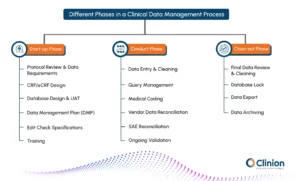
Clinical data management begins during study start-up and continues until the final database is locked and archived. While activities occur across the start-up, conduct, and close-out phases of a study, the CDM workflow typically includes the following stages:
1. Protocol Review and CRF Design
CDM teams review the protocol to identify required data points, endpoints, visit schedules, and data dependencies. Based on these requirements, CRFs or eCRFs are designed to capture study data consistently and accurately.
2. Database Build and Validation
The study database is configured within the EDC or CDMS platform. Edit checks, workflows, and user roles are programmed and tested through user acceptance testing (UAT) before the study begins.
3. Data Collection and Entry
Clinical sites collect and enter patient data into the EDC system throughout the trial. Additional data may come from laboratories, imaging vendors, ePRO/eCOA systems, wearables, and RTSM platforms.
4. Data Validation and Query Management
Automated edit checks and manual reviews identify missing, inconsistent, or potentially inaccurate data. Queries are generated, tracked, and resolved to maintain data quality.
5. Medical Coding
Adverse events, medical history, and medication data are coded using standardized dictionaries such as MedDRA and WHO Drug to support consistent analysis and reporting.
6. Data Reconciliation
Data from external vendors and safety systems are reconciled against the clinical database to identify and resolve discrepancies. This includes laboratory, imaging, ePRO, RTSM, and SAE data.
7. Database Lock and Data Export
Once data cleaning, coding, reconciliation, and quality reviews are complete, the database is locked. The final dataset is then exported in formats such as SDTM and ADaM for statistical analysis and regulatory submission.
8. Archival
Essential study records, audit trails, and datasets are archived according to regulatory and sponsor requirements to support future inspections and audits.
What is a Clinical Data Management Plan (CDMP)?
A Clinical Data Management Plan, sometimes called a Data Management Plan (DMP), is a living document that describes how data will be collected, reviewed, cleaned, coded and controlled during a trial. It forms the operational blueprint for the CDM function. CDMPs should be created during study start‑up and updated as the protocol evolves.
Why is it essential
The DMP is critical for defining processes and reducing ambiguity. The ICH E6 (R3) guideline emphasizes that plans supporting protocol execution, including the data management plan, should be clear, concise, and operationally feasible. A well-developed DMP helps maintain consistency across teams, support data integrity, and demonstrate that data management activities are systematic and controlled.
What a CDMP typically includes
A CDMP typically includes the following elements:
- Protocol details: protocol number, version, study phase and objectives; applicable standard operating procedures.
- Data sources: list of data to be collected (eCRF fields, laboratory data, imaging, ePRO, randomization and supply management) and their formats.
- Database design: description of the EDC/CDMS platform, edit checks, user roles, training plans, and procedures for mid‑study updates.
- Data entry & query handling: processes for data entry, query generation, tracking and resolution.
- Medical coding & terminology: dictionaries (e.g., MedDRA, WHO Drug) and versioning strategy.
- External vendor data: procedures for transferring, verifying and reconciling lab, imaging and ePRO data.
- Serious adverse event reconciliation: steps for aligning safety system data with clinical data.
- Data transfer & export formats: specifications for creating SDTM and ADaM datasets and other analysis files.
- Roles and responsibilities: clear assignment of tasks among data managers, statisticians, programmers, and clinical teams.
- Quality control & audit trail: methods for documenting changes, retaining essential records and ensuring traceability.
A robust CDMP not only guides the data management team but also provides evidence of quality systems to auditors and regulators.
What is a Clinical Data Management System (CDMS)?
A Clinical Data Management System (CDMS) is a software platform used to collect, validate, manage, and maintain clinical trial data throughout a study. Its functions include:
Data collection and integration:
Capturing trial data from eCRFs, ePROs, labs, imaging, randomization systems and other sources and integrating them into a centralized repository.
Data validation and cleaning:
Applying automated checks and manual review to ensure accuracy and completeness.
Data storage & retrieval:
Securely storing data with audit trails and providing easy access for analysis and reporting.
Regulatory compliance:
Supporting compliance with FDA 21 CFR Part 11 and other regulations through electronic signatures, permissions and audit logging.
A CDMS often includes an Electronic Data Capture (EDC) module, but it goes beyond simple data entry. It may offer tools for coding, query management, data reconciliation, dataset conversions, and advanced reporting. Some CDMS platforms include modules for randomization and trial supply management (RTSM), eConsent, electronic source (eSource), integration with electronic health records, and statistical computing environments.
CDMS vs EDC: How do they differ?
EDC and CDMS are closely related terms, and in modern clinical trial platforms their capabilities often overlap. Traditionally, EDC referred to the system used to electronically capture clinical trial data through eCRFs, while CDMS referred more broadly to the systems and workflows used to manage, clean, validate, reconcile, lock, and export trial data.
Today, many EDC platforms already include advanced CDMS-like functionality such as edit checks, query management, audit trails, coding support, reconciliation, database lock, and data exports. So the practical difference is less about a fixed feature list and more about scope: EDC describes the data-capture function, while CDMS describes the broader clinical data-management environment.
Key tools and technologies used in clinical data management
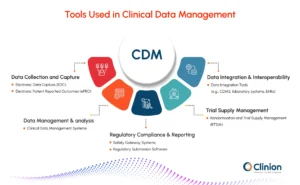
The CDM function relies on a diverse ecosystem of tools and technologies to capture and manage data efficiently:
Electronic Data Capture (EDC) and CDMS platforms:
EDC systems are the central systems used to capture and manage clinical trial data. They support eCRF data entry, edit checks, query management, audit trails, data review, database lock, and exports.
ePRO and eCOA systems:
ePRO/eCOA tools allow participants to report symptoms, quality-of-life measures, diary entries, and medication adherence directly through electronic devices. Some systems also integrate with wearables to collect patient-generated data.
RTSM systems:
Randomization and Trial Supply Management systems manage subject randomization, treatment allocation, and investigational product supply. CDM teams may use RTSM data to verify subject status, visits, and treatment-related records.
eConsent, eSource, and analytics dashboards:
These tools support electronic consent, direct source data capture, risk-based monitoring, and data quality oversight. They help improve traceability and allow teams to focus attention on high-risk data, sites, or trends.
Medical coding tools:
Coding tools and dictionaries such as MedDRA and WHO Drug help standardize adverse events, medical history, and medication data for consistent review and analysis.
Vendor and data integration tools:
These tools support data exchange between EDC/CDMS platforms, laboratories, imaging systems, ePRO tools, EHRs, RTSM systems, and analytics platforms. Data mapping, validation, and reconciliation help maintain consistency across sources.
Safety and SAE systems:
Safety systems manage serious adverse event and pharmacovigilance data. CDM teams reconcile SAE records with EDC data to ensure consistency between the clinical and safety databases.
Statistical computing environments:
Tools such as SAS and R are used to transform, analyze, and report cleaned clinical trial datasets, including submission-ready datasets where applicable.
Together, these technologies support faster data review, better oversight, fewer manual handoffs, and more reliable datasets for analysis and regulatory submission.
Common challenges in clinical data management
Even well-designed studies encounter data management challenges. Understanding these issues early can help teams reduce delays and maintain data quality.
Challenge | What happens in real trials | How to reduce the risk |
Query backlogs | Complex CRFs, unclear fields, duplicate checks, and inconsistent site entry can lead to high query volumes. | Use clear CRF design, focused edit checks, query trend reviews, and continuous data cleaning. |
Data reconciliation delays | Lab, imaging, ePRO, RTSM, wearable, and safety data may arrive in different formats or on different schedules. | Define transfer specs early, validate incoming files, automate ingestion where possible, and reconcile regularly. |
Mid-study amendments | Protocol changes can affect CRFs, edit checks, visit schedules, vendor feeds, reports, and site training. | Use formal change control, assess data impact, update systems together, and retrain sites when needed. |
Vendor integration issues | External data may contain missing files, duplicate records, visit mismatches, or inconsistent subject identifiers. | Agree on formats, transfer frequency, reconciliation rules, and ownership before study launch. |
SAE reconciliation gaps | Safety records may not match EDC data for event terms, onset dates, outcomes, or seriousness criteria. | Reconcile SAE data throughout the study and resolve discrepancies before close-out. |
Database lock delays | Open queries, pending coding, missing forms, and unresolved reconciliation issues often surface late. | Track lock-readiness metrics, clean continuously, and complete coding and reconciliation before final review. |
Roles & Responsibilities in a Clinical Data Management Team
Clinical data management is a collaborative discipline involving multiple stakeholders. Typical roles include:
Clinical Data Manager:
Oversees all CDM activities from protocol interpretation to database lock; ensures data quality and regulatory compliance; coordinates across functions such as biostatistics, medical writing and clinical operations.
Database Programmer / Clinical Database Developer:
Designs and builds the study database, programs edit checks and validation rules, performs testing and supports mid‑study changes.
Data Management Associate / Coordinator:
Handles daily data cleaning activities, including query generation, tracking and resolution.
Medical Coder:
Applies standardized coding dictionaries (MedDRA, WHO Drug) to medical terms, ensuring consistent terminology.
Clinical Research Associate (CRA):
Monitors site‑level data quality and protocol adherence; collaborates with CDM on query resolution.
Investigator & Clinical Research Coordinator (CRC):
Capture and enter patient data into the EDC at the site level; respond to queries and maintain documentation.
Biostatistician:
Provides input on CRF design to ensure statistical relevance; analyses cleaned data and contributes to interim and final reports.
Medical Writer:
Drafts protocols, clinical study reports and other essential documents, translating analyzed data into submission‑ready narratives.
A successful CDM team embraces cross‑functional collaboration. For example, early biostatistics involvement helps ensure that data collected will support planned analyses, and strong communication between CRAs and data managers speeds query resolution and improves site compliance.
How do you become a clinical data manager?
Most clinical data managers come from life sciences, healthcare, or statistics backgrounds. Success in the role requires a strong understanding of clinical trial processes, data quality, regulatory requirements, and data management technologies, along with attention to detail and analytical thinking.
Regulatory Compliance in Clinical Data Management
Several regulations and standards guide how clinical trial data should be collected, managed, protected, and prepared for review.
ICH E6 (R3) / GCP
Sets expectations for reliable trial records, fit-for-purpose data systems, risk-based validation, traceability, and proper data retention.
FDA 21 CFR Part 11
Applies to electronic records and electronic signatures. It requires secure system access, audit trails, system validation, and controls that make electronic data trustworthy.
HIPAA and GDPR
In CDM, this means using safeguards such as controlled access, secure data transfer, encryption, and pseudonymization where applicable.
CDISC standards
Provides standard structures for clinical data collection, submission, and analysis. CDASH supports data collection, SDTM supports regulatory submission, and ADaM supports analysis-ready datasets.
MedDRA and WHODD
Standardize adverse events, medical history, and medication coding so that safety and medical data can be reviewed consistently.
ALCOA+ principles
Defines expectation for data integrity. Clinical data should be attributable, legible, contemporaneous, original, accurate, complete, consistent, enduring, and available.
Safety reporting guidance
Supports the consistent handling and reconciliation of serious adverse event data between clinical and safety systems.
Clinical data management best practices
Strong clinical data management starts with planning and continues throughout the study lifecycle. Key best practices include:
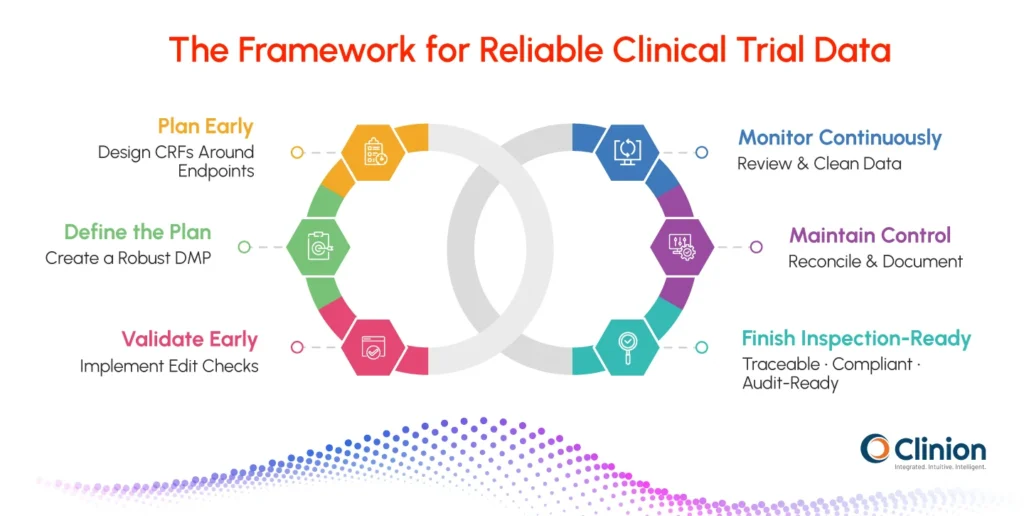
- Build quality in from the start: Design CRFs, databases, and edit checks around protocol requirements to minimize downstream issues.
- Maintain a clear Data Management Plan (DMP): Define processes, responsibilities, validation procedures, and data handling requirements early in the study.
- Review and clean data continuously: Ongoing validation, query management, and reconciliation help identify issues before they affect timelines.
- Standardize data and terminology: Use industry standards and controlled dictionaries to improve consistency and regulatory readiness.
- Ensure traceability and documentation: Maintain complete audit trails, version control, and supporting records for inspection readiness.
- Leverage automation responsibly: Use AI and automation to improve efficiency while maintaining appropriate human oversight and validation.
Implementing these practices not only improves data quality but also demonstrates to regulators that the trial is under control and inspection‑ready.
Artificial Intelligence in Clinical Data Management
AI is becoming an important part of clinical data management because it can reduce repetitive manual work and help teams review data faster. In CDM, AI can support tasks such as anomaly detection, query prioritization, edit check recommendations, medical coding suggestions, vendor data mapping, and reconciliation of lab, imaging, ePRO, and wearable data.
Based on Clinion's experience with AI-assisted workflows, teams may reduce manual review effort by up to 70% and complete certain data review and reconciliation activities nearly 2x faster, especially in repetitive data review, reconciliation, and query management activities. However, these results depend on study complexity, data quality, system integration, validation approach, and human review requirements.
Human oversight remains essential. Data managers, medical reviewers, statisticians, and coders must review AI-generated outputs, confirm that recommendations make clinical and protocol sense, and ensure that automated decisions are traceable, auditable, and compliant. AI can flag risks, suggest actions, and prioritize work, but final responsibility for data quality and regulatory readiness remains with qualified clinical and data experts.
Used well, AI can help CDM teams clean data earlier, reduce query burden, improve reconciliation speed, and support faster database lock while keeping expert review at the center of the process.
Beyond Automation: How AI Is Redefining Clinical Data Management
Explore how AI in clinical data management supports continuous data monitoring, anomaly detection, data alignment, governance, and faster issue identification across modern clinical trials.
Conclusion
Clinical data management has moved beyond basic data cleaning. In modern trials, the real challenge is managing data from multiple sources, keeping every change traceable, and ensuring that the final dataset can be trusted for analysis and submission.
Strong CDM gives sponsors and CROs confidence that trial decisions are based on complete, consistent, and well-governed data. As studies become more complex, the most effective approach is one that combines connected technology, clear processes, automation where it adds value, and expert human oversight where judgment is required.
Ultimately, good clinical data management helps turn trial data into reliable evidence.
External Resources