
- Summary
- What Is AI in Clinical Data Management?
- How Clinical Data Management Has Evolved and Why AI Matters Now
- Managing Distributed Clinical Trial Data: The Core Challenges
- Why Rule-Based Automation Is No Longer Enough for Clinical Data Management
- What Are the Benefits of AI in Clinical Data Management?
- Main Applications of AI Across the CDM Lifecycle
- How Is AI Changing the Clinical Data Manager's Role?
- Human Oversight and AI Governance in CDM
- What Are the Risks and Regulatory Considerations?
- How Do You Prepare a CDM Environment for AI Integration?
- What Measurable Impact Can AI Have in CDM?
- Conclusion
- External References
Summary
AI in clinical data management helps teams review trial data faster, detect anomalies earlier, prioritize queries, support coding, and reconcile data from sources such as EDC, labs, imaging, ePRO, wearables, and safety systems. It reduces repetitive manual work, but final review, interpretation, and accountability remain with qualified clinical and data experts.
What Is AI in Clinical Data Management?
AI in clinical data management refers to the use of machine learning, natural language processing, and pattern recognition within CDM workflows. It supports how clinical trial data is reviewed, validated, reconciled, coded, and prepared for analysis.
In practice, AI works as a decision-support layer. It can surface unusual data patterns, identify likely discrepancies, suggest coding options, compare records across systems, and help teams focus attention on higher-risk issues.
This matters because modern trials generate data from many sources, including EDC systems, ePRO/eCOA tools, laboratories, imaging vendors, wearables, RTSM platforms, safety systems, and electronic health records. AI helps CDM teams manage this complexity without removing human oversight from data quality decisions.
What Is Clinical Data Management? A Complete Guide for Clinical Trials
Understand the complete clinical data management process, including data collection, validation, query management, CDMP, CDMS, compliance, database lock, and the growing role of AI in modern trials.
How Clinical Data Management Has Evolved and Why AI Matters Now
Understanding where AI fits in CDM requires understanding the trajectory that brought the field here.
- The paper era established the foundational principles: structured data collection, source data verification, query management, and controlled review. Every process was sequential because the medium demanded it.
- The EDC era digitized collection and introduced edit checks, automated transfers, and real-time site access. It made data faster to capture, but did not fundamentally change the review model. The teams still worked through listings, reconciled data at milestones, and concentrated effort on the database lock.
- The current environment is defined by data diversity, not just data volume. Studies now draw from a far broader range of sources than EDC platforms were originally designed to handle alone. Data from labs, imaging, wearables, registries, and external databases must be integrated, standardized, and contextualized before it becomes analysis-ready.
This is the gap that rule-based automation cannot close on its own. Edit checks validate what they are configured to find. They do not recognize emerging cross-source patterns, assess context, or adapt when data behavior shifts mid-study.
AI helps close this gap by identifying patterns, relationships, and exceptions across large datasets faster than manual review or fixed rules alone.
Managing Distributed Clinical Trial Data: The Core Challenges
The shift toward distributed data collection is not a future trend. It is the current operational reality for most sponsors and CROs running multi-site or multi-source trials. Today, data arrives from a far broader range of sources, including:
- Electronic health records (EHRs)
- Laboratory systems
- Imaging platforms
- Wearables and connected devices
- Patient-reported channels
In many modern trials, a significant share of study data now comes from sources outside traditional EDC environments. This external data must be integrated, standardized, and contextualized before it becomes analysis-ready.
As data sources expand, operational models must shift from linear handling to coordinated data orchestration.
| Traditional Model | Current Environment |
| Data primarily entered into one system | Data originates across multiple ecosystems |
| Structured inputs dominate | Structured and unstructured inputs coexist |
| Review follows data entry | Review requires alignment before evaluation |
| Reconciliation is limited | Continuous reconciliation becomes necessary |
CDM teams must now manage not just data quality within their EDC system, but data coherence across an entire ecosystem of connected platforms while maintaining the audit trails, traceability, and compliance standards that regulatory submissions require.
AI-assisted reconciliation, cross-source comparison, and continuous monitoring directly address this challenge. They do not eliminate the need for expert review, they make that review faster, more targeted, and less dependent on catching problems at the end.
Why Connected eClinical Workflows Matter in Modern Clinical Trials
Learn how integrated eClinical platforms reduce duplicate entry, improve workflow continuity, support faster amendments, and keep EDC, RTSM, ePRO, CTMS, eSource, eTMF, and safety systems aligned across the trial lifecycle.
Why Rule-Based Automation Is No Longer Enough for Clinical Data Management
Automation has already improved clinical data management in meaningful ways:
- Edit checks reduced repetitive validation.
- Data transfer routines accelerated aggregation.
- Standard workflows improved consistency.
Yet most automation relies on predefined rules. It executes what it has been instructed to look for. It does not evaluate context, identify emerging relationships, or adapt when patterns shift.
This matters when trial data is fragmented across systems, when discrepancies emerge gradually across visits or patient cohorts, or when understanding whether something is actually a problem requires clinical and operational context.
A rule flags an out-of-range laboratory value. It cannot assess whether that value fits a broader pattern across sites, whether it reflects a protocol deviation or a lab instrument issue, or whether it warrants a query or simply a note.
As data diversity has increased, CDM teams have encountered the edges of what rule-based systems handle well:
- Queries still require significant manual interpretation before action.
- Cross-dataset comparisons depend heavily on individual reviewer expertise and availability.
- Pattern recognition across large volumes of incoming data cannot keep pace with the rate of collection.
- Automation accelerates execution but does not change how insight is discovered.
AI adds a layer of contextual evaluation above rule execution. It identifies relationships, trends, and exceptions that are harder to specify in advance and does so continuously, rather than only when a review is scheduled.
What Are the Benefits of AI in Clinical Data Management?
The headline benefit of AI in CDM is not speed. It is the ability to maintain data quality and oversight standards as trial complexity increases, without requiring proportional growth in manual review effort. In practical terms, AI improves data review by shifting teams from uniform effort across all records to risk-stratified attention, focusing expert time on what matters most while monitoring lower-risk data continuously in the background.
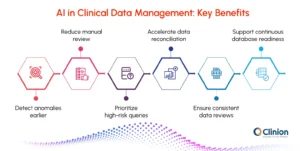
Key operational benefits include:
Earlier anomaly detection:
AI identifies unusual patterns, cross-source mismatches, and emerging quality signals before they accumulate into larger problems requiring intensive resolution.
Reduced manual review burden:
Repetitive detection tasks such as checking listings, reconciling external data, and tracking query aging can be partly automated, redirecting expert time toward evaluation and decision-making.
Smarter query prioritization:
Queries can be ranked by risk, urgency, and likely downstream impact rather than reviewed in the order they were generated.
Faster reconciliation:
External data from labs, imaging, ePRO, wearables, and safety systems can be compared against EDC records continuously rather than at scheduled milestones.
Greater consistency:
AI applies review logic uniformly across sites, studies, and data sources, reducing the variability that comes from manual review under time pressure.
Progressive database lock readiness:
Continuous monitoring distributes clean-up effort throughout the study, reducing the intensity and risk of late-stage data preparation.
Main Applications of AI Across the CDM Lifecycle
AI supports clinical data management at multiple stages, from study setup through database lock. The most effective applications reduce detection and coordination burden while preserving human review for consequential decisions.
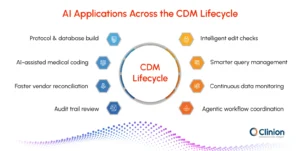
Protocol and Database Build Support
AI can assist with reviewing protocol documents, identifying required data points, and suggesting database configurations or edit check requirements. This helps study teams set up databases faster and reduces missed dependencies during startup, a stage where errors are expensive to correct later.
Edit Check Recommendations
Rather than relying solely on historical templates, AI can suggest or refine edit checks based on protocol requirements and expected data relationships. Human review remains necessary to confirm clinical relevance and avoid generating excessive query volume.
Medical Coding Support
Natural language processing interprets verbatim adverse event, medical history, and concomitant medication terms and recommends standardized MedDRA or WHODrug classifications. Coders review and approve all final coding decisions, particularly in complex or safety-sensitive cases where context matters.
Query Management and Prioritization
AI identifies likely discrepancies, groups similar issues, and ranks queries by risk and potential downstream impact. This reduces repetitive manual review and helps prevent query backlogs from accumulating in the weeks before database lock, one of the most common sources of timeline pressure in CDM operations.
Vendor Data Reconciliation
AI compares external data from laboratories, imaging platforms, ePRO tools, wearables, RTSM systems, and safety databases against EDC records. It surfaces missing entries, duplicate records, visit mismatches, inconsistent identifiers, and timing discrepancies that would otherwise require labor-intensive manual cross-checking.
Continuous Data Monitoring
Instead of concentrating review effort at milestones, AI monitors incoming data throughout the study. Issues are flagged closer to when they occur, reconciliation becomes routine rather than intensive, and database lock becomes a confirmation of ongoing quality rather than a discovery process.
Audit Trail and Quality Review
AI can review audit trails, data corrections, and recurring change patterns to identify unusual activity or process gaps that may indicate site-level training issues or data integrity risks. Final interpretation and accountability remain with qualified personnel.
Agentic AI: Coordinating Workflows at Scale
Beyond single-task automation, agentic AI represents a further evolution now being deployed in clinical data management. Rather than a single AI model handling one task in isolation, agentic architectures use multiple AI agents working in coordination; one assembling a cross-source data view, another triggering a reconciliation workflow, a third flagging downstream dependencies as new data enters the environment.
These systems do not make autonomous clinical decisions. Every action is rules-governed, auditable, and reviewable. The objective is to reduce the coordination burden created by increasingly interconnected data streams, managing the handoffs between tasks that currently consume significant operational effort. Early implementations suggest that agentic approaches help organizations maintain workflow continuity across platforms while preserving the validation and oversight structures that regulated environments require.
Explore Agentic AI for Clinical Data Management
See how Clinion’s agentic AI capabilities support clinical data teams with faster data review, anomaly detection, query prioritization, medical coding, reconciliation, and audit-ready trial workflows.
How Is AI Changing the Clinical Data Manager's Role?
AI is not reducing the need for clinical data managers. It is redirecting where their expertise is applied, and in most implementations, expanding the scope of what they are responsible for.
Traditionally, CDM teams spent significant time on detection: finding discrepancies, checking listings, reconciling external data, and tracking query aging. AI can handle much of that detection work, surfacing likely issues earlier and organizing review priorities.
This shifts CDM expertise toward:
- Interpreting AI-generated signals within clinical and protocol context: understanding whether a flagged pattern represents a real problem or expected variation.
- Reviewing and approving AI-suggested queries, coding outputs, and reconciliation flags before they become actions.
- Monitoring data quality trends across sites, systems, and time periods, and coordinating operational responses.
- Ensuring AI-supported workflows remain validated, traceable, and compliant with applicable regulations.
- Engaging earlier with clinical, safety, statistical, and operational teams to align on data quality expectations.
- Maintaining accountability for final data quality and the integrity of the dataset submitted for analysis.
The expertise, judgment, and regulatory awareness that define strong CDM practice remain central. AI expands the capacity of teams to manage scale. It does not diminish the need for the people who govern that scale.
Human Oversight and AI Governance in CDM
Human oversight in AI-supported CDM is not a design preference; it is a regulatory expectation and a quality requirement. AI flags risks, suggests actions, and prioritizes work. Qualified professionals remain responsible for interpretation, approval, and accountability.
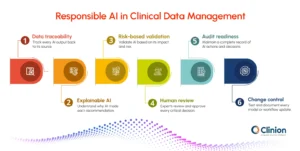
Effective AI governance in a CDM environment should establish:
Clear data lineage: Every AI output must be traceable to the source data, model version, and configuration that produced it, so results can be reconstructed and explained if questioned during an inspection.
Transparent rationale: Reviewers should understand why a record, query, code, or discrepancy was flagged. Opaque outputs undermine the informed human review that governance requires.
Risk-based validation: AI-enabled workflows should be tested according to their potential impact on data quality, patient safety, and regulatory readiness, with documentation commensurate with that risk.
Human-in-the-loop review: Data managers, coders, medical reviewers, and statisticians must review AI-supported outputs before they are accepted. The system recommends. The expert decides.
Auditability: AI recommendations, user decisions, overrides, and final actions must be documented and available for inspection review.
Change control: Model updates, rule changes, and workflow modifications must be versioned, tested, and governed through established change management processes, the same standards applied to any validated system change.
AI should operate as a decision-support layer within a validated CDM environment, not as an independent system operating outside established quality frameworks.
What Are the Risks and Regulatory Considerations?
AI adoption in clinical data management carries risks that require deliberate management. Clinical trial data underlie patient safety determinations, statistical analysis, and regulatory submissions; the consequences of data quality failures are consequential at multiple levels.
Risks to manage include:
- AI recommendations accepted without sufficient human review, particularly when outputs appear confident.
- Poor model performance on study designs, therapeutic areas, or data types outside the model's training scope.
- Insufficient explainability behind flagged records makes informed reviewer decisions difficult.
- Over-reliance on automation that gradually reduces the scrutiny applied to AI outputs over time.
- Incomplete audit trails or documentation gaps that create vulnerabilities during regulatory inspections.
- Privacy and data security risks when sensitive patient information is processed through AI systems.
- Workflow drift when models or configurations change without formal change control processes.
Sponsors and CROs evaluating AI tools should assess validation evidence, data privacy controls, access permissions, model monitoring procedures, audit trail completeness, change management frameworks, and alignment with GCP, 21 CFR Part 11, HIPAA, GDPR, and current FDA and ICH guidance on data integrity and AI use in regulated research.
The goal is not simply to adopt AI. The goal is to adopt AI in a way that is controlled, explainable, validated, and inspection-ready from the outset.
How Do You Prepare a CDM Environment for AI Integration?
Organizations that see meaningful results from AI in CDM typically share one characteristic: they treated adoption as an operational and governance initiative, not a technology deployment. The systems matter less than the readiness of the environment they are being introduced into.
Identify High-Friction Workflows First
Begin with tasks that consume disproportionate time and follow repeatable patterns such as data reconciliation, query review, medical coding, and cross-dataset comparison. These offer the clearest return and the most straightforward validation path.
Standardize Data Structures
AI performs more reliably when data is consistently captured, mapped, and labeled. Standardized CRFs, controlled terminology, and clear data transfer specifications improve both AI accuracy and downstream analysis readiness. Inconsistent upstream data produces inconsistent AI outputs.
Address Integration Gaps Before Deployment
AI is most useful when it can operate across EDC, ePRO, lab, imaging, RTSM, safety, and analytics systems without creating disconnected parallel workflows. Integration gaps limit what AI can see and, therefore, what it can surface. Resolving them before AI deployment is more efficient than working around them after.
Define Governance Structures Before Go-Live
Model validation procedures, human review requirements, performance monitoring schedules, change control processes, and documentation ownership should all be established before AI is deployed, not developed reactively after problems arise.
Prepare Teams to Evaluate AI Outputs
The skill shift in AI-assisted CDM is from performing manual detection tasks to critically evaluating machine-supported outputs. Teams need to understand how AI workflows operate, what outputs mean, when to accept suggestions, and when to escalate or override. This requires training and clear operating procedures, not just access to the system.
Measure What Actually Changes
Define success metrics before deployment: manual review hours, reconciliation turnaround time, query aging, coding review time, database lock timeline, and late-stage escalation frequency. Measuring these before and after provides the evidence base for continued adoption and validation documentation.
What Measurable Impact Can AI Have in CDM?
Measuring AI impact requires operational specificity. Broad claims about efficiency gains are common across vendor marketing material. What matters for sponsors and CROs evaluating these tools is whether outcomes are measurable, attributable, and consistent across comparable study types.
Metrics that reflect genuine CDM impact include:
- Manual review hours per study or per 1,000 incoming data points
- Reconciliation turnaround time before and after AI-assisted comparison
- Query volume, query aging, and average time to resolution
- Speed of anomaly detection relative to data entry timing
- Medical coding suggestion acceptance rate
- Volume of discrepancies identified before versus after milestone reviews
- Database lock timeline relative to historical comparators
- Late-stage clean-up effort and escalation frequency
- Reviewer workload distribution and consistency across the study team
In selected AI-assisted CDM workflows, teams can reduce manual review effort by up to 70% and complete certain review activities nearly 2x faster, especially in repetitive tasks such as anomaly review, reconciliation, query prioritization, and coding support. Actual results depend on study design, data quality, integrations, and validation approach.
Conclusion
AI is becoming a practical, operational component of clinical data management; not a future capability, but one that is already changing how CDM teams manage data review, reconciliation, coding, and oversight across the trial lifecycle. The organisations seeing the most meaningful results are those that have approached adoption deliberately: identifying the right workflows, establishing governance before deployment, and keeping qualified experts accountable for every consequential decision.
The role of clinical data management is not diminishing as AI matures. It is becoming more demanding and more strategically important as the volume, variety, and velocity of trial data continue to grow.
AI-Powered Clinical Data Management with Clinion
Clinion’s AI-native platform supports clinical data management across study build, continuous monitoring, reconciliation, medical coding, and database lock readiness. The platform is designed for regulated clinical workflows, with human review, traceability, and audit readiness built into the process. For sponsors and CROs managing growing trial complexity, Clinion helps reduce repetitive manual review while keeping qualified teams in control of data quality decisions.
External References