
- Summary
- What Is EDC System Migration?
- What Should Be Included in an EDC Migration?
- Common EDC Migration Approaches
- How to Plan and Execute an EDC System Migration
- Common EDC Migration Risks and How to Mitigate Them
- How to Evaluate an EDC Migration Partne
- Conclusion
- External References
Summary
Whether you're replacing a legacy platform, consolidating studies, or adopting a modern AI-enabled EDC, migration is one of the most complex phases of a clinical trial technology transition. Beyond transferring clinical data, sponsors and CROs must preserve study configurations, metadata, auditability, and regulatory compliance without disrupting ongoing trial operations. This guide explains how to plan, execute, and validate a successful EDC migration.
What Is EDC System Migration?
EDC system migration is the process of transferring an existing clinical study or portfolio from one Electronic Data Capture (EDC) system to another while preserving the integrity, traceability, and usability of clinical trial data. Unlike implementing an EDC for a new study, migration involves moving not only participant data but also the study framework that supports its collection, management, and review.
Learn how EDC platforms support structured data collection, validation, query management, audit trails, user access, and clinical study oversight.
A Complete Guide to Electronic Data Capture in Clinical Trials
Learn how EDC systems support clinical trial data capture, eCRF design, edit checks, query management, audit trails, data quality, compliance, and faster database readiness.
A typical EDC migration extends beyond transferring electronic case report form (eCRF) data. Depending on the study and the destination platform, it may also include study metadata, configurations, audit trails, user permissions, and connected system integrations. Each component must remain complete, consistent, and accurately linked to ensure the migrated study continues to function as intended.
Understanding what EDC migration involves is the first step. Equally important is knowing how it differs from implementing an EDC for a new clinical study, as each process follows a distinct approach and set of requirements
A guide to evaluating an existing EDC environment, identifying operational and technical limitations, assessing migration readiness, and determining whether a system transition is required.
Switching to a New EDC System: What Clinical Teams Should Know
Explore key considerations for moving to a new EDC system, including data migration, validation, study continuity, user training, compliance, and reducing disruption during clinical trial operations.
EDC Migration vs. EDC Implementation
While both involve deploying an EDC system, implementation and migration serve different purposes and occur at different stages of a clinical trial.
EDC implementation involves configuring and deploying an Electronic Data Capture system for a new clinical study. This includes designing electronic case report forms (eCRFs), setting up study workflows, configuring edit checks, defining user roles, integrating external systems, and validating the environment before participant enrollment begins.
EDC migration, on the other hand, focuses on transferring an existing study from one EDC platform to another. Instead of building a study from scratch, the goal is to recreate the study environment while preserving existing clinical data, study configurations, metadata, audit trails, and other critical records. The migrated study must continue to function as intended without compromising data integrity, traceability, or regulatory compliance.
The distinction becomes especially important for ongoing clinical trials. While implementation establishes a new environment, migration must account for historical data, active participants, open queries, system integrations, and validated study configurations to ensure continuity throughout the transition.
EDC Implementation | EDC Migration |
Configures an EDC for a new study | Transfers an existing study to a new EDC |
Starts with a blank study environment | Preserves an existing study environment |
No historical clinical data | Existing clinical data is retained |
Builds study configurations from scratch | Recreates and validates existing configurations |
Validation focuses on the newly configured system | Validation confirms migrated data and study assets remain complete, accurate, and traceable |
What Should Be Included in an EDC Migration?
A successful EDC system migration involves far more than transferring participant records from one platform to another. Every component that supports the collection, management, review, and reporting of clinical trial data should be assessed for migration. Overlooking critical study assets can lead to broken workflows, incomplete records, or compliance risks after go-live.
While the migration scope varies depending on the study, regulatory requirements, and the capa bilities of the source and destination EDC systems, most migrations include the following:
Clinical Data
This includes participant records, visit data, laboratory results, adverse events, concomitant medications, and other study data collected throughout the trial. Maintaining the accuracy, completeness, and relationships between these records is essential to preserve the integrity of the clinical database and support reliable study outcomes.
Study Configuration and Metadata
Beyond clinical data, the study framework that defines how data is collected and managed must also be migrated. This may include electronic Case Report Forms (eCRFs), visit schedules, edit checks, workflow rules, user roles and permissions, variable definitions, code lists, and other metadata. Preserving these elements helps ensure the migrated study functions consistently and continues to support existing study processes.
How AI Is Changing eCRFs and Clinical Data Management
Understand how eCRFs support structured clinical trial data capture, real-time edit checks, query resolution, data quality, and how AI is enhancing eCRF design, standardization, and database readiness.
Learn how eCRFs structure protocol-required data, apply validation rules, support query management, and maintain consistent data collection across study sites.
Regulatory Records
Regulatory records provide the traceability needed to demonstrate how clinical data has been collected, reviewed, and modified throughout the study. Depending on the migration strategy, this may include audit trails, electronic signatures, query history, form statuses, and reason-for-change records. Preserving these records helps maintain transparency and supports regulatory inspections.
21 CFR Part 11 Compliance in Clinical Trials
Learn how 21 CFR Part 11 applies to electronic records, electronic signatures, audit trails, system validation, access controls, and compliant clinical trial data management.
Learn about the regulatory requirements for electronic records, electronic signatures, audit trails, system validation, access controls, and long-term record retrieval.
System Integrations
Modern EDC systems rarely operate in isolation. They often exchange data with other clinical trial applications, such as CTMS, RTSM, ePRO, eConsent, laboratory information systems, medical imaging repositories, and safety databases. These integrations should be assessed, migrated where required, and validated to ensure uninterrupted data exchange and operational continuity across the clinical trial ecosystem.
Because these components are interconnected, EDC system migration requires a structured approach rather than a simple data transfer.
Common EDC Migration Approaches
There is no one-size-fits-all approach to EDC system migration. The most appropriate strategy depends on factors such as study status, data volume, regulatory requirements, acceptable downtime, and the complexity of connected systems. Selecting the right approach early helps reduce operational risk and ensures the migration aligns with study objectives.
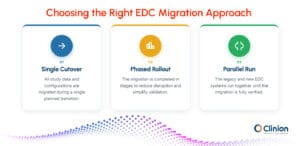
Single Cutover Migration
A single cutover, sometimes called a "big bang" migration, transfers all required study data and configurations to the new EDC during a planned transition window. This approach is often suitable for smaller studies or situations where downtime can be carefully managed.
Phased Migration
A phased migration transfers studies, sites, or system components in stages rather than all at once. This reduces operational risk, allows teams to resolve issues incrementally, and is often preferred for large study portfolios or complex migration projects.
Parallel Migration
In a parallel migration, both the legacy and new EDC systems operate simultaneously for a defined period. This provides additional time to validate migrated data, compare system outputs, and build confidence before fully transitioning to the new platform. Although more resource-intensive, it can be beneficial for high-risk or ongoing clinical studies.
Which Approach Is Best?
The right migration approach depends on the study's complexity, regulatory obligations, operational timelines, and organizational resources. Many sponsors and CROs evaluate these factors during migration planning to determine the strategy that best balances risk, efficiency, and study continuity.
How to Plan and Execute an EDC System Migration
Every EDC migration is unique, but most follow a structured process that minimizes operational disruption. The following steps outline a practical framework for planning, executing and validating an EDC system migration.
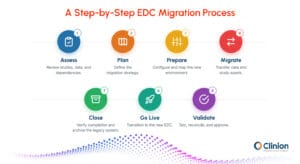
Step 1: Assess the Existing EDC Environment
Objective: Define the migration scope, identify system dependencies, and assess data readiness before planning begins.
What Happens in This Step: Begin by evaluating the existing EDC environment to understand what will be migrated. Review the study portfolio, assess clinical data quality, identify connected systems and integrations, and inventory study assets such as eCRFs, edit checks, workflows, metadata, and user roles. This assessment should also capture any regulatory, technical, or operational constraints that could influence the migration strategy.
Step 2: Define the Migration Strategy
Objective: Develop a structured migration strategy that aligns with study objectives, timelines, and regulatory requirements.
What Happens in This Step: Define the migration scope and determine the most appropriate migration approach based on the study's complexity and operational needs. Establish stakeholder responsibilities, governance processes, project timelines, validation milestones, and communication plans so that every team understands its role before execution begins.
Step 3: Prepare for Migration
Objective: Prepare both the source and destination environments for a secure and accurate migration.
What Happens in This Step: Configure the destination EDC, create source-to-target mappings for clinical data and study configurations, and document any required data transformation rules. Before migration begins, verify system backups, confirm migration readiness, and ensure the necessary technical and operational prerequisites have been completed.
Step 4: Execute the Migration
Objective: Transfer clinical trial data and study assets to the new EDC while maintaining complete traceability.
What Happens in This Step: Execute the approved migration plan by transferring clinical data, study configurations, metadata, and supporting records into the destination EDC. Where applicable, preserve audit trails, electronic signatures, queries, and form statuses while re-establishing integrations with connected systems. Throughout the migration, document each activity and monitor progress to identify and address any issues quickly.
Step 5: Validate and Test the Migration
Objective: Confirm that the migrated EDC environment is complete, accurate, and ready for production use.
What Happens in This Step: Validate the migrated environment by reconciling records against the source system and testing study functionality, including eCRFs, edit checks, workflows, user permissions, and integrations. User Acceptance Testing (UAT) should also be performed to confirm that study teams can carry out their routine activities before the system goes live.
Step 6: Cutover and Go-Live
Objective: Transition from the legacy EDC to the new platform with minimal disruption to ongoing clinical trials.
What Happens in This Step: Implement the approved cutover plan, communicate the transition to all stakeholders, and activate the new EDC environment. Monitor system performance, user access, integrations, and study activities closely during the initial go-live period, while keeping rollback procedures ready if unexpected issues occur.
Step 7: Verify and Close the Migration
Objective: Verify the success of the migration and formally close the project.
What Happens in This Step: Conduct a final review to confirm the completeness and accuracy of migrated data, study configurations, and validation records. Once all stakeholders approve the migration, archive or decommission the legacy EDC according to organizational and regulatory requirements, complete the migration documentation, and formally close the project.
Common EDC Migration Risks and How to Mitigate Them
Many migration challenges arise not from the transfer itself but from insufficient planning and validation. A structured migration strategy, comprehensive testing, and thorough documentation help minimize risks while maintaining study continuity and regulatory compliance.
Migration Risk | Why It Happens | How to Mitigate It |
Data integrity issues | Missing or incorrect mappings, unsupported data formats, or overlooked study assets can result in incomplete or inaccurate clinical data after migration. | Perform comprehensive source-to-target mapping, execute test migrations, and reconcile migrated data against the source system before go-live. |
Regulatory non-compliance | Failure to preserve audit trails, electronic signatures, or validation documentation can create compliance gaps and affect inspection readiness. | Ensure regulatory records are migrated where applicable and maintain complete migration, validation, and audit documentation. |
Validation failures | Insufficient testing may leave data discrepancies, configuration errors, or functional issues undetected before production use. | Perform data reconciliation, functional testing, integration testing, and User Acceptance Testing (UAT) before approving the migration. |
Operational disruption | Poorly planned cutovers or inadequate communication can interrupt site activities and delay ongoing clinical trials. | Schedule migrations during low-activity periods, communicate timelines in advance, and establish rollback procedures to minimize disruption. |
Broken system integrations | Connected systems such as CTMS, RTSM, ePRO, laboratory systems, or safety platforms may fail to exchange data after migration. | Identify all integrations early, test interfaces thoroughly, and verify end-to-end data exchange before production use. |
Loss of study configurations | eCRFs, edit checks, workflows, user roles, or code lists may not be fully recreated in the destination EDC. | Inventory all study configurations during planning and validate them as part of migration testing. |
How to Evaluate an EDC Migration Partne
Migrating to a new EDC system is more than a technical exercise. The right migration partner should have the expertise, processes, and validation capabilities to ensure a smooth transition while protecting study continuity, data integrity, and regulatory compliance. As you evaluate potential vendors, consider the following questions.
Does the vendor have proven migration experience?
Not all EDC providers have experience migrating studies from legacy systems or competing platforms. Ask whether they have handled migrations for studies similar to yours, including active, completed, or multi-study programs, and request examples or references where possible.
How do they approach migration planning?
A successful migration starts with a well-defined plan. Understand how the vendor assesses the source environment, defines migration scope, develops timelines, identifies dependencies, and prepares for potential risks before execution begins.
What validation processes do they follow?
Migration should always be supported by comprehensive validation. Ask how the vendor performs data reconciliation, functional testing, User Acceptance Testing (UAT), and documentation to verify that migrated data and study configurations remain accurate and complete.
Can they preserve regulatory records?
Clinical trials rely on complete traceability. Confirm whether the migration process preserves audit trails, electronic signatures, form statuses, and other regulatory records where required, and how compliance is demonstrated throughout the project.
How do they minimize study disruption?
If active studies are being migrated, ask how the vendor plans cutover activities, manages system downtime, supports study sites, and reduces operational disruption during the transition.
What support is available after migration?
Migration doesn't end at go-live. Understand what post-migration support is available, including issue resolution, performance monitoring, user assistance, and long-term maintenance of the new EDC environment.
Conclusion
An EDC system migration is more than moving clinical trial data from one platform to another. It requires careful planning, thorough validation, and close coordination to ensure data integrity, regulatory compliance, and uninterrupted study operations. From assessing the existing environment and defining the migration strategy to validating the new system and completing the final cutover, every stage plays a critical role in a successful transition. A well-executed migration not only protects existing study data but also creates a stable foundation for future study execution and scalability.
Whether you're replacing a legacy EDC or consolidating studies onto a modern platform, a structured migration approach helps reduce risk, maintain study continuity, and build confidence in the new system.
If you're planning an EDC migration, partnering with a provider that combines proven migration expertise with a modern, AI-enabled platform can simplify the process and help your teams transition with confidence.
How Clinion Supports EDC System Migration
Clinion helps sponsors and CROs plan, validate, and execute EDC migrations with a structured, risk-based approach. From assessing the existing study environment and mapping clinical data to validating migrated records and supporting controlled go-live, our team works to ensure data integrity, regulatory compliance, and study continuity throughout the transition. Combined with an AI-enabled unified EDC platform, Clinion simplifies the move from legacy systems without compromising ongoing trial operations.
External References