
- Summary
- Introduction
- ePRO vs eCOA at a Glance
- Why Are ePRO and eCOA Often Confused?
- How ePRO Fits Within the eCOA Framework
- Selecting the Right Assessment Strategy for Your Study
- Common Misconceptions About ePRO and eCOA
- Conclusion
Summary
ePRO and eCOA are closely related but not interchangeable. eCOA is the broader framework for electronically collecting clinical outcome data, while ePRO is one of the four assessment types within that framework that captures information reported directly by patients. Every ePRO assessment is an eCOA, but not every eCOA assessment is an ePRO. The eCOA framework also includes clinician-reported (eClinRO), observer-reported (eObsRO), and performance outcome (ePerfO) assessments.
Introduction
The terms ePRO and eCOA are frequently used interchangeably in clinical research, often leading to the misconception that they describe the same thing. While both involve the electronic collection of clinical outcome data, they differ in scope and purpose.
Understanding this distinction is essential during protocol design because it influences how clinical endpoints are measured, who reports outcome data, and whether a study requires a single assessment type or a broader outcome assessment strategy. It also helps sponsors evaluate technologies that align with the study's data collection requirements.
This article explains the relationship between ePRO and eCOA, compares their key differences, and explores when each is used in clinical trials.
Our guide to ePRO in clinical trials explains how electronic patient reporting works, its key benefits and the considerations involved in implementation.
The Definitive Guide to ePRO in Clinical Trials
Learn how ePRO supports patient-reported outcome collection, improves data quality, enables remote participation, reduces site burden, and strengthens patient engagement in modern clinical trials.
ePRO vs eCOA at a Glance
Although ePRO and eCOA are closely related, they differ in scope, the type of data they collect, and how they are used in clinical trials. The table below summarizes the key differences.
Aspect | ePRO | eCOA |
| Definition | Electronic Patient-Reported Outcome | Electronic Clinical Outcome Assessment |
| Scope | One type of electronic outcome assessment | Framework for electronically collecting all clinical outcome assessments |
| Who reports the data? | Patients | Patients, clinicians, caregivers/observers, or participants performing standardized tasks |
| Assessment types | Patient-reported outcomes only | ePRO, eClinRO, eObsRO, and ePerfO |
| Primary objective | Capture the patient's perspective on symptoms, health status, treatment experience, or quality of life | Capture clinical outcomes from one or more sources, depending on the study endpoints |
| Typical use | Studies where patient-reported outcomes are primary or secondary endpoints | Studies requiring one or multiple clinical outcome assessment types |
| Integration | Often integrated with EDC or an eCOA platform | May integrate multiple assessment types with EDC and other eClinical systems |
| Relationship | One component of the eCOA framework | Includes ePRO as one of four assessment types |
While the table highlights the differences, the relationship between ePRO and eCOA is often misunderstood. Because ePRO is the most widely used type of electronic outcome assessment, many people use the terms interchangeably. In reality, ePRO represents only one part of the broader eCOA framework.
ePRO and EDC Integration: A Practical Guide for Clinical Trials
Learn how ePRO and EDC integration connects patient-reported outcomes with clinical trial data capture, helping teams reduce manual reconciliation, improve data quality, support real-time review, and maintain cleaner study workflows.
Why Are ePRO and eCOA Often Confused?
The confusion between ePRO and eCOA stems from their close relationship and frequent use together in clinical trials. Although they refer to different concepts, many vendors, study teams, and industry discussions use the terms interchangeably, making it difficult to distinguish between them.
One reason is that ePRO is the most widely used type of electronic clinical outcome assessment. In many studies, patient-reported outcomes are the primary or only outcome assessments being collected electronically. As a result, sponsors and sites may refer to the entire electronic assessment process as "ePRO," even when it is technically part of a broader eCOA strategy. The terminology used by technology providers also contributes to the confusion. Some platforms are marketed as ePRO solutions because patient-reported questionnaires are their primary capability, while others describe similar functionality under the broader eCOA label. Without understanding the relationship between the two terms, it is easy to assume they describe the same technology.
The distinction becomes clearer when viewed from a structural perspective. eCOA describes the overall framework for electronically collecting clinical outcome assessments, whereas ePRO refers specifically to assessments completed directly by patients. Depending on the study, ePRO may be the only assessment required, or it may be combined with clinician-, observer-, or performance-reported assessments as part of a comprehensive eCOA strategy.
Understanding this relationship helps sponsors communicate more precisely during protocol design, technology evaluation, and study planning, ensuring that the selected assessment approach aligns with the objectives of the trial.
How ePRO Fits Within the eCOA Framework
The simplest way to understand the relationship between ePRO and eCOA is to think of eCOA as the overarching framework for electronically collecting clinical outcome assessments and ePRO as one assessment type within that framework.
What Is eCOA in Clinical Trials?
Learn how eCOA supports electronic clinical outcome assessment collection, including ePRO, eClinRO, eObsRO, and ePerfO, while improving data quality, patient participation, compliance, and real-time study visibility.
Clinical outcome assessments can be completed by different individuals depending on what the study is designed to measure. While some outcomes are best reported directly by patients, others require clinical evaluation, caregiver observations, or standardized performance tests. The eCOA framework brings these assessment types together within a single electronic data collection approach.
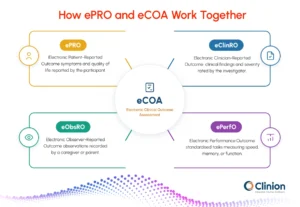
The assessment type selected depends on who is best positioned to evaluate each clinical endpoint. Within the eCOA framework, four assessment types are available:
ePRO (Electronic Patient-Reported Outcome)
ePRO captures information reported directly by participants without interpretation by investigators, caregivers, or healthcare professionals. It is commonly used to assess symptoms, pain, fatigue, treatment satisfaction, and health-related quality of life, providing insight into the participant's experience throughout the study.
eClinRO (Electronic Clinician-Reported Outcome)
eClinRO includes assessments completed by qualified healthcare professionals based on clinical observations or medical judgment. Examples include disease severity scales, physician global assessments, neurological examinations, and tumor response evaluations.
eObsRO (Electronic Observer-Reported Outcome)
eObsRO captures observations made by parents, caregivers, or other observers when participants are unable to reliably report their own outcomes. This approach is frequently used in pediatric studies and trials involving cognitive or neurological disorders.
ePerfO (Electronic Performance Outcome)
ePerfO measures a participant's ability to perform standardized physical or cognitive tasks under controlled conditions. Common examples include timed walking tests, grip strength measurements, mobility assessments, and cognitive performance evaluations.
Although each assessment type serves a different purpose, they are often used together within a single clinical trial. Depending on the study objectives and endpoints, sponsors may collect data from one or multiple sources to build a more comprehensive understanding of treatment effectiveness.
Selecting the Right Assessment Strategy for Your Study
One of the most common misconceptions in clinical research is that sponsors must choose between ePRO and eCOA. In reality, ePRO is one assessment type within the broader eCOA framework, so the decision is not about selecting one over the other. Instead, it is about determining whether patient-reported outcomes alone are sufficient or whether the study requires additional outcome assessments from clinicians, caregivers, or performance-based evaluations.
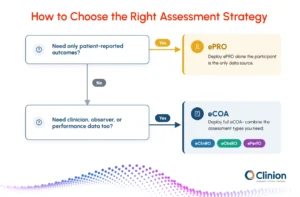
The assessment strategy should always be driven by the study objectives and protocol endpoints rather than the technology itself. The following questions can help determine the most appropriate approach.
Study Requirement | Assessment Strategy | Why |
Collects only patient-reported symptoms, quality of life, or treatment experience | ePRO may be sufficient | All required outcomes come directly from participants. |
Includes investigator assessments alongside patient-reported outcomes | eCOA with ePRO + eClinRO | Combines the patient's perspective with clinical evaluation. |
Involves pediatric participants or individuals unable to self-report reliably | eCOA with eObsRO | Caregivers or observers provide essential outcome data. |
Measures physical or cognitive performance in addition to participant-reported outcomes | eCOA with ePerfO | Objective performance assessments complement subjective patient reports. |
Requires multiple outcome assessment types within the same study | Comprehensive eCOA strategy | Supports data collection from multiple sources within a single electronic framework. |
The choice, therefore, is not between ePRO and eCOA as competing solutions. It is about selecting an assessment strategy that aligns with the clinical endpoints defined in the protocol. Some studies rely entirely on patient-reported outcomes, while others combine multiple assessment types to generate a more complete understanding of treatment effectiveness.
Common Misconceptions About ePRO and eCOA
Because ePRO and eCOA are closely related, they are often misunderstood during protocol planning and technology evaluation. Clarifying these misconceptions helps sponsors choose the right assessment strategy and communicate requirements more accurately across study teams.
Common Misconception | Reality |
ePRO and eCOA are the same thing. | ePRO is one assessment type within the broader eCOA framework. |
Every eCOA study uses all four assessment types. | Studies only include the assessment types required to measure their endpoints. |
ePRO can replace clinician or observer assessments. | ePRO captures the patient's perspective, while clinician, observer, and performance assessments measure different aspects of treatment outcomes. |
Choosing eCOA means every assessment type must be implemented. | Modern eCOA platforms allow sponsors to configure only the assessment types required by the study protocol. |
ePRO always requires a separate system. | In many modern clinical trials, ePRO is integrated within an eCOA platform and connected to EDC and other eClinical systems, enabling seamless data flow and reducing duplicate data entry. |
Understanding these distinctions helps sponsors avoid confusion during study planning, select technology that aligns with protocol requirements, and ensure that every endpoint is measured using the most appropriate assessment method.
Conclusion
Simplifying Patient-Reported Outcomes with Clinion ePRO
Clinion ePRO enables participants to electronically report symptoms, treatment experiences, and quality-of-life outcomes through an intuitive mobile application or web interface. It supports both Bring Your Own Device (BYOD) and provisioned device models, offers multilingual questionnaires for global studies, and can be deployed as a standalone solution or seamlessly integrated with Clinion EDC. This enables patient-reported data to flow directly into the study database, reducing manual transcription, eliminating duplicate data entry, and providing study teams with real-time access to high-quality outcome data.Capture patient-reported outcomes directly from any device
Clinion ePRO helps clinical teams collect patient responses through mobile, web, and BYOD workflows, with multilingual forms, automated reminders, secure syncing with Clinion EDC, real-time monitoring, and complete audit trails.
Explore Clinion ePRO Software