
- Summary
- What Is EU Annex 11?
- Which eClinical Systems Should Be Evaluated for EU Annex 11 Readiness?
- EU Annex 11 Compliance Checklist for eClinical Systems
- Common EU Annex 11 Compliance Gaps
- EU Annex 11 vs. 21 CFR Part 11
- Questions to Ask Your eClinical Vendor About EU Annex 11 Readiness
- Conclusion
- External References
Summary
An EU Annex 11 compliance checklist is a practical framework used to evaluate whether an eClinical system supports the requirements for computerized systems outlined in EU GMP Annex 11. It helps sponsors, CROs, and clinical research organizations verify that regulated software includes the controls needed to protect electronic records, maintain data integrity, and support regulatory inspections.
Whether you're implementing a new Electronic Data Capture (EDC) system, validating a Clinical Trial Management System (CTMS), or assessing a unified eClinical platform, the checklist helps confirm that key areas such as risk management, system validation, user access, audit trails, electronic signatures, change control, backup and recovery, and periodic review are appropriately addressed.
In this guide, you'll learn what EU Annex 11 requires, how it applies to eClinical systems used in clinical trials, and the essential criteria to evaluate before selecting, validating, or maintaining compliant software.
What Is EU Annex 11?
EU Annex 11 is a regulatory guideline within the European Union Good Manufacturing Practice (EU GMP) framework that defines the requirements for computerized systems used in GxP-regulated activities. It establishes expectations for how electronic systems should be designed, validated, operated, secured, and maintained to ensure the reliability of electronic records and the integrity of regulated data.
The guideline applies a risk-based lifecycle approach, requiring organizations to demonstrate that computerized systems consistently perform as intended while protecting patient safety, product quality, and data integrity. Rather than focusing on a single feature, Annex 11 outlines a comprehensive set of controls covering system validation, user access, audit trails, electronic signatures, data backup, change management, supplier oversight, and periodic system evaluation.
Although Annex 11 forms part of the EU GMP regulations, its principles extend beyond manufacturing and are widely applied to computerized systems used across regulated pharmaceutical and life sciences processes. As clinical trials continue to rely on digital technologies, these principles have become an essential benchmark when selecting, validating, and maintaining eClinical systems that manage regulated electronic records.
For sponsors, CROs, and technology providers, understanding Annex 11 is not simply about preparing for inspections. It provides a structured framework for implementing governance, documentation, and technical controls that support compliant, reliable, and inspection-ready clinical operations.
What Does EU Annex 11 Cover?
EU Annex 11 establishes expectations across the entire lifecycle of a computerized system. Some of the key areas include:
- Risk management throughout the system lifecycle
- System validation and documented evidence
- Clearly defined personnel roles and responsibilities
- Supplier and service provider qualification
- Secure user access and authentication
- Audit trails for regulated electronic records
- Electronic signatures
- Data accuracy, integrity, and retention
- Backup, disaster recovery, and business continuity
- Change control and configuration management
- Incident management and deviation handling
- Periodic review to maintain ongoing compliance
These requirements help organizations ensure that computerized systems remain reliable, secure, and fit for their intended use throughout their operational lifecycle.
Which eClinical Systems Should Be Evaluated for EU Annex 11 Readiness?
Modern clinical trials rely on multiple interconnected eClinical systems to capture, manage, review, and archive regulated data. Because these platforms support GxP-regulated processes and electronic records, organizations typically evaluate them against EU Annex 11 requirements during software selection, validation, implementation, and ongoing system management.
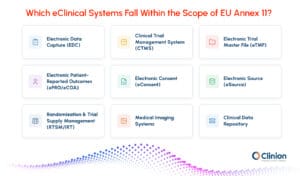
Common eClinical systems include:
- Electronic Data Capture (EDC)
- Clinical Trial Management Systems (CTMS)
- Electronic Trial Master File (eTMF)
- Electronic Patient-Reported Outcomes (ePRO/eCOA)
- Electronic Consent (eConsent)
- Electronic Source (eSource)
- Randomization and Trial Supply Management (RTSM/IRT)
- Medical imaging management systems
- Clinical data repositories
- Other computerized systems that create, process, modify, or archive regulated electronic records
Rather than assessing these applications individually, many sponsors and CROs evaluate the entire eClinical ecosystem to ensure consistent controls for validation, user access, audit trails, electronic signatures, data integrity, and change management across connected systems.
EU Annex 11 Compliance Checklist for eClinical Systems
The following checklist translates the key EU Annex 11 requirements into practical evaluation criteria for eClinical systems. It can help organizations evaluate whether the necessary controls are in place during software selection, validation, implementation, and ongoing system management.
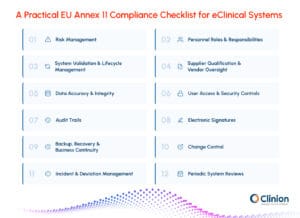
Risk Management
EU Annex 11 requires organizations to adopt a risk-based approach when implementing and maintaining computerized systems. Risks should be assessed according to their potential impact on patient safety, product quality, and data integrity, with appropriate controls applied throughout the system.
Key Evaluation Criteria
- A documented risk assessment is completed before implementation.
- Critical system functions and GxP-relevant processes are identified.
- Validation activities are aligned with the level of risk.
- Risk assessments are reviewed after significant system changes.
- Risk mitigation measures are documented and maintained.
Personnel & Responsibilities
Organizations should ensure that everyone involved in operating, validating, and maintaining eClinical systems has clearly defined responsibilities and the necessary training. Documented ownership and governance help maintain consistent system operation and support inspection readiness.
Key Evaluation Criteria
- Roles and responsibilities are clearly documented.
- Users complete role-specific training before system access.
- SOPs define how the system is used and managed.
- Training records are maintained and regularly reviewed.
- User access aligns with assigned responsibilities.
Validation & System Lifecycle
EU Annex 11 requires computerized systems to be validated to demonstrate they consistently perform as intended and remain fit for their intended use. Validation should be planned, documented, and maintained throughout the system lifecycle, including after significant software updates, configuration changes, or integrations.
Key Evaluation Criteria
- User requirements are documented before system implementation.
- Validation activities demonstrate that the system performs as intended.
- Validation documentation is complete, approved, and version controlled.
- Significant system changes follow documented change control and revalidation procedures.
- Validation records are maintained throughout the system lifecycle.
Supplier Qualification
Organizations remain responsible for ensuring that third-party software and service providers meet applicable quality and regulatory requirements. Before implementing an eClinical system, vendors should be evaluated based on their quality management practices, validation support, documentation, and ability to maintain the system throughout its lifecycle.
Key Evaluation Criteria
- The software vendor has been formally qualified.
- Supplier quality processes and documentation have been assessed.
- Validation documentation and support are available.
- Roles, responsibilities, and service agreements are clearly defined.
- Software updates and system changes follow documented change management procedures.
Data Accuracy & Data Integrity
Maintaining accurate, complete, and reliable electronic records is a fundamental expectation of EU Annex 11. eClinical systems should include controls that preserve data integrity throughout its lifecycle, ensuring records remain attributable, accurate, consistent, and available for review when required.
Key Evaluation Criteria
- Data entry includes appropriate validation and accuracy checks.
- Changes to regulated data are fully traceable.
- Records are protected against unauthorized modification or deletion.
- Data is retained and archived according to regulatory and organizational requirements.
- The system supports principles of data integrity, including ALCOA+.
User Access & Security
Controlling user access is essential to protecting regulated electronic records and preventing unauthorized system activities. eClinical systems should ensure that only authorized personnel can access system functions and data relevant to their roles, with appropriate authentication and access controls in place.
Key Evaluation Criteria
- Each user is assigned a unique account and user ID.
- Role-based access controls restrict users to authorized functions and data.
- Authentication mechanisms, such as password policies or multi-factor authentication, are implemented where appropriate.
- User access is reviewed regularly and updated when roles or responsibilities change.
- User accounts are promptly modified or deactivated when access is no longer required.
Audit Trails
Audit trails provide a secure record of system activities by capturing who performed an action, what changed, and when the change occurred. They play a critical role in maintaining traceability and demonstrating the integrity of regulated electronic records.
Key Evaluation Criteria
- Audit trails are automatically generated for regulated activities.
- Audit records capture the user, date, time, and details of each change.
- Original and updated values are retained where applicable.
- Audit trail records cannot be modified or deleted by unauthorized users.
- Audit trails are available for review during audits and inspections.
Electronic Signatures
Electronic signatures provide a secure and legally attributable method for approving regulated electronic records. Under EU Annex 11, they should be uniquely linked to an individual, permanently associated with the corresponding record, and protected against unauthorized use.
Key Evaluation Criteria
- Electronic signatures are uniquely assigned to individual users.
- Signatures are securely linked to the corresponding electronic record.
- The system records the date, time, and purpose of each signature.
- Signature records cannot be altered or removed without authorization.
- Electronic signatures comply with applicable regulatory and organizational requirements.
Backup & Business Continuity
Organizations should implement backup and recovery processes to protect regulated electronic records from loss, corruption, or system failures. Regular testing of backup and recovery procedures helps ensure that critical data can be restored and clinical operations can continue with minimal disruption.
Key Evaluation Criteria
- Automated backups are performed at defined intervals.
- Backup data is securely stored and protected from unauthorized access.
- Backup integrity and recovery procedures are tested periodically.
- Disaster recovery and business continuity plans are documented.
- Critical systems and data can be restored within defined recovery objectives.
Change Control
Changes to eClinical systems should be planned, assessed, approved, and documented before implementation. A formal change control process helps ensure that software updates, configuration changes, and integrations do not compromise system performance, data integrity, or regulatory compliance.
Key Evaluation Criteria
- A documented change control process is in place for system modifications.
- Proposed changes are assessed for their impact on validated system functions.
- Changes are reviewed and approved before implementation.
- Significant changes are tested and validated before release.
- Change history is documented and retained for audit purposes.
Incident Management
Unexpected system issues, errors, and deviations should be recorded, investigated, and resolved through a controlled process. Effective incident management helps organizations identify root causes, implement corrective actions, and minimize the impact on clinical operations and regulated data.
Key Evaluation Criteria
- System incidents and deviations are documented when identified.
- Root cause investigations are performed for significant issues.
- Corrective and preventive actions (CAPA) are implemented where required.
- Incident resolution and closure are documented.
- Incident trends are periodically reviewed to identify recurring issues.
Periodic Review
EU Annex 11 expects computerized systems to be reviewed periodically to confirm they remain suitable for their intended use. Regular reviews help organizations verify that validation remains current, access controls are appropriate, documentation is up to date, and the system continues to meet regulatory and operational requirements.
Key Evaluation Criteria
- Periodic reviews are performed according to a documented schedule.
- Validation status is reviewed following significant system or process changes.
- User access, security controls, and audit trails are periodically evaluated.
- System documentation is reviewed and updated as needed.
- Review findings are documented, and any identified actions are tracked to completion.
Common EU Annex 11 Compliance Gaps
Even with documented procedures and validated systems, organizations may encounter compliance gaps that affect data integrity, inspection readiness, or system reliability. Identifying these issues early helps reduce regulatory risk and supports the effective management of computerized systems throughout their operational lifecycle.
Common Gap | Potential Impact |
Incomplete system validation | Insufficient evidence that the system performs as intended |
Shared or inactive user accounts | Reduced accountability and increased security risks |
Inadequate audit trail reviews | Limited visibility into critical system activities |
Weak change control processes | Uncontrolled system changes that may affect validated functions |
Poor supplier qualification | Limited assurance that third-party systems meet quality expectations |
Inconsistent backup and recovery testing | Increased risk of data loss or delayed system recovery |
Outdated SOPs or training records | Inconsistent system use and inspection observations |
Delayed periodic reviews | Compliance issues may go undetected over time |
EU Annex 11 vs. 21 CFR Part 11
Organizations conducting global clinical trials often need to comply with both EU Annex 11 and 21 CFR Part 11. While the regulations share many common principles, they differ in scope and regulatory emphasis. Understanding these differences can help sponsors and CROs evaluate eClinical systems that support compliance across multiple regulatory jurisdictions.
| EU Annex 11 | 21 CFR Part 11 |
| Issued under the EU Good Manufacturing Practice (GMP) guidelines | Issued by the U.S. Food and Drug Administration (FDA) |
| Focuses on the lifecycle management of computerized systems | Focuses on electronic records and electronic signatures |
| Emphasizes risk management, validation, supplier oversight, and system governance | Emphasizes record authenticity, electronic signatures, and access controls |
| Applies to computerized systems supporting GxP-regulated activities | Applies to electronic records and signatures maintained under FDA regulations |
| Requires documented controls throughout the system lifecycle | Requires controls to ensure electronic records are trustworthy, reliable, and equivalent to paper records |
21 CFR Part 11 Compliance in Clinical Trials
Learn how 21 CFR Part 11 applies to electronic records, electronic signatures, audit trails, access controls, system validation, and compliant clinical trial data workflows.
Questions to Ask Your eClinical Vendor About EU Annex 11 Readiness
Evaluating an eClinical system involves more than confirming regulatory support. These questions can help determine how well a vendor implements, maintains, and demonstrates EU Annex 11 readiness in real-world clinical environments.
Can you provide examples of how your platform has supported customers during regulatory inspections or compliance audits?
How do you assess the impact of new software releases on existing validated customer environments?
Which responsibilities related to EU Annex 11 are managed by your organization, and which remain with the customer?
How do you document and communicate known system limitations, risks, or unresolved issues that could affect regulated processes?
What evidence can you provide that critical system functions have been consistently tested across multiple software versions?
How do you ensure third-party integrations maintain data integrity and traceability without introducing compliance risks?
What quality metrics or performance indicators do you use to monitor the ongoing reliability of the platform?
How do you help customers maintain Annex 11 readiness over time rather than only during initial implementation?
Conclusion
As clinical trials become increasingly digital, selecting the right eClinical system requires more than evaluating functionality alone. Organizations should choose platforms that support reliable computerized system management, align with their quality processes, and adapt to evolving regulatory expectations. A structured evaluation against EU Annex 11 principles can help reduce compliance risks and support confident technology decisions.
How Clinion Supports EU Annex 11 Readiness
Clinion's unified eClinical platform is built to support the key principles of EU Annex 11 across the clinical trial lifecycle. With capabilities such as validation support, role-based access controls, audit trails, electronic signatures, and data integrity safeguards, the platform helps sponsors and CROs implement and manage regulated computerized systems more effectively.
External References