
- Summary
- Understanding the US and EU Regulatory Landscape for DCTs
- Why US and EU DCT Requirements Need Separate Planning
- FDA and EU Regulatory Frameworks for DCTs at a Glance
- How FDA and EU Requirements Apply to Key DCT Activities
- US vs. EU DCT Implementation Checklist
- Conclusion: Plan the DCT Model Around the Jurisdictions Involved
- External References
Summary
FDA and EU frameworks for decentralized clinical trials share core expectations around participant protection, investigator oversight, data integrity, and safety. However, implementation differs across jurisdictions. In the US, FDA provides specific guidance for decentralized trial elements, while in the EU, sponsors must consider the common clinical trial framework alongside applicable Member State provisions.
Understanding the US and EU Regulatory Landscape for DCTs
The regulatory frameworks in the US and EU allow decentralized elements to be incorporated into clinical trials without changing the fundamental responsibilities of sponsors and investigators. The key differences emerge when sponsors determine how those elements should be implemented in practice.
In the US, the FDA issued its final Conducting Clinical Trials With Decentralized Elements guidance in September 2024, outlining recommendations for implementing decentralized activities while maintaining appropriate oversight and participant protection.
In Europe, sponsors need to consider the EU clinical trial framework alongside recommendations for decentralized elements and applicable national provisions. This is particularly important for multinational studies because a decentralized activity that is acceptable across the EU may still require different operational arrangements in individual Member States.
For sponsors, the practical question is therefore not simply whether a trial can be decentralized, but how each decentralized activity should be designed, documented, overseen, and implemented within the applicable regulatory framework.
What Are Decentralized Clinical Trials?
Learn how decentralized clinical trials use remote technologies, virtual visits, eConsent, ePRO, wearables, and connected workflows to improve patient access and trial efficiency.
Why US and EU DCT Requirements Need Separate Planning
The US and EU are broadly aligned on the principles that should govern decentralized trials, but they do not provide an identical implementation pathway.
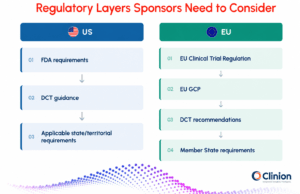
In the US, FDA's DCT guidance provides relatively specific recommendations for decentralized elements such as telehealth visits, local healthcare providers, direct shipment of investigational products, and digital health technologies. In the EU, sponsors must comply with the Clinical Trials Regulation and GCP requirements, alongside the EU Recommendation Paper on Decentralised Elements and applicable Member State provisions.
This distinction matters because sponsors may be able to maintain a common protocol and overall trial design while adapting specific procedures, such as eConsent, home healthcare, IMP delivery, source-data access, or remote services, where local requirements differ.
Planning these differences before study start can reduce the need to redesign decentralized processes after regulatory, ethics, or operational issues emerge.
FDA and EU Regulatory Frameworks for DCTs at a Glance
The regulatory frameworks governing these decentralized activities can be summarized as follows:
The main frameworks can be summarized as follows:
Regulatory consideration | US | EU |
Primary DCT guidance | FDA's Conducting Clinical Trials With Decentralized Elements, finalized in September 2024 | Recommendation Paper on Decentralised Elements in Clinical Trials, Version 02, issued in October 2025 |
Regulatory foundation | FDA requirements and applicable regulations, supplemented by FDA DCT guidance | Clinical Trials Regulation (CTR), EU GCP, GDPR, and applicable national law |
Local requirements | State or territorial requirements may affect activities such as telehealth and healthcare delivery | Member State provisions may affect activities such as eConsent, IMP delivery, delegation, and remote access to source data |
Current GCP direction | ICH E6(R3) Principles and Annex 1 are part of the current GCP framework; FDA's implementation of E6(R3) should be considered alongside applicable FDA requirements | ICH E6(R3) Principles and Annex 1 have been effective since July 23, 2025. Annex 2, which specifically covers decentralized clinical trials, was adopted in June 2026 and will become effective on January 15, 2027 |
Sponsor responsibility | Decentralization does not reduce sponsor or investigator responsibilities | Decentralization does not remove sponsor or investigator responsibilities under the EU framework |
FDA's DCT guidance is nonbinding guidance rather than a new regulation. It provides recommendations for implementing decentralized elements while existing FDA regulatory requirements continue to apply.
The EU recommendation paper is likewise not a standalone regulation. It operates within the broader EU clinical trial framework, while implementation of certain decentralized activities may remain subject to Member State requirements.
How FDA and EU Requirements Apply to Key DCT Activities
The regulatory expectations become more practical when applied to specific decentralized activities. The following areas focus on where requirements are aligned, where implementation may differ, and what sponsors need to establish before study start.
Trial Design and Protocol Documentation
Decentralized elements should be planned from the outset rather than added after the protocol is finalized. Sponsors should define how each activity will be conducted, who will be responsible for it, and how participant safety, data integrity, and investigator oversight will be maintained.
In the US, FDA guidance recommends describing decentralized procedures in the protocol, including how remote or in-home activities will be conducted and how responsibilities will be assigned.
In the EU, sponsors are similarly expected to assess decentralized elements against critical-to-quality factors. Where an element could affect participant rights, benefit-risk, data integrity, or the reliability of results, the relevant considerations should be reflected in the protocol and clinical trial application.
For multinational studies, this means the overall study design can remain consistent while the procedures supporting decentralized activities may need to account for applicable local requirements.
Investigator Oversight and Delegation
Decentralized trials can distribute study activities across investigators, local healthcare providers, and other qualified professionals. Clear responsibility and appropriate investigator oversight therefore remain essential.
In the US, FDA guidance permits certain activities to be performed by qualified individuals outside the investigator’s immediate site environment, while maintaining investigator oversight. In the EU, responsibilities must similarly be clearly allocated, with applicable national requirements considered where relevant.
Sponsors should establish a clear responsibility model showing who performs each activity, what can be delegated, who retains oversight, how communication occurs, and how those responsibilities are documented throughout the trial.
Remote Visits and Local Healthcare Providers
Remote visits can reduce participant travel, but sponsors must determine which activities can be conducted remotely and whether the professionals performing them meet applicable qualification and local requirements.
In the US, FDA guidance allows decentralized activities to be performed through telehealth or by appropriately qualified healthcare providers, provided the investigator retains appropriate oversight. In the EU, home visits and other decentralized activities are similarly permitted, but sponsors must account for applicable national requirements governing the professionals and services involved.
Operational planning should therefore confirm whether a particular activity can be performed remotely, which professionals are permitted and qualified to perform it, where it may take place, and how relevant information will be communicated back to the investigator.
Electronic Informed Consent
Electronic informed consent can support remote participation, but moving consent online does not change the fundamental requirement that participants must be adequately informed and provide consent before trial procedures begin.
Both the US and EU frameworks allow electronic approaches, provided applicable informed-consent requirements are met. The practical difference for multinational studies is that sponsors may need to account for country-specific requirements governing how electronic consent is implemented, documented, and accepted.
Sponsors should therefore assess the eConsent process against applicable national requirements rather than assume that one implementation will automatically work across every participating country.
Direct-to-Patient Investigational Product Delivery
Direct-to-patient delivery can reduce the need for participants to visit trial sites to receive or collect investigational products. However, sponsors must determine whether the investigational product is suitable for direct delivery and establish appropriate controls throughout the distribution process
In the US, FDA guidance addresses whether an investigational product is suitable for direct shipment to participants and highlights requirements around packaging, shipping, receipt, storage, and accountability.
In the EU, direct-to-patient supply is also addressed within the decentralized trial framework, with sponsors needing to consider appropriate handling, accountability, and applicable national requirements for the supply and delivery of investigational products.
Before implementing direct-to-participant supply, sponsors should confirm its permissibility and suitability in each jurisdiction and define responsibilities for shipment, receipt, storage, temperature control where applicable, use, returns, and accountability.
Digital Health Technologies and Remote Data Collection
Digital health technologies can support remote data collection through connected devices, mobile applications, and other digital tools. Their use does not remove the sponsor's responsibility to ensure that the resulting data is reliable and fit for the trial.
In the US, FDA guidance addresses the selection and use of digital health technologies for remote data acquisition, including considerations around verification, validation, usability, training, and risk management.
In the EU, sponsors should similarly consider whether the technology is fit for its intended purpose and how its use affects data quality and factors critical to trial quality.
Sponsors should assess the complete data lifecycle, including how data is generated, transmitted, reviewed, corrected where appropriate, and retained, rather than evaluating a technology solely on its ability to collect data remotely.
Safety Monitoring and Adverse-Event Escalation
Remote trial activities must still support timely identification, assessment, and escalation of safety events. Decentralization changes where information is collected and who may encounter it, but it does not reduce the sponsor's or investigator's safety responsibilities.
In the US, FDA guidance emphasizes establishing clear processes for identifying and communicating adverse events when trial activities occur remotely or through other decentralized arrangements. In the EU, sponsors should similarly define how safety information is captured, communicated, and escalated across the parties involved in decentralized activities.
Sponsors should therefore define a clear escalation pathway from the participant or remote provider to the investigator and appropriate study team.
Third-Party and Vendor Oversight
Decentralized trials can increase reliance on third parties such as home-health providers, telemedicine services, laboratories, couriers, eConsent providers, digital technology vendors, and other service providers.
Outsourcing an activity does not remove the sponsor's responsibility for appropriate oversight. FDA guidance specifically notes that sponsors using contracted services should ensure that providers are qualified for the activities they perform.
Sponsors should establish how decentralized service providers are qualified, trained, contracted, monitored, and managed. Responsibilities for subcontractors, data exchange, issue escalation, access to records, system changes, business continuity, and auditability should also be clear.
Source Data, Remote Access, and Record Availability
A decentralized model can create source data across multiple locations and systems, including investigator records, participant devices, ePRO platforms, laboratories, local healthcare records, and home-health documentation.
Sponsors should prospectively define what constitutes source data, where it resides, who is authorized to access it, and how it will remain available for monitoring, audit, and inspection. Remote access to medical or source records may also be affected by privacy rules and Member State or local requirements.
The objective is to maintain traceability from the point at which relevant data is generated through review, transfer, correction where appropriate, and inclusion in the clinical trial record.
Privacy, Data Protection, and Cross-Border Data
Decentralized trials can involve participant data moving across digital platforms, healthcare providers, and national borders. Privacy requirements therefore need to be considered alongside the clinical trial framework.
US
- Privacy requirements depend on the type of data, organizations involved, and applicable federal or state requirements.
- Sponsors should establish appropriate controls for data access, storage, and transfer.
EU
- The GDPR applies to the processing of personal data within its scope.
- Sponsors must also consider relevant Member State data-protection requirements.
- Cross-border transfers require particular attention to applicable data-transfer rules.
For multinational trials, sponsors should map where data is collected, where it is stored, who can access it, and where it is transferred before the decentralized model is implemented.
EU Member State Requirements: What Sponsors Should Check
Although the EU operates under a common clinical trial framework, decentralized activities may still be subject to Member State-specific provisions. The 2025 EU recommendations provide country-level information on areas such as remote consent, investigational product delivery, delegation, and access to source data.
Before implementing a decentralized model across multiple EU countries, sponsors should verify:
- Requirements for remote consent
- Conditions for direct-to-participant IMP delivery
- Local requirements for healthcare professionals and delegation
- Rules governing access to medical records and source data
The key point: EU-level guidance provides the common framework, but the operational model may need to be adapted to the requirements of each participating Member State.
US vs. EU DCT Implementation Checklist
Rather than repeating the requirements above, sponsors can use the following questions as a decision framework for each decentralized element.
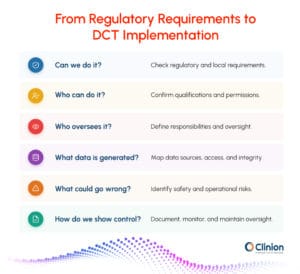
Can we do it?
Assess whether the decentralized activity is permitted under applicable regulatory and ethical requirements. Consider relevant federal, state, EU, and Member State provisions before implementation.
Who can do it?
Determine whether the people performing the activity have the required qualifications, licenses, and role-specific permissions. Consider delegation requirements and any local restrictions that may apply.
Who oversees it?
Define who is responsible for overseeing the activity and how that oversight will be maintained.
This may involve the investigator, sponsor, vendor, or other responsible parties.
What data does it create?
Identify where the data is generated and stored, how it moves between systems, and who can access it. Assess data provenance, integrity, privacy, retention, and its role as source data.
What could go wrong?
Identify risks that could affect participant safety, data quality, technology, or trial operations.
Consider potential issues with remote services, logistics, vendors, connectivity, and data collection.
How will we demonstrate control?
Define how the activity will be documented, monitored, and reviewed throughout the trial.
Consider audit trails, vendor oversight, issue management, records, and inspection readiness.
Applying these questions to each decentralized element can help sponsors identify jurisdiction-specific requirements, operational risks, and documentation needs before implementation.
What Makes Decentralization the Future of Clinical Trials?
Explore how decentralized clinical trials improve patient access, enable remote participation, reduce site burden, and support more flexible, connected study workflows.
Conclusion: Plan the DCT Model Around the Jurisdictions Involved
Decentralized clinical trials do not require sponsors to choose between a US or EU model. The core principles are broadly aligned, but individual decentralized elements may require different operational approaches across jurisdictions.
The goal is therefore to establish a common trial model with controlled local adaptations where regulatory, privacy, healthcare, or operational requirements differ. When responsibilities, data flows, technologies, vendors, safety pathways, and local requirements are considered prospectively, sponsors are better positioned to implement decentralized elements without introducing avoidable fragmentation or compliance risk.
How Clinion Supports Decentralized Trial Implementation
Clinion’s unified eClinical platform brings EDC, ePRO, eConsent, eSource, and other clinical trial capabilities into a connected environment, supporting remote data collection and oversight across decentralized workflows.
Built to support regulated clinical research, Clinion aligns with FDA 21 CFR Part 11, GDPR, ICH, and EU requirements, helping sponsors operate clinical trials across US and European regulatory environments. Clinion has also supported clinical studies conducted under both FDA and EMA regulatory frameworks.
For multinational decentralized trials, this connected approach can reduce fragmentation between participants, sites, vendors, and study teams while supporting a more consistent operational model across jurisdictions.
External References