
- Summary
- What is an eClinical Solution?
- What Sponsors and CROs Look for in eClinical Platforms in 2026
- Leading eClinical Solution Providers in 2026: Comparison Table
- How AI Is Reshaping the eClinical Market
- Conclusion
Summary
This guide compares the top clinical trial solution providers in 2026, including enterprise leaders like Oracle Health Sciences, Medidata, and Veeva Systems, alongside rapidly growing AI-focused platforms such as Clinion and specialized vendors like Clario and Signant Health.
Clinical trials are no longer powered by standalone Electronic Data Capture (EDC) systems alone. In 2026, sponsors and CROs are looking for unified eClinical ecosystems that combine EDC, RTSM, CTMS, eTMF, eConsent, and AI-driven automation.
The shift toward decentralized trials and real-time data review has pushed eClinical vendors to evolve from basic software providers into intelligent clinical operations platforms. Today’s leading systems are expected to do far more than collect data. They must simplify study build, reduce manual effort, improve visibility, and integrate seamlessly with external systems.
As a result, choosing the right eClinical platform has become a strategic decision for sponsors, CROs, and biotech organizations alike.
What is an eClinical Solution?
An eClinical solution is a digital platform designed to manage clinical trial operations and clinical data electronically. Modern eClinical platforms typically combine multiple technologies into a unified ecosystem, including:
Pharmacovigilance and safety management
Clinical analytics and AI
Integrations with EHRs, labs, imaging systems, and wearable devices
The goal of these systems is not only to digitize clinical operations but also to improve study efficiency, enhance visibility, reduce manual effort, and maintain regulatory compliance across increasingly complex trials.
What Sponsors and CROs Look for in eClinical Platforms in 2026
The criteria for selecting eClinical software have changed considerably in recent years. While functionality remains important, sponsors are now placing equal emphasis on interoperability, usability, automation, and operational intelligence.
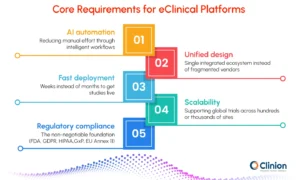
AI Is Becoming a Core Evaluation Factor
Artificial intelligence is rapidly becoming one of the biggest differentiators in the eClinical market. Vendors are embedding AI across workflows to reduce manual effort and accelerate timelines. Modern platforms now support AI-assisted protocol generation, automated medical coding, predictive enrollment forecasting, intelligent query management, and risk-based monitoring.
More advanced systems are moving toward Agentic AI models capable of proactively surfacing risks, suggesting actions, and automating repetitive operational tasks. This shift is especially important for sponsors looking to improve efficiency without significantly increasing operational headcount.
Unified Platforms Are Replacing Fragmented Clinical Technology Stacks
Sponsors are increasingly moving away from disconnected systems that require complex integrations between EDC, CTMS, RTSM, eTMF, and patient-facing tools. Maintaining multiple vendors often creates operational silos, reconciliation delays, and inconsistent data visibility.
As a result, unified cloud-based platforms are becoming more attractive because they provide a single operational ecosystem across study management, patient data, and analytics workflows.
Faster Study Startup Has Become a Competitive Priority
Speed remains one of the biggest challenges in clinical research. Many organizations are prioritizing platforms that enable rapid study configuration, simplified amendments, reusable templates, and low-code workflows.
Emerging biotech companies, in particular, are seeking systems that can reduce implementation timelines from months to weeks without extensive customization requirements.
Scalability Still Matters for Global Trials
Despite growing demand for agility, scalability remains critical for large sponsors running multinational studies across hundreds or thousands of sites. Enterprise platforms must support global deployment, multilingual operations, large patient volumes, and extensive integrations with external systems.
Vendors serving this segment continue to invest heavily in cloud infrastructure, analytics, and enterprise-grade security.
Regulatory Compliance Remains Non-Negotiable
All leading eClinical providers continue to prioritize compliance with standards such as FDA 21 CFR Part 11, GDPR, HIPAA, GxP, and EU Annex 11. Regulatory readiness remains foundational, particularly as decentralized trial models introduce new data privacy and oversight challenges.
Leading eClinical Solution Providers in 2026: Comparison Table
Vendor | Platform Focus | AI Maturity | Enterprise Scalability | Best Fit |
Clinion | Unified AI-native platform | Very High | Moderate to High | Agile biotech and CROs |
Oracle Health Sciences | Enterprise clinical ecosystem | High | Very High | Global pharma and enterprise CROs |
Medidata | Comprehensive clinical suite | High | Very High | Complex multinational trials |
Veeva Systems | Unified cloud platform | High | High | Pharma and biotech |
Clario | Endpoint and imaging solutions | Moderate | High | Imaging and cardiac-focused studies |
IQVIA | Data-driven clinical ecosystem | Very High | Very High | Enterprise sponsors |
Signant Health | Patient-centric decentralized trials | Moderate to High | High | Decentralized and hybrid trials |
ArisGlobal | Safety and regulatory automation | High | High | Pharmacovigilance-heavy organizations |
Fountayn | Unified operational simplicity | Moderate | Moderate | Mid-sized biotech |
Calyx | Imaging and IRT specialization | Moderate | High | Imaging-intensive studies |
1. Clinion
Over the past few years, Clinion has emerged as one of the more notable AI-focused companies in the eClinical market. While many traditional platforms have added AI capabilities onto legacy infrastructures, Clinion has positioned itself as an AI-native platform designed to simplify clinical trial workflows from the outset.
The company offers a unified cloud-based ecosystem that combines EDC, RTSM, CTMS, eTMF, eConsent, ePRO, and eSource within a single architecture. This unified approach reduces dependency on multiple vendors and minimizes operational silos between clinical teams.
One of Clinion’s biggest differentiators is its use of Agentic AI across the trial lifecycle. The platform includes AI-assisted protocol generation, intelligent clinical data review, automated query management, CSR automation, and workflow recommendations designed to accelerate study execution while reducing manual effort.
Unlike larger enterprise platforms that often require lengthy implementation cycles, Clinion emphasizes rapid deployment and operational agility. This has made the platform increasingly attractive for emerging biotech sponsors, CROs, and academic research organizations looking for faster study startup timelines.
Key Features and Platform Capabilities
Built on a shared data architecture, the platform enables seamless data flow across clinical and operational workflows, helping sponsors reduce dependency on multiple vendors and disconnected systems.
Its EDC platform supports configurable study builds, integrated data review, medical coding, and real-time edit checks, while the native RTSM module manages randomization and trial supply workflows without requiring external integrations. Integrated CTMS and eTMF capabilities further streamline study oversight, monitoring activities, and document management within the same environment.
Clinion also places significant emphasis on AI-driven automation. The platform includes AI-powered protocol generation, AI Medical Coding, intelligent clinical data review, automated query workflows, and CSR automation designed to reduce manual effort and accelerate study execution.
A major differentiator is its Agentic AI framework, which enables proactive workflow support across study configuration, risk identification, and data analysis. The platform also includes Agentic AI Assiatant that allows users to interact with study data and operational insights through natural language-based workflows.
In addition, Clinion supports decentralized and hybrid trial models through integrated eConsent, ePRO/eCOA, and eSource capabilities, alongside APIs and interoperability with EHRs, wearable devices, and third-party systems.
Strengths
Clinion’s strongest advantage lies in its AI-first architecture and operational simplicity. The platform is designed to reduce manual dependencies across clinical operations while maintaining a unified experience across modules.
Its faster deployment timelines and modular pricing structure also make it more accessible to mid-sized sponsors compared to traditional enterprise systems.
Limitations
Compared to larger incumbents such as Oracle or Medidata, Clinion has a smaller global footprint and a shorter track record in extremely large multinational Phase III programs. Organizations running highly complex enterprise-scale trials may still prefer vendors with broader historical adoption at global scale.
Best For
Emerging biotech companies, CROs, medtech organizations, and sponsors seeking AI-native clinical operations with faster implementation timelines and unified workflows.
2. Oracle Health Sciences
Oracle Health Sciences continues to be one of the most established enterprise eClinical providers in the industry. Its Clinical One platform combines EDC, RTSM, CTMS, and operational analytics within a scalable cloud environment designed for large global trials.
Oracle’s biggest advantage remains enterprise scalability. The platform is built to support highly complex multinational studies involving large site networks, extensive patient populations, and sophisticated integrations across enterprise systems.
The company has also expanded its AI investments in recent years, introducing predictive forecasting, automated workflows, and AI-assisted operational insights within Clinical One.
Key Features and Platform Capabilities
Oracle Clinical One provides unified trial management across data capture, randomization, supply management, and operational oversight. Integration with Oracle Cloud Infrastructure enables organizations to connect clinical data with broader enterprise ecosystems, including analytics and healthcare data systems.
The platform supports integrations with EHRs, laboratories, imaging systems, and safety databases through APIs and cloud services.
Strengths
Oracle’s scale, infrastructure maturity, and deep analytics capabilities make it one of the strongest options for global enterprise trials. Its compliance framework and worldwide support network also remain major advantages for large pharmaceutical organizations.
Limitations
The platform’s complexity and implementation timelines can make it less suitable for smaller or rapidly moving clinical teams. Total ownership costs are also typically higher than mid-market alternatives.
Best For
Large pharmaceutical companies and enterprise CROs managing complex global clinical programs.
3. Medidata (Dassault Systèmes)
Medidata remains one of the most recognized names in the EDC and eClinical space. Its Rave platform has long been considered an industry standard for large-scale clinical data management.
Over time, Medidata has expanded well beyond EDC into a broad ecosystem that includes RTSM, CTMS, eCOA, eConsent, analytics, and AI-driven operational intelligence.
A major differentiator is Acorn AI, Medidata’s clinical data and analytics environment, designed to provide predictive insights across study operations and patient enrollment.
Key Features and Platform Capabilities
The Rave platform supports end-to-end clinical workflows with strong interoperability across modules. Medidata also offers extensive integrations with labs, imaging providers, EHR systems, and external analytics environments.
Its analytics capabilities are among the most mature in the industry, particularly for benchmarking and operational forecasting.
Strengths
Medidata’s strongest advantages include global adoption, proven reliability, and broad functionality across enterprise clinical operations. The platform is widely trusted across large regulatory studies.
Limitations
Study configuration and implementation can be more complex compared to newer low-code systems. Pricing also places the platform firmly in the enterprise category.
Best For
Large sponsors and CROs managing complex multinational trials that require mature operational infrastructure and advanced analytics.
4. Veeva Systems
Veeva Systems has become one of the leading providers of unified cloud software for life sciences organizations. Its Vault Clinical Suite combines EDC, CTMS, eTMF, safety, and quality workflows within a connected cloud architecture.
Unlike platforms built through multiple acquisitions, Veeva’s applications operate on a common platform and data model, helping reduce integration complexity across clinical operations.
The company has also accelerated investments in AI-powered workflow automation, particularly around content generation and operational productivity.
Key Features and Platform Capabilities
Vault Clinical Suite supports clinical data management, operational oversight, document management, and safety workflows through a unified interface. The platform also provides APIs and integration frameworks for interoperability with external systems.
Frequent product updates and cloud-native deployment have contributed to strong customer adoption across both enterprise and mid-sized sponsors.
Strengths
Veeva is widely recognized for usability, deployment speed, and unified workflows. Organizations already using Veeva’s commercial or quality platforms often benefit from ecosystem continuity.
Limitations
Highly customized workflows may still require significant configuration effort. Enterprise pricing can also be a barrier for smaller organizations.
Best For
Pharma and biotech companies seeking a modern unified clinical ecosystem with strong usability and rapid implementation capabilities.
5. Clario
Clario differentiates itself through its specialization in endpoint data collection, imaging, and cardiac safety solutions. Rather than positioning itself as a broad operational suite, the company focuses heavily on scientific and patient data workflows.
The platform is particularly strong in eCOA, wearable integrations, imaging analysis, and cardiac monitoring services, making it highly relevant for trials with complex endpoint requirements.
Key Features and Platform Capabilities
Clario combines software capabilities with scientific operational services, including imaging core labs, ECG monitoring, and patient-reported outcome management.
Its eCOA infrastructure includes validated instruments and workflows tailored to decentralized and patient-centric trials.
Strengths
Clario’s biggest advantage is its deep therapeutic and endpoint expertise, particularly in cardiology, oncology, and neurology studies.
Limitations
Compared to broader enterprise suites, Clario offers a narrower operational ecosystem and less emphasis on trial management infrastructure.
Best For
Clinical trials requiring advanced imaging, cardiac monitoring, wearable integrations, and endpoint expertise.
6. IQVIA
IQVIA combines clinical technology with one of the largest healthcare analytics and CRO ecosystems in the industry. Its Orchestrated Clinical Trials platform is designed to connect operational workflows with real-world healthcare intelligence, helping sponsors improve trial planning and study execution across global programs.
Key Features and Platform Capabilities
IQVIA’s platform includes EDC, IRT, eCOA, eConsent, clinical analytics, and site management capabilities within a connected ecosystem. A major differentiator is its integration with IQVIA’s broader healthcare datasets and patient intelligence network, allowing sponsors to leverage real-world data for recruitment planning and site selection.
The platform also incorporates AI-driven forecasting and operational analytics designed to improve enrollment visibility and trial performance across multinational studies.
Strengths
IQVIA’s biggest advantage is its ability to combine clinical technology with global healthcare analytics and CRO services. Sponsors benefit from strong operational visibility alongside access to extensive patient and site intelligence.
Its global infrastructure and large-scale operational support also make the platform highly scalable for enterprise clinical programs.
Limitations
The platform’s enterprise-focused ecosystem can feel complex for smaller biotech organizations with lean operational teams. Its technology stack is also often closely tied to broader IQVIA service engagements.
Best For
Large pharmaceutical sponsors and enterprise CRO partnerships requiring integrated technology, analytics, and operational support.
7. Signant Health
Signant Health has built a strong position in patient-centric and decentralized clinical trial technologies. The company focuses heavily on improving remote participation and digital patient engagement through connected data collection workflows.
Key Features and Platform Capabilities
The platform supports eCOA, eConsent, remote assessments, and digital patient engagement capabilities designed for hybrid and decentralized trials. Signant also offers tools for patient compliance monitoring and risk-based quality management that help sponsors maintain oversight across distributed study models.
The company continues to expand its ecosystem through wearable integrations and remote data capture technologies that support modern decentralized trial strategies.
Strengths
Signant’s strongest differentiator is its focus on patient engagement and decentralized trial support. Its digital workflows are designed to simplify remote participation while improving visibility into patient activity and study compliance.
Its expanding wearable and remote monitoring ecosystem also strengthens its position within decentralized and hybrid trial environments.
Limitations
Compared to broader enterprise eClinical suites, Signant offers a narrower operational ecosystem with limited CTMS and enterprise trial management functionality. Organizations seeking a fully unified operational platform may still require additional vendor integrations.
Best For
Sponsors and CROs prioritizing decentralized trial models, remote patient participation, and digital engagement workflows.
8. ArisGlobal
ArisGlobal is primarily known for its pharmacovigilance and regulatory management capabilities through the LifeSphere platform and NavaX AI suite. The company focuses heavily on automating safety operations and regulatory workflows for global life sciences organizations.
Key Features and Platform Capabilities
The LifeSphere platform includes pharmacovigilance, regulatory information management, and safety workflow automation capabilities designed to streamline compliance-heavy operations. Its NavaX AI suite supports automated case intake, literature review, signal detection, and workflow orchestration for safety teams.
ArisGlobal has also expanded its AI ecosystem through intelligent workflow agents designed to improve operational efficiency across pharmacovigilance and regulatory processes.
Strengths
ArisGlobal’s biggest strength is its deep specialization in pharmacovigilance and regulatory intelligence. The company has invested significantly in AI-driven safety automation, helping organizations reduce manual processing effort and manage growing safety data volumes more efficiently.
Its strong regulatory focus also makes it well-suited for organizations operating in highly compliance-driven environments.
Limitations
ArisGlobal is less focused on core clinical operations such as EDC, RTSM, or CTMS compared to broader eClinical vendors. Organizations seeking a full end-to-end clinical trial platform may require integrations with external systems.
Best For
Large life sciences organizations prioritizing pharmacovigilance automation, regulatory intelligence, and AI-driven safety operations.
9. Fountayn (formerly DATATRAK)
Fountayn focuses on delivering a unified eClinical ecosystem designed around operational simplicity and faster deployment timelines. The platform combines multiple clinical trial functions within a connected environment aimed at reducing integration complexity.
Key Features and Platform Capabilities
The platform includes EDC, RTSM, CTMS, eTMF, and eConsent capabilities within a unified architecture that supports end-to-end study management. Fountayn is particularly known for enabling rapid study setup and simplified mid-study amendments without significant downtime.
Its connected workflow structure also helps sponsors maintain operational visibility while reducing dependency on multiple vendors.
Strengths
Fountayn’s strongest advantage is its operational simplicity and deployment flexibility. The platform enables sponsors to manage multiple trial workflows within a single environment while reducing implementation overhead.
Its reputation for validated reliability and transparent pricing also makes it attractive for mid-sized biotech companies and CROs.
Limitations
Compared to larger enterprise vendors, Fountayn offers more limited AI and advanced analytics capabilities. Its ecosystem scale and global market presence are also smaller than platforms such as Oracle, Medidata, or Veeva.
Best For
Mid-sized biotech companies and CROs looking for unified trial management with faster implementation timelines and simplified workflows.
10. Calyx
Calyx specializes in imaging and randomization technologies for clinical trials, with a strong focus on endpoint management and biomarker-driven research programs. The company combines operational software with scientific expertise for studies requiring advanced imaging workflows.
Key Features and Platform Capabilities
The platform supports imaging workflows, IRT, EDC, and centralized endpoint management for studies involving complex efficacy assessments and biomarker analysis. Calyx also provides scientific operational services that help sponsors manage image acquisition, analysis, and trial coordination across multicenter studies.
Its infrastructure is particularly designed for oncology and imaging-intensive clinical programs.
Strengths
Calyx’s biggest differentiator is its expertise in imaging operations and endpoint management. The platform is especially valuable for trials where imaging data plays a critical role in efficacy evaluation and regulatory submissions.
Its combination of scientific services and operational technologies also provides stronger support for specialized clinical workflows.
Limitations
Compared to broader enterprise eClinical suites, Calyx has a narrower platform scope and smaller operational ecosystem. Sponsors seeking extensive AI automation or unified enterprise-wide workflows may require additional integrations.
Best For
Oncology studies, imaging-intensive trials, and research programs requiring centralized imaging or biomarker-focused endpoint management.
How AI Is Reshaping the eClinical Market
AI is rapidly shifting from a supporting feature to a core operational layer within modern eClinical platforms. What began with basic automation has evolved into AI-driven workflows that directly influence how studies are designed and managed.
Enterprise vendors are increasingly using AI for predictive forecasting and operational oversight to help sponsors improve planning and study execution. At the same time, AI-native platforms are embedding automation into workflows such as protocol generation, medical coding, query management, and CSR creation.
This shift is being driven by growing operational pressure across clinical trials. Sponsors and CROs are managing larger datasets and tighter timelines while trying to reduce manual review effort and improve study visibility. As a result, AI is becoming less about standalone functionality and more about improving speed and efficiency across clinical operations.
Conclusion
The eClinical market in 2026 is being shaped by two major shifts: platform consolidation and AI-driven automation.
Large enterprise vendors continue to dominate global trials through scalability and mature infrastructure. At the same time, newer AI-native platforms are redefining expectations around implementation speed and workflow automation.
The best eClinical platforms today are no longer just systems for data capture. They are connected operational ecosystems designed to improve collaboration, reduce delays, support decentralized trial models, and simplify study execution.
For sponsors and CROs evaluating eClinical software in 2026, the decision is no longer only about selecting an EDC vendor. It is about choosing a platform that can support future clinical operations while adapting to evolving regulatory and operational demands.