- Summary
- Why CTMS Integration with EDC and eTMF Matters
- What This CTMS Comparison Covers
- Best CTMS Platforms with EDC and eTMF Integration: Detailed Analysis
- How to Choose the Right CTMS for Your Organization
- External References
Summary
Clinical trial technology has become increasingly interconnected, changing how organizations evaluate Clinical Trial Management Systems (CTMS). While operational capabilities remain essential, a CTMS is no longer assessed in isolation. Its ability to work alongside Electronic Data Capture (EDC) and electronic Trial Master File (eTMF) systems has become equally important in supporting efficient study execution.
This article compares the leading CTMS platforms that integrate with EDC and eTMF in 2026 using a consistent set of integration-focused criteria. Beyond core clinical operations capabilities, it examines how each platform approaches integration, supports end-to-end trial workflows, and addresses the needs of sponsors, CROs, and research organizations.
Why CTMS Integration with EDC and eTMF Matters
Clinical trials generate a continuous flow of operational, clinical, and regulatory information throughout the study lifecycle. To manage these activities effectively, organizations rely on multiple specialized systems rather than a single application. A Clinical Trial Management System (CTMS) supports study planning and operational oversight, Electronic Data Capture (EDC) manages participant data, and an electronic Trial Master File (eTMF) maintains the essential documents required for regulatory compliance.
While this specialized approach allows each system to perform its role effectively, it also distributes critical study information across multiple platforms. Site activation, participant enrollment, monitoring visits, protocol deviations, and regulatory documentation are closely connected activities, yet they often reside in different systems. Without effective integration, study teams may need to reconcile updates manually, duplicate information across applications, and spend additional time verifying that records remain aligned.
What Is CTMS? A Complete Guide for Researchers
Understand how a clinical trial management system helps teams manage study planning, site oversight, subject tracking, workflows, reporting, and trial operations.
As organizations adopt increasingly specialized clinical technologies, integration between CTMS, EDC, and eTMF has become a practical requirement rather than a convenience. Weak integrations often appear as protocol deviations recorded in EDC that take time to reach operational teams, TMF completeness gaps identified late in the study, or monitors entering the same visit information across multiple systems. The effectiveness of these integrations has a direct impact on operational efficiency, data consistency, and inspection readiness.
How CTMS, EDC, and eTMF Commonly Support Trial Activities
| Clinical Trial Activity | CTMS | EDC | eTMF |
| Study planning and site startup | ✓ | ✓ | |
| Subject enrollment | ✓ | ✓ | |
| Visit scheduling and monitoring | ✓ | ✓ | ✓ |
| Protocol deviations | ✓ | ✓ | ✓ |
| Essential document management | ✓ | ||
| Study closeout | ✓ | ✓ |
No single platform manages every aspect of a clinical trial. As the table illustrates, many trial activities span two or more systems. Site startup depends on CTMS for site selection and budgeting and eTMF for the regulatory approvals and ICF versions that clear a site to activate, while monitoring activities typically touch all three systems at once. Keeping these workflows synchronized helps prevent the kind of gaps and duplicate effort described above.
Benefits of Electronic Data Capture Systems
See how EDC systems improve data quality, reduce manual entry, support real-time validation, simplify query management, and accelerate database readiness.
How Information Flows Between CTMS, EDC, and eTMF
Integration is more than simply connecting systems. It determines whether updates move between teams automatically or require someone to notice, re-enter, and reconcile them by hand.
The architecture varies across vendors. In some environments, CTMS acts as the operational coordination layer connecting EDC and eTMF. In others, particularly unified eClinical platforms, CTMS, EDC, and eTMF operate within a shared platform architecture with native data sharing. Enterprise organizations may also use APIs, middleware, or integration platforms to synchronize information across best-of-breed applications.
Regardless of the technical approach, the objective remains the same: ensuring operational milestones, clinical data, and essential documentation remain aligned throughout the study lifecycle. Because integration directly influences study efficiency, data consistency, and inspection readiness, it serves as one of the primary evaluation criteria in the platform comparison that follows.
| Information Flow | Operational Value |
| EDC → CTMS | Participant enrollment, visit completion, and protocol deviations provide operations teams with timely updates on study progress. |
| CTMS → eTMF | Site milestones, monitoring reports, and study activities are reflected in the Trial Master File to support complete and up-to-date documentation. |
| eTMF → CTMS | Document status and regulatory completeness give study teams greater visibility into inspection readiness and overall study progress. |
What Is eTMF in Clinical Trials?
Learn how an electronic trial master file helps clinical teams manage essential documents, version control, audit readiness, compliance, and study oversight.
What This CTMS Comparison Covers
CTMS platforms differ significantly in their integration models, operational capabilities, scalability, and intended users. Some provide native connectivity across applications within the same eClinical ecosystem, while others rely on APIs, configurable integrations, or connections with third-party systems.
This comparison examines ten CTMS platforms that support EDC and eTMF connectivity in different ways. It considers how each platform approaches integration, the clinical operations it supports, and the types of sponsors, CROs, research sites, and research organizations it is best suited to serve.
How We Assessed These CTMS Platforms
To ensure a fair and consistent comparison, we evaluated every CTMS platform using the same framework. Rather than comparing feature lists alone, we assessed the capabilities that have the greatest impact on connected clinical trial operations and long-term scalability.
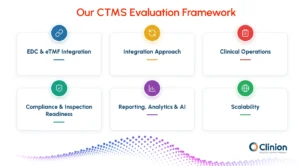
EDC & eTMF Integration:
We assessed how effectively each CTMS integrates with Electronic Data Capture (EDC) and electronic Trial Master File (eTMF) systems, including the depth of integration, data synchronization, and support for connected workflows.
Integration Approach:
We evaluated whether integrations are native within a unified platform, available through the same vendor ecosystem, supported through standard APIs, or dependent on third-party connectors and middleware.
Clinical Operations:
We reviewed core CTMS capabilities, including study planning, site management, subject tracking, monitoring, milestone management, and operational oversight.
Compliance & Inspection Readiness:
We considered features that support regulatory compliance, audit trails, documentation management, and inspection readiness throughout the trial lifecycle.
Reporting, Analytics & AI:
We examined reporting capabilities, operational dashboards, workflow automation, and AI-assisted features that improve visibility and efficiency.
Scalability:
We assessed how well each platform supports organizations of different sizes, study portfolios, and global clinical operations.
Quick Comparison of the Best CTMS Platforms
The table below summarizes the leading CTMS platforms based on the evaluation criteria discussed above, providing a quick side-by-side comparison of their integration approach, core strengths, and best-fit use cases.
| Platform | Integration Model | EDC & eTMF Connectivity | Key Strength | Best Suited For |
| Advarra | Site-focused platform | Third-party integration support | Connected site management, participant tracking, and study workflows | Research sites managing multiple concurrent studies |
| Clinion | Unified eClinical platform | Native connectivity across CTMS, EDC, and eTMF | Connected study, site, subject, monitoring, and document workflows within a single platform | Sponsors, CROs, and research organizations seeking an integrated eClinical platform |
| CRScube | Connected eClinical ecosystem | Integrates with cubeCDMS (EDC) and cubeTMF | Connected clinical operations, data management, and document workflows across the CRScube ecosystem | Sponsors and CROs seeking a configurable multi-product eClinical ecosystem |
| Ennov | Unified clinical suite | Pre-integrated with Ennov EDC and eTMF | Configurable clinical operations, data management, and document workflows within a unified suite | Sponsors, CROs, and research organizations requiring cloud or on-premises deployment |
| IQVIA | Enterprise ecosystem | Integration across the IQVIA technology ecosystem and external systems | Connected enterprise clinical operations with scalable global study management | Global sponsors and full-service CROs |
| Medidata Solutions | Unified clinical platform | Native EDC with ecosystem-based eTMF connectivity | Enterprise clinical operations with integrated data management and study oversight | Large sponsors managing global clinical trials |
| Octalsoft | Unified eClinical platform | Integrated connectivity across CTMS, EDC, and eTMF | Connected clinical operations, data capture, and document management within a unified platform | Sponsors and CROs seeking a configurable unified eClinical platform |
| Oracle | Enterprise platform | API-based and configurable enterprise integrations | Configurable enterprise workflows and interoperability across complex technology environments | Large pharmaceutical companies with established IT ecosystems |
| ResearchManager | Modular clinical research platform | Integrated CTMS, EDC, and eTMF modules | Flexible clinical operations, data capture, and document management within a modular platform | Sponsors, CROs, academic institutions, and healthcare research organizations |
| Veeva Systems | Unified Vault ecosystem | Native integration within the Vault ecosystem | Connected clinical operations, quality processes, and document management across the Vault platform | Organizations using the Veeva Vault ecosystem |
Disclaimer: Platforms are listed in alphabetical order and are not ranked based on performance, capabilities, or market position.
Best CTMS Platforms with EDC and eTMF Integration: Detailed Analysis
The reviews below expand on the comparison by examining how each CTMS approaches EDC and eTMF integration, where those integrations are strongest, and any implementation considerations buyers should evaluate before making a decision.
Advarra
Advarra Clinical Conductor is a site-focused CTMS designed to help research sites and site networks manage study operations, participant recruitment, enrollment, budgeting, billing, and reporting.
EDC & eTMF Integration
Clinical Conductor has a documented integration with Advarra eSource + EDC, enabling study and participant information to move between data-capture and site-management workflows. It can also connect with Advarra eReg, Epic, and external clinical systems through APIs. However, organizations requiring a sponsor-level eTMF integration should confirm the supported connection and implementation model directly with Advarra.
Why It Stands Out
- Site-focused workflows for participant, financial, and study management.
- Documented connectivity between Clinical Conductor and Advarra eSource + EDC.
- API, eReg, and Epic connectivity for broader research-site environments.
Considerations:
Organizations requiring sponsor-level eTMF integration should confirm the supported integration model and implementation approach during product evaluation.
Clinion
Clinion is a unified AI-enabled eClinical platform that combines CTMS, EDC, eTMF, and other clinical applications within a single ecosystem for connected clinical trial management.
EDC & eTMF Integration
Clinion provides native connectivity across its CTMS, EDC, and eTMF modules, enabling operational, clinical, and regulatory information to remain synchronized within a unified platform. This reduces manual reconciliation and supports connected workflows throughout the clinical trial lifecycle.
Why It Stands Out
- Native connectivity across CTMS, EDC, and eTMF within a unified platform.
- AI-enabled platform capabilities supporting clinical operations, data management, and document workflows.
- Connected trial management spanning study, site, subject, monitoring, and document workflows.
Considerations:
Organizations should confirm which integration capabilities and workflows are available based on the Clinion modules included in their deployment.
CRScube
CRScube (cubeCTMS) is part of the company's connected eClinical ecosystem, connecting CTMS, EDC, and eTMF to support coordinated clinical trial management. The platform is designed for sponsors and CROs seeking configurable solutions across the clinical trial lifecycle.
EDC & eTMF Integration
cubeCTMS integrates with cubeCDMS for electronic data capture and cubeTMF for trial documentation, enabling operational, clinical, and regulatory information to flow across the CRScube ecosystem. This connected architecture helps reduce manual data transfer while improving visibility across study management and documentation processes.
Why It Stands Out
- Connected eClinical ecosystem linking CTMS, EDC, and eTMF.
- Configurable workflows that can be adapted to different study requirements.
- Integrated oversight across study operations, clinical data, and trial documentation.
Considerations:
Buyers should verify CTMS-specific workflows, reporting capabilities, and integration scope during product demonstrations.
Ennov
Ennov CTMS is part of Ennov's unified clinical suite, supporting study planning, site management, and clinical operations within a configurable environment. It is designed for sponsors, CROs, and research organizations that require deployment flexibility alongside integrated clinical applications.
EDC & eTMF Integration
Ennov CTMS operates within a clinical suite designed to work out of the box with Ennov EDC and eTMF, allowing operational activities, clinical data, and essential documents to remain connected throughout the study lifecycle. Organizations can deploy the platform in cloud or on-premises environments while maintaining integrated workflows across clinical operations and documentation.
Why It Stands Out
- Pre-integrated clinical suite connecting CTMS, EDC, and eTMF.
- Flexible deployment options supporting both cloud and on-premises environments.
- Configurable workflows for clinical operations, data management, and document control.
Considerations:
Organizations should confirm the deployment model, configuration requirements, and implementation approach based on their clinical and IT environment.
IQVIA
IQVIA CTMS is part of IQVIA's enterprise clinical technology ecosystem, supporting study planning, site management, monitoring, and operational oversight for complex global clinical trials.
EDC & eTMF Integration
IQVIA describes the products within its Digital Trial Management Suite as interoperable and capable of operating independently or together. IQVIA also offers eTMF and clinical data-exchange solutions that consolidate information from EDC, CTMS, CRO, and other clinical systems. The exact connectivity model may vary according to the products, services, and integrations selected by the organization.
Why It Stands Out
- Configurable enterprise technology and services ecosystem.
- Data-exchange capabilities supporting internal and external clinical systems.
- Scalable operational oversight for complex and multinational study portfolios.
Considerations:
Organizations should confirm how the selected IQVIA products and services integrate within their existing clinical technology ecosystem.
Medidata Solutions
Medidata CTMS is part of Medidata's unified clinical platform, supporting study management alongside the company's broader suite of clinical trial technologies. It is designed for sponsors conducting large, complex, and global clinical studies.
EDC & eTMF Integration
Medidata CTMS is tightly integrated with Rave EDC and Medidata eTMF on the Medidata Platform. Data from Rave EDC can automatically populate CTMS dashboards, analytics, and monitoring visit reports, while completed monitoring documents can be automatically filed in the eTMF. This reduces duplicate data entry and keeps clinical operations and trial documentation aligned.
Why It Stands Out
- Tight integration across Medidata CTMS, Rave EDC, and Medidata eTMF.
- Enterprise-grade platform built for complex global clinical trials.
- Automated data population and document-filing workflows across clinical applications.
Considerations:
Buyers should evaluate whether the platform's enterprise capabilities align with the scale and complexity of their clinical trial portfolio.
Octalsoft
Octalsoft provides an integrated eClinical platform that combines CTMS, EDC, and eTMF to support connected clinical trial management. The platform is designed for sponsors and CROs seeking configurable solutions across multiple stages of the clinical trial lifecycle.
EDC & eTMF Integration
Octalsoft offers integrated connectivity across its CTMS, EDC, and eTMF modules, enabling operational activities, clinical data, and essential trial documentation to remain connected within a unified environment. This helps reduce manual processes while improving visibility across study execution and documentation.
Why It Stands Out
- Unified eClinical platform connecting CTMS, EDC, and eTMF.
- Configurable workflows supporting diverse study requirements.
- Connected clinical operations spanning study management, data capture, and document control.
Considerations:
Organizations should confirm supported integration scenarios, synchronization capabilities, and implementation details during the product evaluation process.
Oracle
Oracle Siebel CTMS is an enterprise clinical trial management solution designed for organizations with complex operational requirements and established technology infrastructures. It supports large-scale study management through a highly configurable platform.
EDC & eTMF Integration
Oracle Siebel Clinical supports web-service and API-based integrations with clinical data-capture systems, external eTMF platforms, and other enterprise applications. Its eTMF integration can transfer approved monitoring trip reports to the eTMF and return document links and receipt information to CTMS. These connections require configuration and are not enabled as a unified out-of-the-box environment.
Why It Stands Out
- Highly configurable integration model suited to established enterprise technology environments.
- Flexible architecture supporting complex organizational workflows.
- Enterprise-scale deployment for large, global clinical development programs.
Considerations:
Buyers should verify the technical resources and configuration effort required to implement EDC and eTMF integrations within their existing enterprise environment.
ResearchManager
ResearchManager Clinical Research Suite is a modular platform that combines CTMS, EDC, and eTMF capabilities to support connected clinical research management. It is designed for sponsors, CROs, academic institutions, and healthcare research organizations.
EDC & eTMF Integration
ResearchManager integrates its CTMS, EDC, and eTMF modules within the broader clinical research suite, enabling operational, clinical, and document-related information to remain connected throughout study execution. Its modular architecture allows organizations to implement the capabilities they require while maintaining integrated workflows.
Why It Stands Out
- Modular clinical research suite integrating CTMS, EDC, and eTMF.
- Flexible implementation supporting a wide range of research organizations.
- Connected workflows across study operations, data capture, and document management.
Considerations:
Organizations should confirm the integration capabilities available for the specific modules and deployment configuration they plan to implement.
Veeva Systems
Veeva Vault CTMS is part of the Vault Clinical Operations ecosystem, connecting study operations with Vault eTMF, Study Startup, Payments, and other clinical applications. It is designed for sponsors and CROs seeking enterprise clinical operations and content management within the Veeva environment.
EDC & eTMF Integration
Veeva Vault CTMS connects with Veeva EDC through the Clinical Operations–EDC Connection. Once configured, the connection synchronizes study, country, site, subject-status, monitoring, protocol-deviation, and payment information across the applications. Veeva also supports the transfer of final CRFs and closeout PDFs from EDC to eTMF, while CTMS and eTMF operate within the Vault Clinical Operations environment.
Why It Stands Out
- Connected CTMS, EDC, and eTMF workflows across the Vault ecosystem.
- Automated transfer of study, subject, monitoring, and closeout information.
- Enterprise clinical operations and trial-document management within the Veeva environment.
Considerations:
Buyers should verify the supported synchronization scenarios and integration behavior across the Vault ecosystem based on their implementation requirements.
Integrated eClinical Platforms for Connected Trial Workflows
Learn how connected eClinical platforms reduce data silos, improve workflow continuity, and keep EDC, RTSM, ePRO, CTMS, eSource, and eTMF systems aligned.
How to Choose the Right CTMS for Your Organization
The best CTMS isn't necessarily the platform with the most features. It should align with your organization's study complexity, technology ecosystem, operational workflows, and long-term clinical strategy. Before making a decision, evaluate how each platform supports your current processes while remaining flexible enough to meet future requirements.
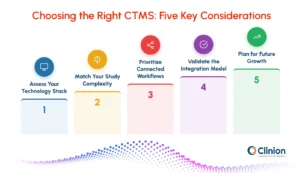
Evaluate Your Existing Technology Stack
If your organization already uses an EDC, eTMF, or other clinical applications, assess how the CTMS will integrate with those systems. Native integrations may simplify implementation, while API-based or third-party connections can offer greater flexibility in multi-vendor environments.
Match the Platform to Study Complexity
The needs of a research site running a handful of studies differ significantly from those of a global sponsor managing multinational trials. Choose a platform whose capabilities align with your operational scale rather than paying for functionality that may never be used.
Look Beyond Feature Lists
Instead of comparing features alone, evaluate how information moves between CTMS, EDC, and eTMF. Connected workflows can reduce duplicate data entry, improve operational visibility, and minimize manual reconciliation throughout the trial lifecycle.
Validate the Integration Model
Ask vendors how integrations are implemented, what information is synchronized, whether updates are bidirectional, and what level of configuration or technical support is required. Understanding these details early can help avoid unexpected implementation challenges.
Consider Long-Term Scalability
As clinical programs expand, technology requirements often change. Assess whether the platform can support additional studies, users, geographic regions, or eClinical applications without requiring significant system changes.
Conclusion
Selecting the right CTMS is about more than comparing features or choosing the most widely adopted platform. The real value lies in how effectively the system connects with EDC, eTMF, and the broader clinical technology ecosystem to support efficient, connected trial execution. While some platforms provide native integration within a unified environment, others offer configurable or API-based connectivity that may better align with existing technology investments and organizational needs.
As this comparison demonstrates, integration approaches, implementation models, and workflow capabilities vary considerably across platforms. Evaluating these differences alongside scalability, deployment requirements, and long-term operational fit will help organizations identify a solution that not only meets current study needs but also supports future clinical research growth. Ultimately, the best CTMS is the one that integrates seamlessly with your clinical operations and enables teams to manage studies more efficiently from startup through closeout.
Research disclaimer: This comparison is based on publicly available vendor information, product documentation, and independent review sources at the time of research. Features, integrations, and availability may vary by edition, region, and configuration. Organizations should conduct their own due diligence, including vendor demos and technical validation, before selecting a CTMS. Platforms are listed alphabetically and are not ranked.
Manage clinical trial operations with a connected CTMS
See how Clinion CTMS helps clinical teams manage study planning, site performance, subject tracking, milestones, monitoring workflows, reporting, and trial oversight from one connected platform.
External References