- Summary
- Which eConsent Platform Is Right for Your Clinical Trial?
- What to Look for in an eConsent Platform
- Compare the Leading eConsent Platforms
- The 10 Best eConsent Software Platforms for Clinical Trials
- Why Sponsors Switch eConsent Platforms
- Questions to Ask Before Choosing an eConsent Vendor
- What Does Implementation Involve?
- Which eConsent Platform Is Right for Your Study?
- Conclusion
- External References
Summary
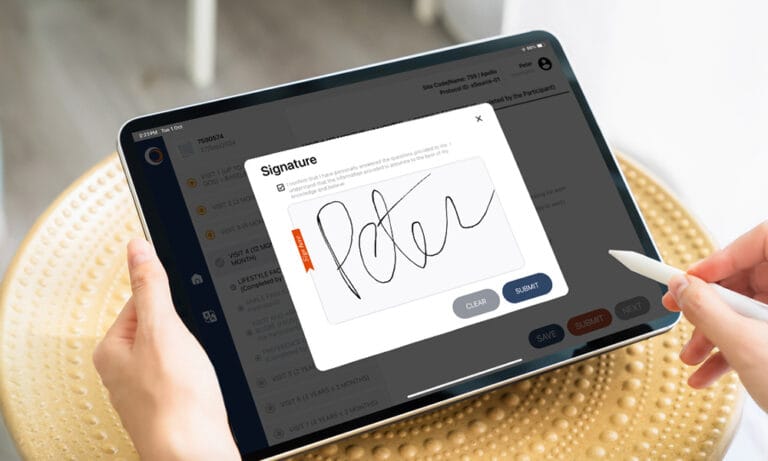
Selecting an eConsent platform is about more than replacing paper consent with a digital form. The right solution can improve participant understanding, simplify protocol amendments, support regulatory compliance, and integrate seamlessly with the rest of your clinical technology ecosystem. With dozens of platforms offering similar capabilities, however, identifying the best fit isn't always straightforward.
Which eConsent Platform Is Right for Your Clinical Trial?
There's no single eConsent platform that's right for every study. A solution designed for global, multi-country trials may offer capabilities that smaller studies don't need, while platforms built for decentralized or hybrid trials may prioritize participant-facing features over enterprise-scale workflows.
Rather than focusing on the longest feature list, evaluate each platform based on how well it supports your study's operational needs. To help you narrow your options, we've compared the leading eConsent platforms using consistent evaluation criteria and practical buying considerations that matter across different types of clinical trials.
What Is eConsent in Clinical Trials?
Learn how electronic informed consent improves participant understanding, supports remote consent, strengthens version control, and helps study teams manage consent documentation with better traceability.
What to Look for in an eConsent Platform
Every eConsent platform digitizes the consent process, but the capabilities behind the interface can vary significantly. Beyond capturing electronic signatures, the right platform should simplify consent management, improve participant understanding, and fit seamlessly into your clinical trial workflows.
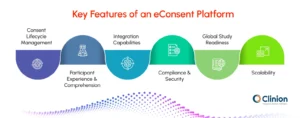
Before comparing vendors, evaluate these key capabilities.
Consent Lifecycle Management
An effective eConsent platform should support the entire consent lifecycle, not just the initial signature. Look for capabilities such as version control, automated reconsent, protocol amendment management, audit trails, and consent tracking to ensure participants always receive the correct, IRB-approved documents throughout the study.
Participant Experience & Comprehension
Informed consent is about understanding, not just signing a document. Features such as videos, illustrations, interactive content, multilingual support, and comprehension checks can help participants better understand study procedures, risks, and expectations before they provide consent.
eConsent vs. eSignature
eSignature
Captures a participant's signature electronically.
eConsent
Supports the entire informed consent process with educational content, comprehension tools, version control, and audit trails.
Integration Capabilities
Your eConsent platform should work seamlessly with the rest of your clinical technology ecosystem. Native or API-based integrations with EDC, CTMS, ePRO, RTSM, and other systems reduce duplicate data entry, streamline workflows, and maintain consistent participant information across the study.
Compliance & Security
Regulatory compliance should be built into the platform, not managed through manual processes. Evaluate whether the solution supports requirements such as 21 CFR Part 11, GDPR, electronic audit trails, secure data handling, and role-based access controls appropriate for your study.
Global Study Readiness
For multinational studies, look beyond language translation. Consider whether the platform supports multilingual consent, country-specific workflows, regional regulatory requirements, and flexible consent processes that can adapt to local ethics committee expectations.
Scalability
The platform you choose should support both your current study and future research needs. Consider how easily it can scale across different study phases, therapeutic areas, countries, and participant populations without introducing unnecessary operational complexity.
Compare the Leading eConsent Platforms
| Platform | Best For | Deployment | Key Integrations | Remote Consent | Multilingual Support | Reconsent | Standout Strength |
|---|---|---|---|---|---|---|---|
| Advarra eConsent | Institutional research and site networks | Cloud | Advarra ecosystem | ✓ | ✓ | ✓ | Research compliance and IRB support |
| Castor eConsent | Academic research and smaller studies | Cloud | Castor EDC | ✓ | ✓ | Limited | Ease of use and rapid deployment |
| Clinion eConsent | Sponsors, CROs, and biotech companies | Cloud | EDC, RTSM, CTMS, ePRO, eSource, eTMF | ✓ | ✓ | ✓ | Unified eClinical platform with AI capabilities |
| Florence eConsent | Research sites and sponsors | Cloud | Florence platform | ✓ | ✓ | ✓ | Site-centric workflows |
| Medable | Decentralized and hybrid trials | Cloud | API integrations | ✓ | ✓ | ✓ | Decentralized trial capabilities |
| Medidata eConsent | Enterprise pharmaceutical companies | Cloud | Medidata platform | ✓ | ✓ | ✓ | Enterprise scalability and ecosystem integration |
| Medrio eConsent | Medical device and mid-market studies | Cloud | Medrio platform | ✓ | ✓ | ✓ | Simplicity and regulatory compliance |
| Signant SmartSignals | Global and complex clinical trials | Cloud | Signant platform | ✓ | ✓ | ✓ | Strong participant engagement features |
| Veeva eConsent | Organizations using Veeva Vault | Cloud | Veeva Vault | ✓ | ✓ | ✓ | Native Vault integration |
| Viedoc eConsent | Mid-sized clinical studies | Cloud | Viedoc platform | ✓ | ✓ | ✓ | Integrated EDC workflows |
Note: Platform capabilities may vary by license, product version, configuration, deployment model, and regional availability. Buyers should confirm current functionality directly with each vendor.
The 10 Best eConsent Software Platforms for Clinical Trials
The detailed reviews below take a closer look at each solution, including its core strengths, ideal use cases, and factors buyers should consider during the evaluation process. The goal is to help you determine which solution best aligns with your study requirements, organizational needs, and existing clinical technology ecosystem.
Advarra eConsent
Advarra eConsent is an electronic informed consent solution that helps research organizations digitize and manage participant consent throughout the clinical trial lifecycle. As part of Advarra's broader research technology ecosystem, it is commonly used by sponsors, CROs, and research sites.
Best For
- Academic medical centers and research institutions
- Sponsors managing regulated clinical studies
- Site networks transitioning from paper-based consent
- Organizations already using Advarra solutions
Key Highlights
- Supports multimedia consent experiences to improve participant understanding.
- Enables electronic consent, reconsent, and consent version management.
- Maintains audit trails to support regulatory compliance.
- Integrates with Advarra's broader research ecosystem.
Advarra eConsent is well suited for organizations seeking a compliance-focused consent solution, particularly those already using other Advarra products. Buyers evaluating broader eClinical interoperability should review available integrations to ensure the platform aligns with their existing technology stack.
Castor eConsent
Castor eConsent is part of the Castor clinical trial platform and enables research teams to manage informed consent digitally. Designed with simplicity and flexibility in mind, it is widely used for academic research, investigator-initiated studies, and small to mid-sized clinical trials.
Best For
- Academic and investigator-initiated studies
- Small to mid-sized clinical trials
- Research teams seeking rapid study deployment
- Organizations already using Castor EDC
Key Highlights
- Simplifies electronic consent creation and participant enrollment.
- Supports remote consent and centralized consent management.
- Integrates with Castor EDC to streamline study workflows.
- Offers an intuitive interface for both study teams and participants.
Castor eConsent is a practical choice for organizations that prioritize ease of use and quick implementation. Sponsors planning large, multinational studies should assess whether its capabilities align with the complexity and scale of their research programs.
Clinion eConsent
Clinion eConsent is part of Clinion's unified eClinical platform, enabling sponsors and CROs to manage participant consent alongside study operations. By integrating with applications such as EDC, RTSM, CTMS, ePRO, and eSource, it helps reduce disconnected workflows and supports a more streamlined trial experience.
Best For
- Sponsors managing Phase I to Phase IV clinical trials
- CROs seeking a unified eClinical platform
- Organizations adopting decentralized or hybrid trial models
- Research teams looking to consolidate clinical trial technologies
Key Highlights
- Integrates natively with Clinion's unified eClinical platform.
- Supports multimedia consent, remote consent, and electronic reconsent.
- Maintains audit trails and version control for regulatory compliance.
- Reduces duplicate data entry through connected clinical workflows.
Organizations looking to manage consent within a unified clinical trial ecosystem may find Clinion particularly valuable, especially when reducing system fragmentation is a priority. Buyers considering standalone consent software should evaluate whether a broader integrated platform better aligns with their long-term technology strategy.
Florence eConsent
Florence eConsent is part of the Florence eBinders platform and helps research sites and sponsors manage informed consent digitally. The platform focuses on simplifying participant enrollment while supporting compliant consent workflows across traditional, hybrid, and decentralized clinical trials.
Best For
- Research sites managing multiple clinical studies
- Sponsors running hybrid or decentralized trials
- Organizations seeking site-centric workflows
- Teams already using the Florence platform
Key Highlights
- Supports electronic and remote informed consent.
- Offers multimedia content to improve participant understanding.
- Simplifies consent version management and reconsent.
- Integrates with the Florence research ecosystem.
Florence eConsent is well suited for research sites and sponsors looking to modernize consent management while maintaining familiar site workflows. Organizations with broader eClinical integration requirements should evaluate how the platform fits within their existing technology landscape.
Medable
Medable eConsent is part of the Medable decentralized clinical trial platform, enabling participants to review and complete informed consent remotely. It is designed to support patient-centric study experiences while helping sponsors manage consent across decentralized and hybrid clinical trials.
Best For
- Decentralized clinical trials (DCTs)
- Hybrid clinical trial models
- Global patient recruitment programs
- Sponsors focused on participant engagement
Key Highlights
- Enables fully remote electronic consent workflows.
- Supports multimedia content and participant comprehension.
- Offers multilingual consent for global studies.
- Integrates with Medable's decentralized trial platform.
Medable is a strong option for organizations prioritizing decentralized research and remote participant engagement. Sponsors evaluating the platform should consider how its broader DCT ecosystem aligns with their operational and technology requirements.
Medidata eConsent
Medidata eConsent is part of the Medidata Platform and enables sponsors and CROs to digitize the informed consent process across global clinical trials. It is widely adopted by enterprise organizations seeking integrated study management and participant engagement within a single ecosystem.
Best For
- Enterprise pharmaceutical companies
- Global Phase II to Phase IV clinical trials
- Sponsors using the Medidata Platform
- Large CROs managing complex studies
Key Highlights
- Supports electronic consent, reconsent, and audit trails.
- Includes multimedia tools to enhance participant understanding.
- Integrates natively with the Medidata clinical ecosystem.
- Supports multinational studies with multilingual capabilities.
Medidata eConsent is well suited for large organizations seeking an integrated enterprise platform. Buyers should assess the broader Medidata ecosystem and implementation approach to determine whether it aligns with their operational needs and existing technology investments.
Medrio eConsent
Medrio eConsent is an electronic informed consent solution designed to simplify participant enrollment and consent management. As part of the Medrio clinical research platform, it focuses on usability, regulatory compliance, and efficient study execution for sponsors and CROs.
Best For
- Medical device studies
- Small to mid-sized sponsors
- CROs managing regulated clinical research
- Organizations seeking straightforward implementation
Key Highlights
- Supports electronic consent and remote enrollment.
- Maintains secure audit trails and consent version history.
- Simplifies study startup with intuitive workflows.
- Integrates with the Medrio clinical platform.
Medrio eConsent is a practical choice for organizations looking for a straightforward, compliance-focused solution without unnecessary complexity. Sponsors with extensive enterprise integration requirements should evaluate how the platform fits into their broader clinical technology ecosystem.
Signant SmartSignals eConsent
Signant SmartSignals eConsent is part of the Signant Health platform and helps sponsors digitize informed consent while improving participant engagement. Designed for global clinical trials, it supports compliant consent management across traditional, hybrid, and decentralized study models.
Best For
- Large global clinical trials
- Sponsors managing multi-country studies
- Organizations focused on participant engagement
- CROs running complex clinical programs
Key Highlights
- Supports electronic consent, remote consent, and reconsent.
- Uses multimedia content to improve participant understanding.
- Enables multilingual consent for global studies.
- Integrates with the broader Signant Health platform.
Signant SmartSignals eConsent is a strong choice for organizations conducting global studies that require consistent participant experiences across multiple regions. Buyers should evaluate how well the platform integrates with their existing clinical technology ecosystem and operational workflows.
Veeva eConsent
Veeva eConsent is part of the Veeva Vault Clinical Suite, enabling sponsors and research sites to digitize and manage informed consent throughout the clinical trial lifecycle. The platform is designed to simplify consent management while supporting regulatory compliance and connected clinical operations.
Best For
- Organizations using Veeva Vault Clinical Suite
- Enterprise pharmaceutical companies
- Global clinical trial programs
- Sponsors seeking integrated clinical workflows
Key Highlights
- Supports electronic consent, remote consent, and reconsent.
- Provides version control and comprehensive audit trails.
- Integrates seamlessly with the Veeva Vault ecosystem.
- Offers multilingual support for global clinical studies.
Veeva eConsent is well suited for organizations already invested in the Veeva ecosystem and looking for a connected approach to clinical trial management. Sponsors using multiple third-party systems should assess integration capabilities during their evaluation.
Viedoc eConsent
Viedoc eConsent is part of the Viedoc clinical trial platform and helps research teams manage informed consent through a secure digital workflow. Designed to work alongside Viedoc EDC, it simplifies participant enrollment while supporting compliant consent management across a range of clinical studies.
Best For
- Small to mid-sized sponsors
- CROs managing multiple studies
- Organizations using Viedoc EDC
- Clinical trials seeking an integrated platform
Key Highlights
- Supports electronic consent and remote participant enrollment.
- Simplifies consent version management and reconsent.
- Integrates with the Viedoc clinical trial platform.
- Helps maintain secure, compliant consent documentation.
Viedoc eConsent is a practical option for organizations seeking a streamlined consent solution within an integrated clinical trial platform. Buyers should consider how its capabilities align with their study complexity, integration needs, and long-term technology strategy.
Why Sponsors Switch eConsent Platforms
Implementing an eConsent platform is a long-term investment, but that doesn't mean organizations stay with the same solution forever. As clinical trials become more complex, sponsors and CROs often find that a platform that once met their needs may no longer support their evolving workflows, technology ecosystem, or global operations.
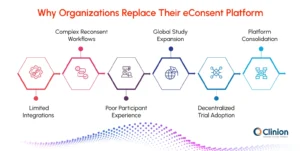
While every organization has different priorities, these are some of the most common reasons teams evaluate a new eConsent solution.
Limited Integration Capabilities
Many organizations adopt eConsent as a standalone tool, only to discover that disconnected systems create duplicate data entry and fragmented workflows. Integrating eConsent with platforms such as EDC, CTMS, ePRO, and RTSM can help reduce manual effort and improve data consistency throughout the study.
Challenges Managing Protocol Amendments
Protocol amendments often require participants to review and sign updated consent forms. Without efficient reconsent workflows, study teams may spend significant time tracking document versions, coordinating participant communication, and maintaining compliance.
Poor Participant Experience
Complicated interfaces, lengthy consent documents, and limited accessibility can make it difficult for participants to understand study information. Modern eConsent platforms increasingly support multimedia content, multilingual experiences, and remote consent to improve engagement and comprehension.
Scaling Across Global Studies
As studies expand into new countries, sponsors may need support for multiple languages, regional regulations, and varying ethics committee requirements. Organizations often reassess their eConsent platform when preparing for larger, multinational clinical trials.
Transitioning to Decentralized and Hybrid Trials
Traditional consent workflows may not fully support remote enrollment or virtual study visits. Sponsors adopting decentralized or hybrid trial models often look for platforms that enable secure remote consent while maintaining regulatory compliance.
Consolidating Clinical Trial Technologies
Managing multiple standalone applications can increase administrative effort and create disconnected workflows. Some organizations choose to move toward integrated eClinical platforms that bring consent together with study management, data capture, and participant-facing technologies.
Questions to Ask Before Choosing an eConsent Vendor
Once you've shortlisted a few eConsent platforms, the next step is evaluating how well they align with your organization's operational, regulatory, and technical requirements. Asking the right questions during vendor demonstrations can help you identify potential limitations early and ensure the platform supports both your current and future studies.
How does the platform support protocol amendments and reconsent?
Protocol changes are common throughout the course of a clinical trial. Ask how the platform manages consent versioning, participant notifications, and reconsent workflows to ensure updates can be implemented efficiently while maintaining compliance.
Does it integrate with your existing clinical technology stack?
Understanding how the platform connects with systems such as EDC, CTMS, RTSM, ePRO, and eSource can help reduce manual data entry and improve operational efficiency. Clarify whether integrations are native, API-based, or require additional development.
How does the platform improve participant understanding?
Electronic informed consent should do more than capture signatures. Ask whether the platform supports multimedia content, multilingual consent, accessibility features, and comprehension assessments that help participants make informed decisions.
What compliance and security measures are included?
Request details about support for regulations such as 21 CFR Part 11, GDPR, and regional privacy requirements. It's also important to understand how the platform manages audit trails, user permissions, data security, and electronic records.
Can the platform support future studies?
Your research needs may evolve over time. Ask whether the solution can scale across different study phases, therapeutic areas, countries, and participant populations without requiring significant changes to your existing workflows.
What does implementation and ongoing support look like?
Implementation timelines, training resources, customer support, and post-deployment assistance can vary between vendors. Understanding what's included can help set realistic expectations and ensure a smoother transition for study teams.
What Does Implementation Involve?
Selecting an eConsent platform is only the first step. Successful implementation requires careful planning to ensure the platform integrates with existing processes, meets regulatory requirements, and is adopted effectively by study teams and participants.
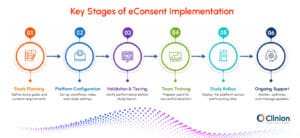
Although implementation timelines vary depending on study complexity and organizational requirements, the process typically includes the following stages.
Study and Workflow Planning: Define study-specific consent requirements, participant workflows, language needs, and regulatory considerations before configuring the platform.
Platform Configuration: Configure consent forms, user roles, workflows, integrations, and study settings to align with the approved protocol and organizational processes.
Validation and User Acceptance Testing: Test consent workflows, integrations, and system functionality to verify that the platform performs as expected before study launch.
Training and Study Rollout: Provide training for study teams, site staff, and other stakeholders to ensure consistent adoption and efficient use of the platform.
Ongoing Support and Optimization: Monitor platform performance throughout the study, address protocol amendments, manage reconsent activities, and implement updates as operational requirements evolve.
Implementation requirements vary by vendor and study complexity, so it's important to understand the level of support, training, and technical assistance included before making a purchasing decision.
Which eConsent Platform Is Right for Your Study?
Rather than asking which platform is the "best," it's more useful to identify the solution that best aligns with your study requirements, operational workflows, and long-term technology strategy. The recommendations below provide a starting point based on common clinical research scenarios.
If you're... | You may want to consider... |
A large pharmaceutical company managing global studies | Enterprise platforms with strong scalability, compliance, and global support, such as Medidata or Veeva. |
A CRO managing multiple sponsors and study types | Flexible platforms that integrate with diverse clinical systems and support a range of workflows, such as Clinion, Viedoc, or Medrio. |
An emerging biotech company | Solutions that balance functionality with ease of implementation and scalability, such as Castor or Medrio. |
Running decentralized or hybrid clinical trials | Platforms with robust remote consent, participant engagement, and virtual study capabilities, such as Medable or Signant SmartSignals. |
A research institution or academic center | Platforms designed for investigator-led research and institutional workflows, such as Advarra or Castor. |
Looking to consolidate your clinical technology stack | Unified eClinical platforms that combine eConsent with applications such as EDC, CTMS, RTSM, and ePRO, such as Clinion. |
The right platform ultimately depends on your study design, participant population, regulatory requirements, existing technology ecosystem, and long-term research goals. Evaluating multiple vendors against your organization's priorities will help you select a solution that supports both current studies and future growth.
Conclusion
Selecting an eConsent platform isn't about choosing the solution with the most features. It's about finding the platform that best supports your study's operational needs, regulatory requirements, participant experience, and long-term technology strategy.
As clinical trials continue to evolve, eConsent has become more than a digital replacement for paper forms. Today's platforms play an important role in improving participant understanding, streamlining consent management, supporting decentralized research, and integrating with broader eClinical workflows.
Whether you're evaluating your first eConsent platform or considering a change from your current solution, taking the time to compare vendors, ask the right questions, and assess how each platform aligns with your research goals can help you make a more confident purchasing decision.
External References