
How to choose EDC software for clinical trials: on evidence, not demos.
A practical five-step framework for defining requirements, weighting the capabilities that matter, evaluating AI-assisted review, scoring vendors and modeling total cost of ownership. Built for sponsors, CROs, biotech and MedTech teams.
- Data review and query management 20%
- Compliance, security and auditability 20%
- Study build and configuration 15%
- Data capture and site usability 15%
- Integrations and interoperability 15%
- Pricing and total cost of ownership 10%
- Support, implementation and training 5%
what to look for
A strong EDC platform should support configurable eCRFs, real-time edit checks, structured query management, role-based access, complete audit trails, e-signatures, medical coding, dashboards, exports and integrations with RTSM, CTMS, ePRO, eConsent and eSource. Evaluate study build speed, amendment flexibility, site usability and total cost of ownership, not just the license price. AI capabilities increasingly matter for configuration, data review, queries, reporting and standards mapping, but judge them on intended use, human oversight, traceability, validation and measurable operational value.
What is EDC software in clinical trials?
Electronic Data Capture (EDC) software is the central system used to collect, integrate, validate, review and manage clinical trial data electronically.
It supports protocol-aligned eCRFs, but its role extends well beyond form-based data entry. Modern EDC platforms bring together data from ePRO, eSource, laboratories, RTSM, medical imaging, wearable devices and other external systems.
Within the EDC environment, study teams apply edit checks, manage discrepancies and queries, control user access, maintain audit trails, support electronic signatures, perform medical coding, generate reports, and prepare structured datasets for downstream analysis and regulatory submission.
In simple terms: EDC provides the controlled data environment through which clinical trial information is captured, consolidated, reviewed, corrected, and prepared for use by data management, clinical operations, biostatistics, and regulatory teams.
Many platforms also support standards such as CDASH and connect with broader eClinical systems (RTSM, CTMS, ePRO, eConsent, eSource and eTMF), allowing EDC to function as part of a connected clinical trial technology ecosystem rather than an isolated data-entry tool.
The five-step EDC selection process
Feature checklists are useful, but they don't tell you how to get from "we need new EDC" to a signed contract. The clearest path is five steps: define requirements, set your must-haves, shortlist vendors, score the demos and evidence, and pressure-test the commercial model before you sign.
Define study & business requirements
STEP / 02Weight the capabilities that matter
STEP / 03Shortlist & run comparable demos
STEP / 04Score evidence with a scorecard
STEP / 05Model total cost of ownership
Once the selection process is defined, buyers need a consistent way to compare shortlisted vendors. The weighting model below translates the most important operational, regulatory, technical, and commercial considerations into a practical scoring framework, helping teams evaluate vendors on more than feature breadth or presentation quality.
| Evaluation area | Suggested weight | Why it belongs in the model |
|---|---|---|
| Study build and configuration | 15% | Startup speed and dependency on vendor services |
| Data capture and site usability | 15% | Site adoption and data quality at entry |
| Data review and query management | 20% | Review-cycle efficiency and database-lock readiness |
| Compliance, security and auditability | 20% | Non-negotiable for regulated trial execution |
| Integrations and interoperability | 15% | Cross-system continuity, less reconciliation work |
| Support, implementation and training | 5% | Time to value and issue resolution |
| Pricing and total cost of ownership | 10% | Commercial viability over the study lifecycle |
* These weights are an editorial starting point rather than a fixed industry standard. Adapt them to your organization's study mix, operating model, and risk tolerance.
Define your study and business requirements
Separate study complexity from buying-model complexity before comparing anything.
A buyer's guide is only useful once you've separated study complexity from buying-model complexity. A study can be simple from a protocol standpoint and still be hard to operationalize if your team has limited internal build resources, a multi-system ecosystem, an aggressive timeline, or a need to minimize change orders.
Study-led questions Protocol
- Phase, therapeutic area and visit complexity
- Expected subject volume and number of sites
- Geographic and multi-country spread
- Decentralized elements, imaging or randomization needs
- Patient-reported data sources (ePRO, wearables)
- Downstream standards requirements (CDASH, SDTM)
Organization-led questions Operating model
- Single-study purchase, or a platform decision for the portfolio?
- Will study build stay in-house, or depend on vendor services?
- Does historical data need to migrate from an existing EDC?
- Standalone EDC, or a unified eClinical suite?
- Are AI features expected to meaningfully reduce review burden, or are they a nice-to-have?
Buyer readiness check
| Readiness question | Why it matters | Typical owner |
|---|---|---|
| Single-study buy or platform decision? | Changes how much you weight scalability and governance | Clinical operations |
| Who configures studies after go-live? | Determines whether codeless self-service matters more than vendor services | Data management / systems |
| Do we need amendments without downtime? | Affects cost, timeline risk and vendor dependence | Clinical operations |
| Do we need eSource, ePRO, eConsent, RTSM, CTMS or eTMF in the same ecosystem? | Determines whether unified-platform value should be scored explicitly | Clinical operations / IT |
| Is CDASH or another standard required at collection? | Impacts startup efficiency and downstream submission readiness | Data standards / DM |
| Have we defined acceptable and prohibited AI use cases? | Prevents buying vague AI capability with no governance plan | QA / DM / leadership |
| Do we know our validation and security-document expectations? | Essential for regulated procurement and vendor screening | QA / IT security |
| Do we have a total-cost horizon and budget range? | Prevents over-optimizing on license fee alone | Finance / procurement |
Define and weight the EDC capabilities that matter
Six capability groups define trustworthy electronic trial data.
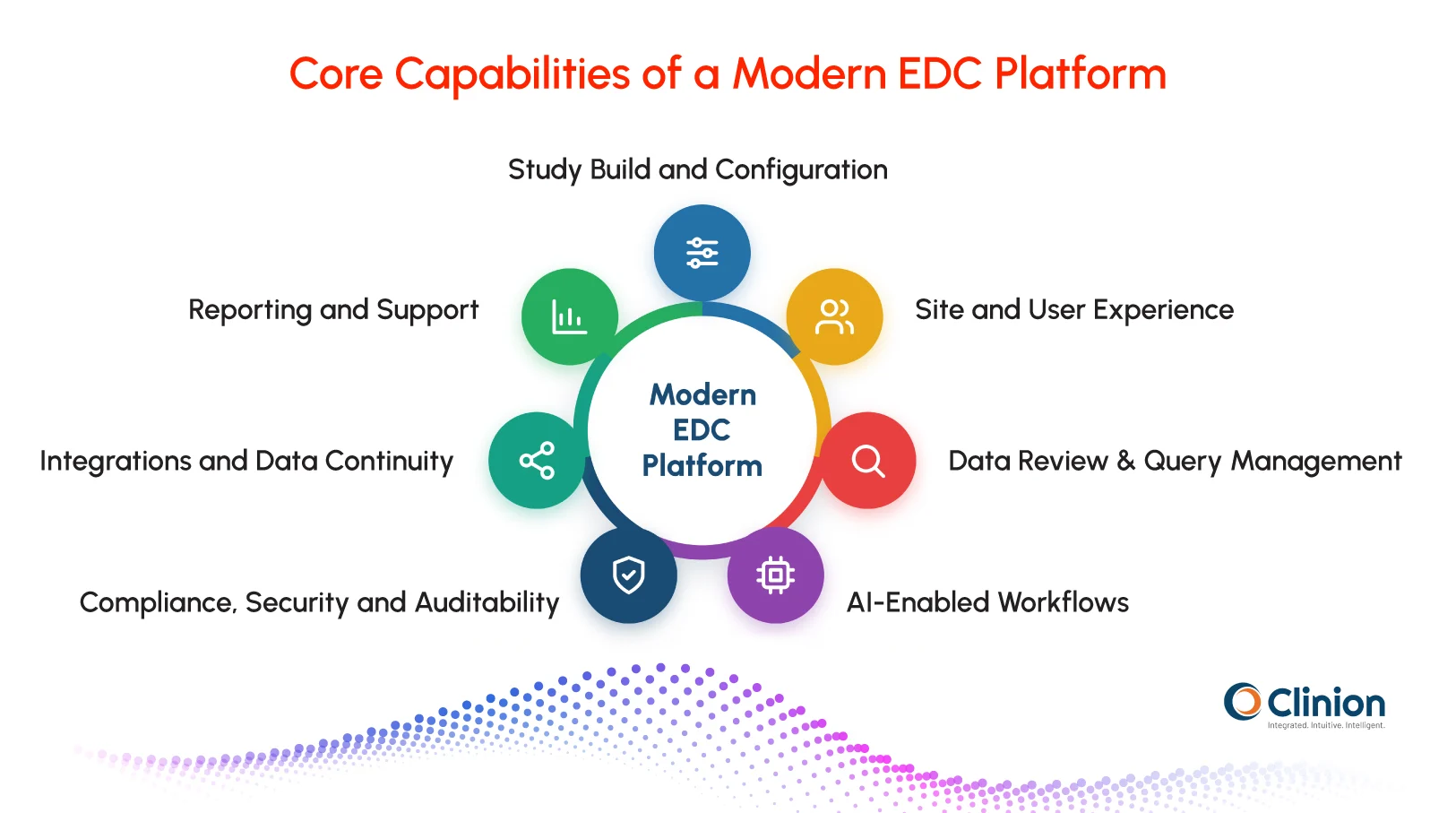
These capability groups reflect what buyers need from trustworthy electronic trial data: fit-for-purpose configuration, traceable collection, auditable handling, controlled access, interoperable data structures and dependable support.
| Capability group | What to evaluate | Key buyer question |
|---|---|---|
| Study build and configuration | Forms, visits, checks, workflows, libraries and version control | Can authorized users configure and reuse studies without heavy programming? |
| Data capture and site usability | Investigator and site-facing workflows, corrections, navigation and training | Can site users complete common tasks without avoidable friction? |
| Data review and query management | Discrepancy detection, query lifecycle, bulk actions and aging | Can reviewers prioritize, issue and close queries efficiently? |
| Compliance, security and auditability | Validation, audit trails, access control, e-signatures and inspection readiness | Can the vendor produce evidence, not only compliance statements? |
| Integrations and interoperability | Native connections, APIs, exports, reconciliation and support ownership | Which integrations are native, proven and auditable? |
| Reporting, support and scalability | Self-service reporting, implementation, training, service levels and multi-study use | Can the platform scale without increasing dependence on vendor services? |
In practice, this means asking vendors to demonstrate how they support named frameworks 21 CFR Part 11, ICH GCP, GDPR and, for device studies, EU MDR, rather than accepting a general compliance claim at face value.
Site adoption and training
An EDC platform may meet technical requirements but still create operational delays if site users find data entry, navigation or query response difficult. Assess the number of steps required to complete common tasks, the clarity of visit and form status, multilingual support, contextual help, training requirements, and the level of support available during study startup.
Two areas deserve separate consideration because they can materially change both platform value and risk: AI-enabled workflows and the choice between standalone EDC and a unified eClinical platform.
How to evaluate AI-enabled EDC
Treat AI as a workflow capability that needs controls, not as a badge on a feature page. Ask what each AI capability does, what data it reads, how users supervise it and what evidence supports its intended use.
In a regulated EDC context, the safest operating model for high-impact workflows is usually "AI proposes, humans approve." This is especially important when AI contributes to study configuration, review checks, queries, coding, standards mapping or reports.
| AI dimension | What good looks like | Red flag |
|---|---|---|
| Data sources | Sources are explicit, study-bounded and documented | Vendor can't state what the model reads |
| Explainability | Source-backed outputs, citations, reproducible context | "Black box" answers with no evidence chain |
| Traceability | Every output is logged and attributable | Output can't be reconstructed after the fact |
| Human oversight | Review and approval required before high-impact actions | Actions auto-post without review |
| Validation | Intended use, tests, limits and change controls are documented | Marketing claims with no validation package |
| False positives | Tuning and reviewer feedback loops are visible | Alert volume rises with no measurable benefit |
| Governance | RBAC, study isolation and policy controls exist | Cross-study leakage risk or broad open access |
| Audit logs | Prompt, source, user action and timestamp are accessible | No exportable or reviewable logs |
Standalone EDC vs. unified eClinical platform
Standalone EDC can be the right call if you already have strong best-of-breed adjacent systems and want to optimize data capture specifically. A unified eClinical platform tends to be the better answer when you want fewer handoffs, fewer integrations to maintain, and a more continuous workflow from consent through capture, review and closeout.
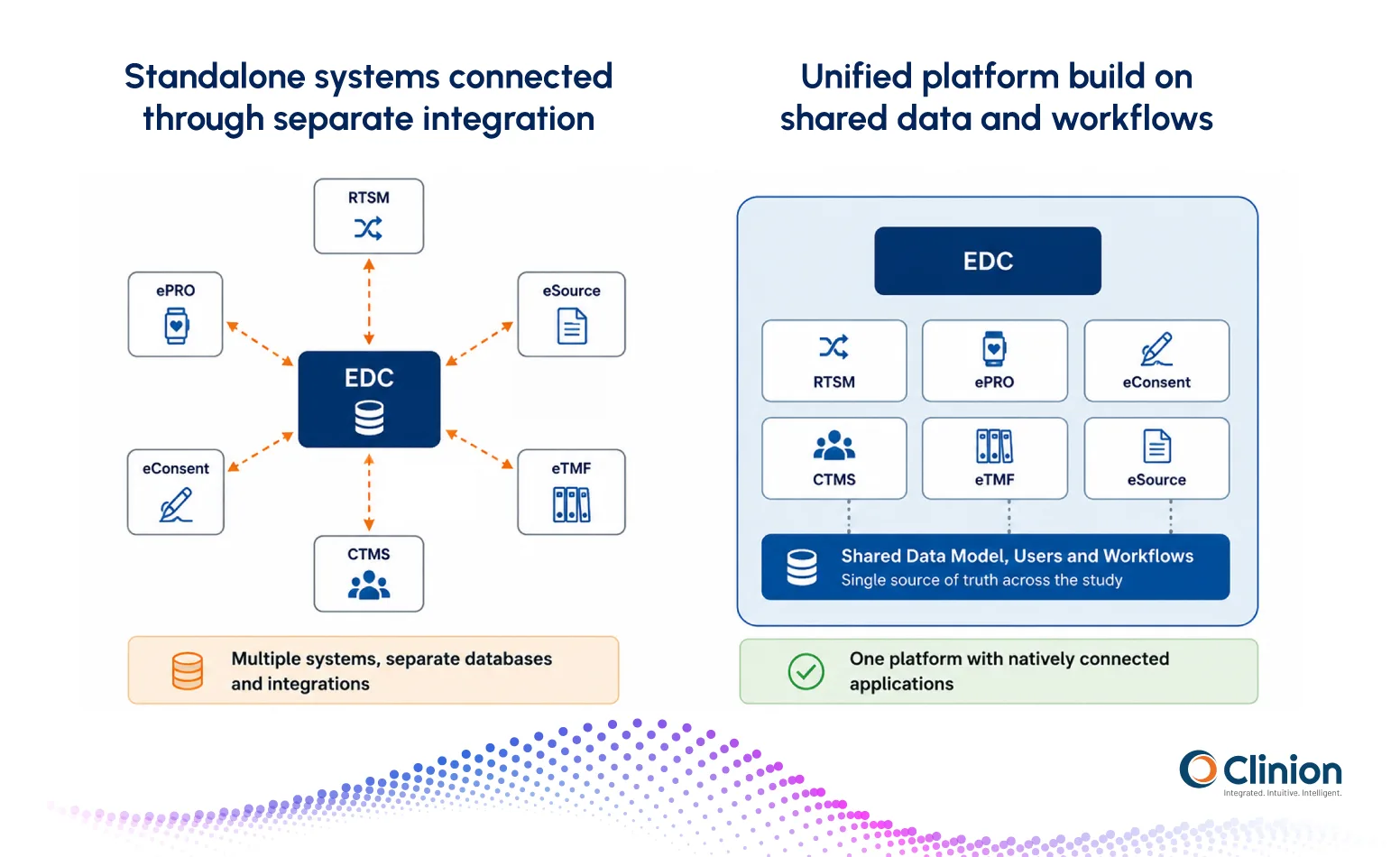
A unified platform may reduce handoffs and reconciliation, but buyers should also evaluate module maturity and vendor-concentration risk.
| Dimension | Standalone EDC | Unified eClinical platform |
|---|---|---|
| Integration effort | Often higher, because adjacent tools must be connected | Often lower if modules are natively connected |
| Duplicate entry risk | Higher when patient or site data must sync across systems | Lower when modules share a data model |
| Reconciliation burden | Higher across vendors and data stores | Lower with a shared or tightly integrated model |
| Vendor management | Multiple contracts and escalation paths | Fewer vendors, but more concentration risk |
| Reporting continuity | Often distributed across tools | Easier when operational and clinical data can be queried together |
| Implementation flexibility | Can be best-of-breed and modular | Can be faster to deploy for standardized stacks |
| Total cost | Depends on integration and amendment pattern | Depends on suite breadth and lock-in risk |
Implementation, data migration and vendor continuity
Implementation is a major source of EDC risk. Clarify how study configuration, validation, user acceptance testing, training and production deployment will be managed. If an existing system is being replaced, the evaluation should also cover data migration, metadata transfer, audit-trail retention, reconciliation and validation of migrated records.
Before you sign, get these in writing De-risk
- Request a clear responsibility matrix
- Ask for a protocol-to-production timeline with assumptions
- Define the required buyer resources and approval points
- Confirm the migration scope and validation approach
- Review training, go-live support and escalation procedures
Vendor viability and service continuity
EDC selection is also a long-term vendor decision. Assess product maturity, implementation capacity, support coverage, release management, customer retention, business continuity and the ability to support the required regions and study types.
Data ownership and exit planning
Before signing, confirm who owns the study data, how it can be exported and what support is available at study closeout or contract termination. The agreement should address metadata, audit trails, query histories, configuration records, user-access records and archival requirements.
Testing amendment handling? Watch it live, not on a slide.
Mid-study change costs can dominate total cost of ownership. Ask Clinion to amend a live visit on your protocol without taking the study offline.
Shortlist vendors and run comparable demos
Workflow realism beats feature breadth.
Two to four vendors are usually sufficient for a serious shortlist. What matters more than feature breadth is workflow realism. Ask every vendor to complete the same protocol-based scenarios rather than relying on a curated sales walkthrough.
The six demo scenarios every vendor should run Same protocol, every vendor
- Build a form from a protocol excerpt
- Amend a live visit without taking the study offline
- Review a discrepancy and issue a query
- Track a query from open to closed
- Generate a report from a natural-language or ad hoc request
- Pull a complete audit trail for a single subject
Score the evidence with a vendor scorecard
Score each shortlisted vendor against the same weighted categories. Try it below.
Keep the scorecard blank until demonstrations and documentation reviews are complete. One strong feature should not outweigh weak compliance, implementation or support evidence.
Interactive weighted vendor scorecard
SCORE 0 TO 5 PER CATEGORY · WEIGHTED /100 · CALCULATES LIVE| Evaluation area | Weight | |||
|---|---|---|---|---|
| Weighted total | 100 | 0 | 0 | 0 |
Scores stay in your browser. Nothing is saved or sent. Adapt the weights to your own study mix and risk tolerance.
Get this as a shareable worksheetRFP questions to ask EDC vendors
An RFP, or Request for Proposal, is a formal document sent to shortlisted EDC vendors during selection. It outlines the buyer's study, technical, compliance, implementation and commercial requirements and asks each vendor to explain how its platform and services meet them.
Using the same RFP questions for every vendor makes responses easier to compare and creates a documented basis for scoring functionality, validation, security, support, implementation timelines and total cost of ownership. The questions below are the ones most likely to separate vendors on substance rather than presentation.
RFP·01Study build and configuration
- Describe which study-configuration activities can be completed by authorized client users without custom programming or vendor services.
- Which reusable libraries, therapeutic-area templates or accelerators are available?
- How are forms, edit checks, visits and workflows version-controlled?
- What is the typical timeline from final protocol to production go-live?
- How are mid-study amendments tested, approved and deployed?
RFP·02Data capture and review
- How do sites enter, correct and submit data while preserving complete change history?
- Which field-level, form-level, cross-form and cross-visit checks are supported?
- Can queries be created, assigned, reviewed and closed in bulk?
- Can reviewers monitor query status, ownership and aging by site or study?
- How are medical coding and dictionary versions managed?
RFP·03Compliance, validation and security
- What system validation documentation is provided as standard?
- Are audit trails complete, time-stamped, searchable and exportable at field level?
- How are role-based access, user provisioning and access revocation managed?
- How are electronic signatures linked to the corresponding records?
- How does the platform support inspection readiness, backup and disaster recovery?
RFP·04Integrations and data exchange
- Which systems does the platform integrate with natively, including RTSM, CTMS, ePRO, eConsent, eSource, eTMF, laboratories, safety systems and imaging platforms?
- Which integrations require custom development or third-party services?
- How are interface failures identified, reported and resolved?
- Does the platform support CDASH-aligned configuration and standards-based exports such as ODM?
- How are reconciliation and support ownership handled across connected systems?
RFP·05AI capabilities and governance
- Which AI capabilities are production-ready today and which remain on the roadmap?
- Which workflows use AI, and what data sources does each capability read?
- Can authorized users review, modify, approve or reject AI outputs?
- How are AI recommendations explained, traced and logged?
- What validation evidence exists for each intended use?
- How are false positives, model changes, study isolation and customer-data use managed?
RFP·06Implementation and support
- What implementation activities are included in the proposal?
- Which responsibilities belong to the vendor and which belong to the buyer?
- How are UAT, validation, training and go-live supported?
- What support hours, response times and escalation procedures are included?
- How are urgent production issues and amendment requests managed?
RFP·07Data migration, ownership and exit
- How is data migrated from an existing EDC and how is migrated data validated?
- Who owns study data, metadata, audit trails and configuration records?
- Which records can be exported at closeout and in which formats?
- What transition support is available if the organization changes vendors?
- Which archival and retention options are available?
RFP·08Commercial and contractual
- Provide a complete pricing breakdown covering licensing, study build, implementation, integrations, validation support, training, protocol amendments, ongoing support, closeout and data export.
- Which fees vary by study, site, user, subject, module or data volume?
- Which costs increase materially if the study expands or the protocol changes?
- Are sandbox, validation and production environments priced separately?
- What customer references can you provide from organizations with comparable studies?
Model total cost of ownership
License price is not total cost of ownership.
The full commercial picture includes platform fees, implementation and study build, integrations, validation support, training, protocol amendments, closeout, data export, and the internal labor required to operate the system.
| Cost category | What buyers should include |
|---|---|
| Platform fees | Subscription, environments, user access, study or module fees |
| Study setup and implementation | Configuration, build, testing support and production deployment |
| Integrations and validation | Interfaces, technical testing, documentation and validation support |
| Internal operating effort | Governance, system administration, issue management and vendor coordination |
| Amendments and change requests | Form changes, visit updates, edit-check revisions and workflow modifications |
| Training and support | Administrator training, site onboarding, hypercare and premium support |
| Data review and reporting effort | Manual review, custom datasets, report generation and reconciliation |
| Closeout and data export | Final exports, archival, transition support and record retention |
Common EDC selection mistakes
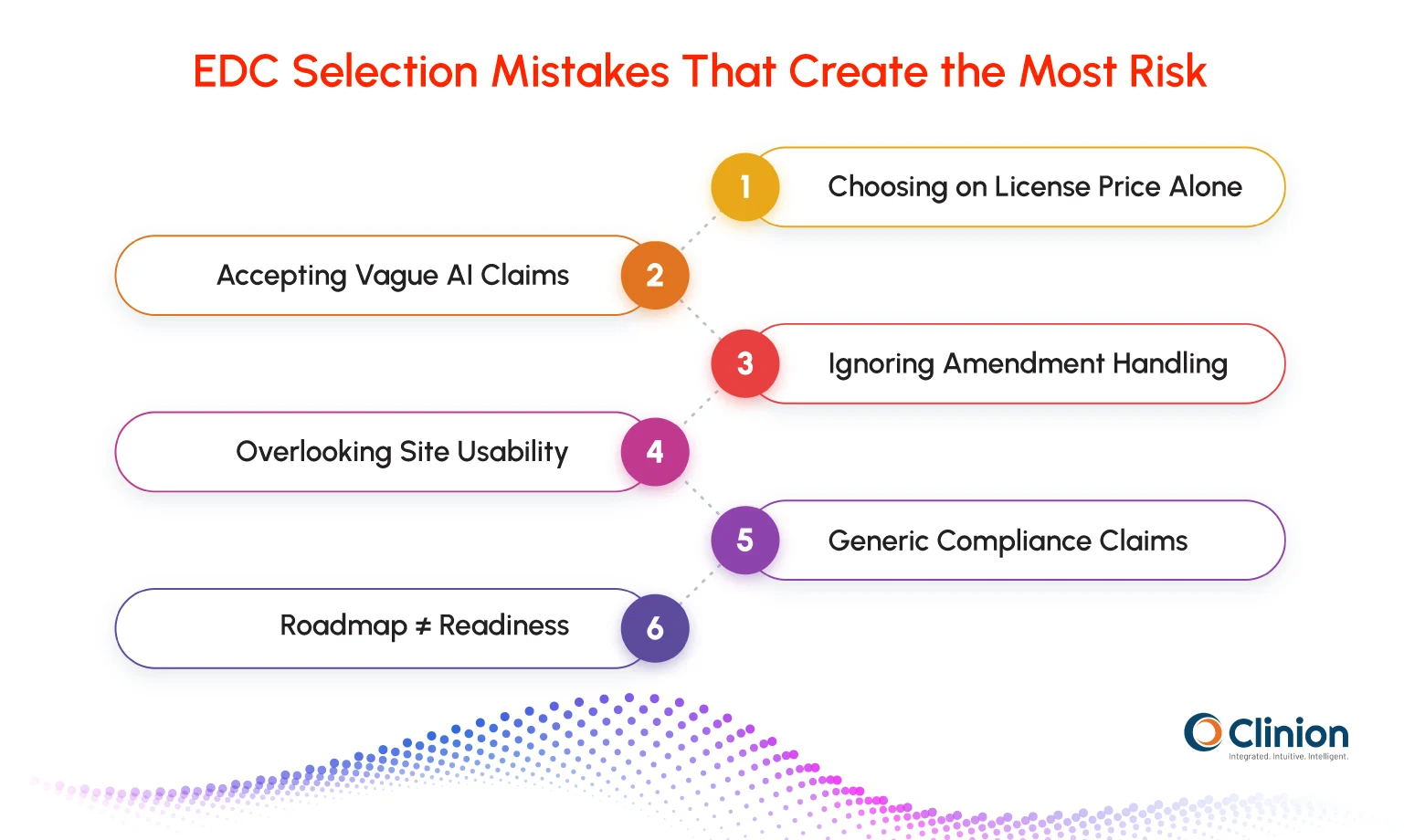
Most EDC selection failures happen when the process rewards presentation quality over operational evidence.
| Selection mistake | Why it hurts | Better buyer behavior |
|---|---|---|
| Buying on license fee alone | Understates integration, amendment and labor cost | Compare full TCO over a defined horizon |
| Treating AI as a headline feature | Encourages vague or ungoverned adoption | Score only validated, traceable, reviewable AI |
| Ignoring amendment handling | Mid-study change costs can dominate | Test live amendment scenarios in the demo |
| Overlooking site usability | Poor UX creates slower entry and more query back-and-forth | Include a site-user workflow walkthrough |
| Accepting generic compliance claims | "Part 11 compliant" isn't enough on its own | Request mappings, audit-trail evidence and validation summaries |
| Failing to define the operating model | Your team may not be able to self-serve the platform | Decide early what your team will own versus the vendor |
| Underweighting interoperability | Reconciliation burden rises across systems | Score native integrations and data-exchange evidence |
| Confusing roadmap with production readiness | You end up funding the vendor's product maturity | Separate GA features from roadmap items explicitly |
| Skipping reference calls with similar buyers | Success stories can be non-comparable | Require references matched by size, phase and operating model |
How EDC priorities differ by organization type
No single EDC platform is the right fit for every organization. The most important selection criteria change depending on the buyer's operating model, internal resources, study portfolio and level of technical maturity.
Sponsors typically prioritize governance, portfolio standardization, auditability and consistent reporting across studies. Look for controlled configuration, cross-study visibility, reusable standards and reliable integration with adjacent clinical systems.
CROs often need fast study builds, flexible configuration, multi-study efficiency and strong client reporting. Reusable libraries, role-based controls and rapid onboarding are especially important when supporting multiple sponsors with different requirements.
Biotech teams usually place greater emphasis on speed, lean administration and predictable total cost of ownership. They often need a platform that can move quickly without requiring a large internal systems team.
MedTech buyers may need support for device-specific workflows, safety and performance endpoints, medical imaging, post-market studies and specialized data sources. Flexibility matters because device studies may not follow the same operating model as traditional drug trials.
Academic research teams often prioritize simplicity, affordability, ease of training and fit for investigator-led workflows. The platform should be easy to adopt without extensive administration or technical support.
How Clinion EDC supports this buying framework
Clinion EDC is an AI-native Electronic Data Capture platform designed to support study configuration, clinical data collection, review, reporting and connected trial execution within one environment.
Its strongest alignment with this framework is in codeless study build, AI-assisted and agentic data review, controlled mid-study amendments, natural-language data access and integration across a broader eClinical suite. The capabilities below map Clinion to the evaluation criteria in this guide. Buyers should validate product claims through protocol-specific demonstrations, documentation review and references relevant to their own study requirements, exactly as this framework recommends for every vendor.
Faster study setup with AI-supported standards mapping
Clinion EDC uses standardized, reusable global libraries and codeless configuration to support study build without extensive custom programming. CDASH-aligned templates allow teams to reuse forms, edit checks and study structures across programs.
Clinion also provides AI-assisted CDASH mapping: users select study variables, receive mapping suggestions, and then review, accept or modify them within the platform. Qualified users remain in control while the system supports standards alignment.
AI data review and agentic review support
AI Data Review
Data managers create datasets using natural-language prompts, identify discrepancies and apply bulk queries or corrections across affected records, reducing dependence on repeated programming requests and one-record-at-a-time review.
Agentic AI Data Review
Adds protocol-aware review by reading the protocol, CRF metadata and configured edit checks before proposing study-specific checks:
- Protocol-aware checks: agents interpret study logic and propose custom review checks. Qualified users review and approve them before use.
- Contextual discrepancy detection: potential issues are identified using protocol context rather than only fixed ranges or hardcoded rules.
- Query drafting assistance: agents prepare query drafts linked to identified discrepancies. Authorized users review, edit and send the final query, with the workflow recorded for traceability.
Controlled mid-study amendments
Clinion EDC supports changes to visits, pages and fields after study launch, with version control designed to preserve existing data and maintain continuity across form versions.
During evaluation, ask Clinion to demonstrate how changes are applied to active studies, how existing subject data is protected, how different CRF versions are managed, and how approvals and change history are recorded.
Natural-language data access and reporting
Authorized users request datasets and reports using natural-language prompts, defining the data they need without relying on SQL or repeated programming support, reviewing the generated output, and exporting or reusing the result where appropriate.
Agentic Assistant also lets users ask protocol, operational and clinical-data questions in natural language and receive formatted, traceable responses based on the study environment.
Connected AI-native eClinical ecosystem
Clinion EDC is part of a broader AI-enabled eClinical ecosystem:
The value of this model is not simply the number of modules. Determine whether the connected workflows reduce duplicate entry, reconciliation, system switching and fragmented reporting across the trial lifecycle:
- eConsent to automatic EDC enrollment
- EDC to RTSM randomization and supply workflows
- ePRO synchronization with EDC
- eSource direct data capture into EDC
- Clinical and operational visibility across EDC and CTMS
- Protocol intelligence and live data querying through Agentic Assistant
Governed AI operations
Clinion's AI capabilities are designed around human review and controlled use. Product materials describe role-based access, study-level data isolation, logged interactions and user approval before AI-generated outputs, such as queries, are finalized.
Request evidence showing how users approve or reject outputs, how prompts and responses are logged, how study isolation is enforced, how workflow changes are validated, how false positives are monitored, and whether customer data is used to train shared models.
The right EDC choice should simplify the entire study lifecycle
EDC software influences far more than data entry. It affects how quickly a study is built, how easily sites work, how efficiently data is reviewed, how safely amendments are managed and how confidently teams move toward database lock.
The right platform should therefore be selected through a structured process that weighs functionality, compliance, AI governance, integrations, support and total cost of ownership. Every shortlisted vendor should be tested against the same study scenarios and evidence requirements.
The final decision should go to the platform that best fits the organization's operating model, and that can support reliable, scalable trial execution from study setup through closeout.
Frequently asked questions
How early should an EDC vendor be selected before study startup?
Selection should begin early enough to allow requirements gathering, vendor evaluation, contracting, study configuration, integrations, validation, UAT and site training. Buyers should work backward from the required production date rather than relying only on the vendor's stated build time.
What should be included in an EDC proof of concept?
Use realistic workflows: configure a protocol-based form, create edit checks, apply a mid-study change, identify and query a discrepancy, generate a report, demonstrate an integration and retrieve the corresponding audit history.
How can buyers verify that an EDC is suitable for their study?
Combine protocol-specific demonstrations, validation and security documentation, reference calls, scored RFP responses and commercial review. A feature list alone cannot show whether the system will fit the study design and operating model.
What validation documents should an EDC vendor provide?
The expected package may include validation summaries, requirements and testing evidence, traceability records, release documentation, change-control procedures and support for customer validation activities. Quality teams should define the required evidence before selection.
Who should own EDC study configuration after go-live?
Ownership depends on the buyer's resources and governance model. Some organizations prefer trained internal administrators, while others rely on vendor services. Compare speed, control, cost and training requirements for each model.
How should buyers assess EDC usability for sites?
Include site-facing users in the evaluation and ask them to complete common tasks such as enrollment, visit entry, correction and query response. Assess navigation clarity, number of steps, training needs and contextual support.
What should buyers ask about mid-study protocol amendments?
Ask which changes can be made without downtime, how existing data is preserved, how form versions are controlled, what testing is required and whether amendment work is included or charged separately.
How should EDC integrations be evaluated?
Ask the vendor to demonstrate actual data transfer, exception handling, reconciliation, timing, audit records and support ownership when an interface fails. Architecture diagrams are not enough.
What should happen to study data when the EDC contract ends?
The contract should specify ownership, export formats, metadata, audit trails, query histories, access records, configuration records, archival support and transition assistance.
How can buyers compare AI capabilities across EDC vendors?
Evaluate AI by workflow and intended use. Ask what data it reads, how outputs are explained, whether users approve actions, how interactions are logged, how performance is validated and how study data is isolated.
Is the lowest-cost EDC suitable for a small biotech?
It may be, provided it meets the study's operational, compliance and support requirements. Small teams can be especially affected by vendor dependence, slow amendments and weak support because they have fewer internal resources to compensate.
Should an organization choose one EDC for every study?
Not necessarily. Standardization can improve governance, reuse and training, but the platform must still fit the study type, geography, integrations and complexity. Define when standardization is mandatory and when exceptions are justified.


