
- Section title
- Why ePRO and eCOA Platform Selection Matters
- Understanding Today's ePRO and eCOA Platforms
- How We Evaluated the Platforms in This Comparison
- Platform Comparison at a Glance
- Leading ePRO & eCOA Platforms
- How to Choose the Right ePRO & eCOA Platform
- Conclusion
- External References
Section title
Many leading ePRO solutions are now offered within broader eCOA platforms or unified eClinical ecosystems, making the two closely connected when evaluating clinical trial software. This article compares 10 leading ePRO and eCOA platforms in 2026, examining their capabilities, strengths, and ideal use cases to help sponsors, CROs, and research organizations make a more informed technology decision.
Why ePRO and eCOA Platform Selection Matters
As clinical trials become more decentralized and participant-focused, electronic clinical outcome assessments are playing a greater role in the collection of endpoint, symptom, quality-of-life, and treatment-experience data.
The selected platform can influence participant adherence, assessment completion, protocol compliance, data quality, site workload, and the ease with which outcome data flows into EDC, IRT, and other clinical systems. Platform selection therefore involves more than comparing electronic questionnaire features.
Sponsors and CROs must consider the assessment types required by the protocol, questionnaire licensing and migration, language requirements, device strategy, offline access, site oversight, global support, integrations, validation documentation, and the platform’s ability to accommodate study amendments.
Understanding Today's ePRO and eCOA Platforms
Electronic patient-reported outcomes, or ePRO, are a category of electronic clinical outcome assessment. They capture information reported directly by participants without interpretation by clinicians or caregivers.
Broader eCOA platforms may also electronically administer clinician-reported outcomes, observer-reported outcomes, performance outcomes, and study diaries. The exact scope varies between vendors, and not every product marketed alongside eCOA supports every assessment category.
As a result, selecting a platform is no longer only about digitizing questionnaires. Sponsors increasingly evaluate participant usability, instrument implementation, integration architecture, global deployment, regulatory controls, and the platform’s ability to support the complete outcome-assessment strategy.
ePRO vs eCOA in Clinical Trials
Understand how ePRO fits within eCOA, how both support outcome assessment, and when clinical teams should use patient, clinician, observer, or performance-based data capture.
How We Evaluated the Platforms in This Comparison
Choosing an ePRO or eCOA platform involves more than comparing feature lists. Every clinical trial has different operational, regulatory, and technical requirements, so there is no single solution that is the best fit for every organization.
To provide a balanced comparison, we evaluated the platforms featured in this article based on the capabilities that most influence technology selection for sponsors, CROs, and research organizations. Our assessment considered publicly available product information, customer evidence, regulatory and compliance documentation, integration capabilities, and overall platform maturity.
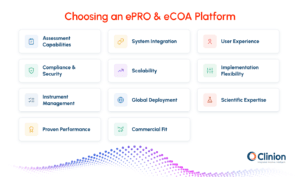
The comparison focuses on the following evaluation criteria.
Clinical Outcome Assessment Capabilities:
Documented support for ePRO, eClinRO, eObsRO, ePerfO, electronic diaries, questionnaire management, scheduling, reminders, and assessment workflows.
Integration and Interoperability:
Integration with EDC, IRT or RTSM, eConsent, CTMS, connected devices, wearables, APIs, and other eClinical systems.
Participant and Site Experience:
Ease of use across web and mobile applications, multilingual support, BYOD, provisioned devices, accessibility features, reminders, and offline capabilities.
Compliance and Data Integrity:
Audit trails, role-based access, electronic signatures, validation support, security controls, traceability, and functionality designed to support applicable regulatory requirements.
Scalability:
Ability to support different study phases, therapeutic areas, geographic regions, participant populations, site counts, and data volumes.
Implementation and Flexibility:
Deployment options, study-build approach, configurability, protocol-amendment support, workflow adaptability, and suitability for different trial designs.
Instrument Services:
Questionnaire licensing, electronic migration, instrument-owner review, translation management, linguistic validation, and access to preconfigured assessment libraries.
Global Delivery:
Countries and languages supported, device provisioning and logistics, multilingual help desks, regional infrastructure, and international deployment experience.
Scientific Expertise:
Therapeutic-area knowledge, endpoint strategy support, assessment implementation, rater training, and scientific consulting services.
Evidence and Transparency:
Public case studies, documented deployment experience, customer evidence, validation information, certifications, and transparency of product documentation.
Commercial Fit:
Publicly available commercial information, purchasing model, likely implementation requirements, and suitability for different study and sponsor sizes.
Platform Comparison at a Glance
The platforms below offer different strengths based on study complexity, assessment requirements, organizational size, global deployment needs, and broader technology strategy. This at-a-glance comparison is designed to help sponsors and CROs identify potentially suitable options before reviewing each platform in greater detail.
Platform | Best For | Platform Model | Documented Assessment Scope | Key Strength | Potential Consideration |
Castor | Emerging biopharma companies, CROs, academic research teams, and configurable global studies | Standalone eCOA or unified with Castor EDC and eConsent | ePRO, eClinRO, eObsRO | Configurable, API-first eCOA that can operate independently or within Castor’s unified clinical trial platform | Organizations requiring extensive specialist endpoint-science or centralized rater services may also need to evaluate dedicated endpoint providers. |
Clinion | Sponsors and CROs seeking integrated patient-reported data collection and broader eClinical workflows | Standalone ePRO or integrated Clinion eClinical platform | Native integration with Clinion EDC and other clinical applications, with multilingual forms, reminders, and mobile, tablet, and web access | Publicly documented functionality focuses on patient-reported outcomes rather than eClinRO, eObsRO, or ePerfO. | |
Clario | Large global, endpoint-driven, and therapeutically complex clinical trials | Specialized eCOA within a multimodal endpoint technology platform | ePRO, eClinRO, eObsRO, ePerfO | Extensive endpoint-science expertise combined with global deployment, device, imaging, cardiac, respiratory, and other evidence-generation capabilities | Its science-led endpoint technology and service model may be more extensive than straightforward ePRO-only studies require. |
IQVIA | Large multinational trials requiring global technology, scientific, and operational support | Enterprise eCOA within IQVIA’s patient-engagement and clinical-services ecosystem | ePRO and broader eCOA workflows, including caregiver-supported reporting | Global delivery capabilities, extensive assessment libraries, therapeutic expertise, BYOD, provisioned devices, and online or offline reporting | Its broad technology and clinical-services ecosystem may exceed the requirements of smaller or operationally straightforward studies. |
Kayentis | Patient-centric global studies requiring specialist eCOA delivery | Specialized eCOA platform | ePRO, eClinRO, eObsRO, ePerfO, eDiary | Strong participant experience, multilingual delivery, instrument services, and support for different devices and collection modes | Its portfolio is primarily focused on eCOA rather than complete end-to-end eClinical workflows. |
Medidata | Enterprise sponsors and CROs running complex studies within an established clinical data ecosystem | Unified Rave clinical data and patient-experience platform | ePRO, eClinRO, eObsRO, ePerfO | Mature clinical trial ecosystem with connected participant, site, clinical data, sensor, and study-management capabilities | The breadth of the Rave ecosystem may require more implementation coordination than a lightweight standalone eCOA solution. |
Signant Health | Endpoint-heavy trials requiring scientific consulting, instrument services, device logistics, and global operational support | eCOA-led unified eClinical platform | ePRO, eClinRO, eObsRO | Strong scientific expertise, complex clinician-rating capabilities, global services, participant support, and integrated eClinical options | Its scientific, logistics, and managed-service depth may be more than simple, low-complexity studies require. |
Suvoda | Complex oncology, rare-disease, CNS, and adaptive trials requiring close coordination between randomization and outcome assessments | Unified IRT and eCOA platform | ePRO, eClinRO | Purpose-built integration between IRT and eCOA for studies involving complex patient, visit, and supply workflows | Its overall eClinical ecosystem is narrower than full-suite vendors offering EDC, CTMS, and eTMF within the same platform. |
Veeva | Sponsors and CROs already using or standardizing on the Veeva Vault ecosystem | Unified Veeva Clinical Data and Vault platform | ePRO, eClinRO, eObsRO | Connected sponsor, site, and participant workflows with reusable assessment libraries and integration across Veeva Clinical applications | The greatest operational value is likely to be realized by organizations already invested in the Veeva ecosystem. |
YPrime | Global studies requiring configurable eCOA, rapid startup, participant engagement, and protocol adaptability | Specialized eCOA within an eCOA, IRT, and eConsent platform | ePRO and configurable eCOA workflows | Participant-centered design, configurable workflows, connected-device support, global deployment, and rapid implementation of study changes | Its broader platform scope is narrower than full-suite vendors offering EDC, CTMS, and eTMF. |
*The platforms are listed alphabetically in the comparison table and not in ranked order.
Leading ePRO & eCOA Platforms
The following profiles provide a closer look at each platform’s core capabilities, strengths, and important considerations. Vendors are listed alphabetically rather than ranked, allowing readers to compare the solutions based on their specific study and technology requirements.
Castor
Castor is a clinical trial platform that includes configurable eCOA capabilities alongside EDC and study management. It emphasizes self-service study configuration, making it well suited for sponsors and research organizations seeking flexibility without a heavily service-driven implementation model.
Key Capabilities
- Configurable questionnaires, visit schedules, automated reminders, and participant workflows
- Centralized dashboards for monitoring assessment completion, compliance, and missing data
- Offline data capture to support participants with limited or inconsistent internet connectivity
Before You Choose
- Confirm which study configurations and protocol amendments can be managed internally versus requiring vendor support.
- Verify questionnaire licensing, translation services, device provisioning, and scientific support for multinational studies.
Clinion
Clinion ePRO enables sponsors and CROs to collect patient-reported outcomes through web, mobile, and tablet applications. Available as both a standalone solution and an integrated module within Clinion's unified eClinical platform, it streamlines outcome data collection while supporting real-time data review and operational oversight.
Key Capabilities
- Standalone deployment or native integration with Clinion EDC and the broader eClinical platform
- Configurable multilingual questionnaires with support for licensed instruments such as EQ-5D-5L and PROMIS
- Automated scheduling, reminders, real-time validation, and AI-assisted comparison of ePRO and EDC data
Before You Choose
- Confirm how AI-assisted discrepancy detection is configured, reviewed, and documented for your study.
- Verify questionnaire licensing, translation services, offline access, device provisioning, and participant support across participating countries.
The Definitive Guide to ePRO in Clinical Trials
Learn how ePRO supports patient-reported outcome collection, remote participation, data completeness, patient engagement, and connected clinical trial workflows.
Clario
Clario delivers enterprise eCOA solutions supported by scientific, operational, and endpoint expertise. It is widely used in global clinical trials where electronic outcome assessments are closely tied to primary and secondary study endpoints.
Key Capabilities
- Science-led support for instrument migration, endpoint strategy, and assessment design
- BYOD, web-based, and provisioned-device data collection for global studies
- Centralized monitoring of participant compliance, assessment completion, and study performance
Before You Choose
- Clarify which scientific, translation, and instrument-management services are included in the engagement.
- Review study-build timelines, device logistics, participant support, and change-control processes before implementation.
IQVIA
IQVIA eCOA combines electronic outcome assessments with the company's broader clinical research ecosystem. It is designed for multinational studies that require standardized instrument management, localization, and global operational support alongside eCOA technology.
Key Capabilities
- Visual tools for designing and managing electronic questionnaires and diaries
- Libraries of validated assessments with support for licensing and localization
- Online and offline data collection with accessibility features for diverse participant populations
Before You Choose
- Determine whether your study requires IQVIA's broader managed-service model or primarily the technology platform.
- Clarify responsibilities for integrations, validation, licensing, translations, and protocol amendments.
Kayentis
Kayentis provides a dedicated eCOA platform focused on complex electronic outcome assessments. Its Clin'form solution combines configurable workflows with scientific and linguistic support for organizations conducting multinational clinical trials.
Key Capabilities
- Advanced questionnaire logic, automated scoring, and configurable assessment workflows
- Real-time dashboards, alerts, consistency checks, and Data Clarification Form management
- Integration with IRT systems, wearables, patient portals, eConsent, and external data environments
Before You Choose
- Confirm which questionnaire migration, licensing, and translation services are included.
- Verify integration responsibilities, participant support, and device logistics before study startup.
Medidata
Medidata eCOA is part of the Medidata Patient Experience suite, enabling sponsors to collect patient, clinician, and caregiver-reported outcomes within the broader Rave ecosystem. It is designed for organizations seeking standardized assessments and unified clinical data management.
Key Capabilities
- AI-assisted study build to accelerate study configuration and reduce deployment timelines
- Reusable library of validated instruments and translations across multiple studies
- Native integration with the Medidata Rave ecosystem for centralized clinical data management
Before You Choose
- Confirm how AI-assisted study configurations are validated before deployment.
- Assess integration requirements if your organization uses non-Medidata clinical systems.
Signant Health
Signant Health provides enterprise eCOA solutions supported by scientific expertise and global operational services. It is particularly suited for endpoint-driven studies where assessment quality, rater consistency, and regulatory confidence are critical.
Key Capabilities
- Scientific support for endpoint strategy, instrument migration, and electronic COA implementation
- Integrated rater training, qualification, and central review for clinician-reported assessments
- StudyIQ analytics for monitoring endpoint quality, participant compliance, and study performance
Before You Choose
- Determine whether your study requires Signant's full scientific service model or a technology-only deployment.
- Clarify which translation, logistics, analytics, and participant-support services are included.
Suvoda
Suvoda integrates eCOA with its Interactive Response Technology (IRT) platform to streamline participant management and outcome assessments. It is particularly well suited for complex clinical trials where randomization, supply management, and participant workflows must remain closely connected.
Key Capabilities
- Unified eCOA and IRT workflows managed through a single platform
- Shared participant workflows that reduce duplicate site administration and reconciliation
- Integrated ecosystem supporting eConsent and other participant-facing trial solutions
Before You Choose
- Confirm whether the same workflow efficiencies are available when deploying eCOA without Suvoda IRT.
- Verify support for instrument licensing, external integrations, translations, and study-specific assessment requirements.
Veeva
Veeva eCOA is part of the Veeva Clinical Platform, enabling sponsors to manage electronic outcome assessments alongside clinical data and patient engagement. It emphasizes reusable study assets, centralized governance, and greater sponsor control across clinical programs.
Key Capabilities
- Centralized library of validated instruments with reusable translations and version control
- Sponsor-controlled study configuration and mid-study amendments without extensive vendor dependency
- MyVeeva for Patients application supporting ePRO, eConsent, virtual visits, and participant communications
Before You Choose
- Evaluate the implementation approach if your organization is not already using the Veeva Clinical Platform.
- Confirm responsibilities for localization, licensed instruments, device provisioning, and third-party integrations.
YPrime
YPrime provides configurable eCOA technology for global clinical trials, with a strong emphasis on participant engagement, rapid study startup, and operational flexibility. Its platform can be deployed independently or alongside integrated IRT and eConsent solutions.
Key Capabilities
- No-code configuration with reusable assessment components to accelerate study startup and amendments
- Participant Hub providing in-app study guidance, task management, and participant engagement
- Integration with wearables, sensors, and other connected digital health technologies
Before You Choose
- Confirm which study configurations and protocol amendments can be managed directly by sponsor teams.
- Verify integration scope, connected-device support, questionnaire licensing, translation services, and implementation timelines.
How to Choose the Right ePRO & eCOA Platform
After comparing the leading ePRO and eCOA platforms, the next step is determining which solution best fits your clinical trial. The right choice depends less on the number of features and more on how well the platform aligns with your study design, operational workflows, and long-term technology strategy.
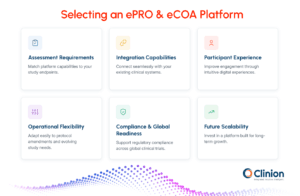
Consider the following factors during your evaluation.
Define Your Assessment Requirements First
Start by identifying the types of outcome assessments your study requires. While some trials only need patient-reported outcomes (ePRO), others combine clinician-, observer-, or performance-reported assessments. Selecting a platform that supports your current and future assessment requirements can help avoid unnecessary system changes as study complexity increases.
Evaluate Integration Capabilities
Outcome assessment data should flow seamlessly into your broader clinical technology ecosystem. Look for platforms that integrate with EDC, RTSM/IRT, eConsent, eSource, and other eClinical applications to reduce duplicate data entry, improve visibility, and streamline study operations.
Consider the Participant Experience
Participant engagement has a direct impact on assessment completion and data quality. Evaluate whether the platform offers intuitive mobile applications, BYOD support, multilingual questionnaires, automated reminders, offline functionality, and accessibility features appropriate for your study population.
Assess Operational Flexibility
Clinical trials evolve over time. Consider how easily questionnaires, visit schedules, translations, and protocol amendments can be managed, as well as whether these changes require vendor involvement or can be configured by your internal study teams.
Verify Compliance and Global Readiness
Ensure the platform meets applicable regulatory requirements and can support multinational studies. Review capabilities such as audit trails, role-based access, electronic signatures, data security, validated instrument support, localization services, and compliance with regulations such as 21 CFR Part 11.
Look Beyond Today's Study
Many organizations evaluate platforms for a single trial but ultimately use them across multiple studies. Consider scalability, reusable study assets, deployment flexibility, vendor support, and the platform's ability to support your organization's long-term clinical technology strategy.
Conclusion
The ePRO and eCOA landscape has evolved significantly, with platforms offering everything from standalone patient-reported outcome collection to fully integrated clinical trial ecosystems. While many solutions share core capabilities, they differ in their approach to study configuration, participant engagement, scientific services, interoperability, and operational flexibility.
Rather than searching for a universally "best" platform, sponsors should evaluate which solution aligns most closely with their protocol requirements, technology ecosystem, and long-term clinical strategy. By focusing on the needs of the study rather than feature lists alone, organizations can select a platform that supports high-quality outcome data, improves operational efficiency, and delivers a better experience for both participants and study teams.
Capture patient-reported outcomes directly from any device
Clinion ePRO helps clinical teams collect patient responses through mobile, web, and BYOD workflows, with multilingual forms, automated reminders, secure EDC syncing, real-time monitoring, validation checks, and complete audit trails.
External References